 English
 Français
 Deutsch
 Italiano
 Español
 Português
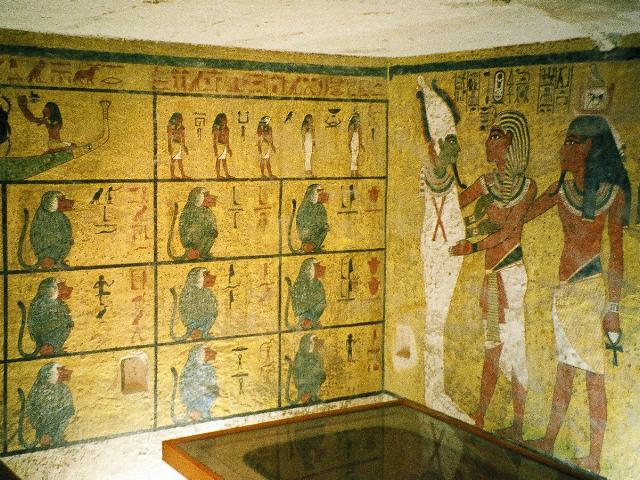

1922: a discovery that captivated the world
On 4 November 1922, Egyptian workers excavating in the Valley of the Kings under Howard Carter uncovered the first step leading towards Tutankhamun’s tomb. Lord Carnarvon financed the expedition. The discovery became a worldwide cultural event because an unusually rich royal burial offered an extraordinary encounter with ancient Egypt. Yet the familiar image of a solitary European explorer misses the collective work behind it. Egyptian excavators, craftspeople and specialists helped make the discovery and its subsequent investigation possible. The Metropolitan Museum’s centenary account explicitly credits the Egyptian team. [1]
The sequence matters. According to Oxford’s Griffith Institute archive, a sealed doorway appeared on 5 November. Carter secured the entrance and contacted Carnarvon. After further clearance, the first doorway was opened on 25 November; on 26 November, Carter looked through a small opening in a second doorway. The antechamber contained furniture, chariots, statues and containers. The burial chamber itself was opened on 16 February 1923. These were separate stages, rather than one dramatic moment when every treasure and the king’s body were immediately revealed. [2]
The objects transformed the find into more than a spectacle of gold. Furniture, personal belongings, protective shrines and funerary equipment connected royal life with expectations of an existence after death. For readers interested in esoteric traditions, this is the essential historical connection: material objects and carefully bounded space expressed religious purposes. Such beliefs belong to ancient Egyptian culture and deserve interpretation within that culture. They should neither be dismissed as decorative curiosities nor casually merged with unrelated spiritual systems. The tomb was a burial environment before it became an archaeological attraction. [3]
Excavation also meant recording and conserving a vulnerable ensemble. The Metropolitan Museum describes almost 5,400 objects and highlights Harry Burton’s photographs. Their importance extends beyond beautiful images: documentation preserves relationships that can disappear when objects are removed. The slow work of identification, photography and preservation contrasts with the instantaneous excitement of discovery. Understanding that difference helps explain why archaeology is an organised investigation, not simply the recovery of valuable possessions. An object’s location and association with other objects may reveal as much as its material or craftsmanship. [1] [3]
The esoteric legend developed alongside this historical achievement. Carnarvon died on 5 April 1923, and rumours connected his death to interference with the tomb. Birmingham researcher Eleanor Dobson’s work draws attention to a revealing complication: a 1923 story attributed to Carter and novelist Percy White described a cobra killing Carter’s canary. The story linked royal symbolism, an ominous animal and entry into a forbidden space. It shows how narrative could turn coincidence into apparent supernatural warning. A contemporary tale is evidence that people told such stories, not proof that its supernatural implications were true. [2] [4]
The enduring curse therefore deserves study as cultural history. A BMJ-published historical cohort study examined survival among Westerners associated with the opening and found no significant association between supposed exposure and survival. Its limited historical sample cannot answer every possible claim, but it provides no support for a lethal curse. The responsible conclusion preserves both wonder and proportion: the discovery changed public engagement with ancient Egypt, while the curse illustrates how powerful stories grow around death, sacred boundaries and uncertainty. Evidence and imagination should remain visibly distinct. [5]
A Feng Shui interpretation: place, memory and balance
Tutankhamun and Feng Shui can be discussed together through a comparison of funerary landscapes, not a claim of historical influence. Chinese burial geomancy considers how a resting place relates to its surroundings. Giulio Magli’s research on imperial Chinese mausoleums examines topography, orientation, astronomy and traditional geomancy. This supplies a real comparative context, but no evidence that Tutankhamun’s tomb was designed according to Feng Shui. Egyptian funerary religion and Chinese traditions developed distinct vocabularies, practices and histories. [6]
In a symbolic Feng Shui reading, a tomb’s enclosure suggests protection and stillness; an entrance marks a transition between different uses of space. Yin and yang offer a vocabulary for reflecting on quiet remembrance and active investigation. Here these terms are interpretive tools, not measurable forces explaining illness or archaeological outcomes. Opening a sealed chamber can consequently prompt an ethical question: how should curiosity be balanced with care for the dead, the material environment and the communities connected to that heritage?
The useful lesson concerns relationships rather than magical blame. A place is more than its contents: setting, approach, boundaries and human behaviour contribute to its meaning. Applied today, this perspective encourages respectful circulation, restrained display, clear information and space for reflection at heritage sites. Those are editorial recommendations inspired by a philosophy of harmony, rather than authenticated ancient prescriptions for KV62.
Finally, a serious interpretation must acknowledge what cannot be inferred. Without a documented survey and an appropriate historical framework, assigning a precise compass diagnosis, a bagua sector or a Five Phases imbalance would be speculative. Feng Shui does not establish the existence of a curse. Its contribution here is a thoughtful question about inhabiting and approaching meaningful places: can knowledge be pursued while preserving dignity, context and balance?
Sources and further reading
- The Metropolitan Museum of Art — Tutankhamun: Commemorating 100 Years
- Griffith Institute, University of Oxford — 1st Season (1922–1923)
- The Metropolitan Museum of Art — Tutankhamun’s Tomb: The Thrill of Discovery
- University of Birmingham — Howard Carter and the Curse of Tutankhamun (2023)
- Mark R. Nelson — The mummy’s curse: historical cohort study. BMJ 325 (2002), 1482–1484. DOI: 10.1136/bmj.325.7378.1482
- Giulio Magli — Astronomy and Feng Shui in the project of the Tang, Ming and Qing royal mausoleums (2018; preprint)
Let’s discuss about this here…
What Is Feng Shui? — Explore the basics and ask questions in our forum.