 English
 Français
 Deutsch
 Italiano
 Español
 Português

The event: an earthquake that shook a worldview
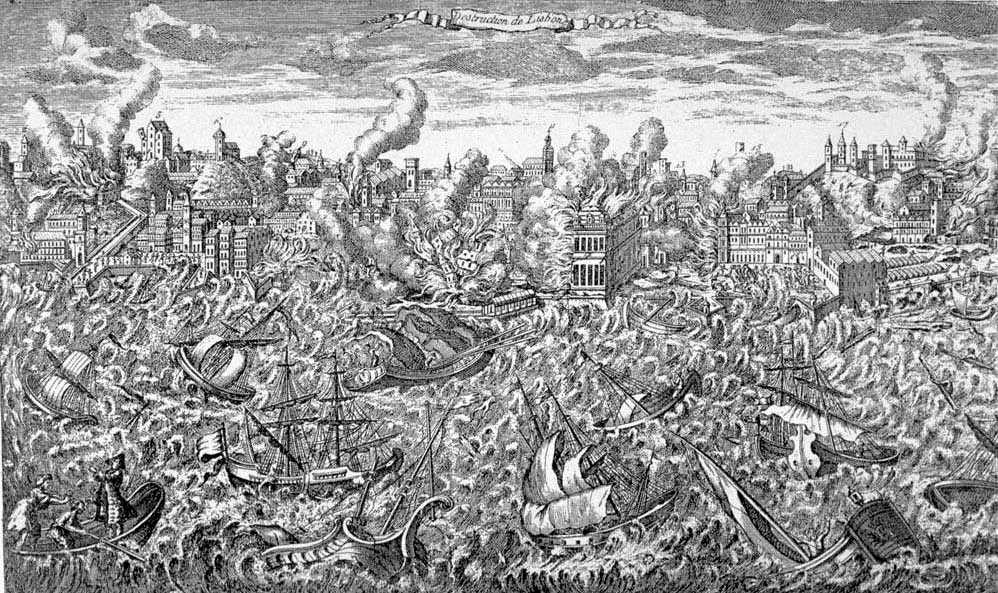
On 1 November 1755, All Saints’ Day, a powerful earthquake struck Lisbon in the morning. Worshippers had gathered in churches, and the Portuguese capital was a busy Atlantic port connecting Europe with overseas territories and trading networks. Within minutes, collapsing buildings transformed familiar streets into dangerous passages. The event became far more than a Portuguese tragedy: its physical effects crossed borders, while reports of destruction circulated through Europe and challenged assumptions about civilization, faith and humanity’s place in nature. [1]
The catastrophe unfolded through several connected hazards. Violent shaking brought down masonry and damaged homes, religious buildings and public institutions. A tsunami then struck the waterfront, turning an apparent refuge from collapsing streets into another exposed space. Fires spread through the damaged city, with overturned candles and other ignition sources contributing to destruction. This sequence matters: the historical disaster was an interaction between earth movement, seawater, combustion and the built environment, rather than a single isolated shock. [1][2]
Modern reconstructions commonly place the earthquake’s magnitude around 8.5, although its exact offshore source and mechanism remain debated. There were no instrumental recordings comparable to modern seismograms, so researchers work with historical testimony and physical evidence. Death estimates also vary substantially; many thousands died, and an apparently precise total would disguise uncertainty. Portugal, Spain and Morocco experienced serious effects, while tsunami observations extended across the Atlantic. Lisbon therefore belongs to a shared history of coastal vulnerability, not merely to the memory of one city. [1][2]
The date intensified the spiritual shock. Churches had offered both sacred meaning and physical shelter, yet many were devastated. For believers, this raised painful questions about providence, punishment and the suffering of innocent people. These questions overlap with an esoteric interest in hidden order, but they should not be confused with proof of supernatural causation. Religious interpretations existed alongside emerging attempts to explain the event through natural processes. The catastrophe exposed how strongly people seek intelligible patterns when ordinary expectations collapse. [3]
Voltaire challenged philosophical optimism in his poem on the Lisbon disaster; Rousseau responded in a letter on providence. Their disagreement became a landmark in Enlightenment debates about evil, nature and responsibility. Voltaire’s later Candide also made Lisbon part of a wider critique of comforting systems that fail to confront suffering. This was not a simple victory of reason over belief: different thinkers disagreed about what the disaster demonstrated, and the relationship between a natural hazard and human arrangements remained central to the discussion. [3]
Under King Joseph I and his minister Sebastião José de Carvalho e Melo, later Marquis of Pombal, reconstruction gave Lisbon a new urban form. Broad streets, planned squares and a geometric downtown expressed an ambition to restore order after chaos. Rebuilding also posed enduring questions: whose lives are protected, how should movement through a city work, and what makes settlement resilient? Lisbon’s lasting significance lies in this combination of physical devastation, spiritual argument and practical reconstruction. Its ruins became a demand to examine both our explanations of the world and the places we build within it. [1]
A Feng Shui interpretation: balance without blame
Lisbon 1755 and Feng Shui can be brought into conversation through a shared concern with the relationship between people and place. This is a contemporary comparative reading, not evidence that Lisbon was planned according to Chinese geomancy. Feng Shui cannot explain tectonic rupture or predict a tsunami, and a disaster must never be presented as punishment for bad qi or incorrect furniture placement.
In Feng Shui, water is often associated with movement, connection and opportunity. Lisbon’s harbour makes that symbolism vivid: the waterfront supported exchange, yet also exposed people to destructive waves. The lesson is not that water is inherently lucky or unlucky. A place’s value depends on context, proportion and the relationship between benefit and exposure. Symbolic interpretation becomes useful when it encourages careful observation rather than certainty.
Yin and yang offer another reflective lens. Shelter and openness, stillness and circulation, security and exchange need one another. An entirely enclosed city can feel oppressive; openness without protection can leave inhabitants vulnerable. Reconstructed streets and squares can therefore be considered as arrangements of movement, visibility and shared space. This is an analogy about lived experience, not a scientific claim about invisible forces.
The five phases likewise provide a vocabulary for interdependence: earth as support, water as flow, fire as transformation, wood as renewal and metal as structure. They are interpretive categories, not substitutes for engineering. A responsible reading of Lisbon ultimately joins meaning with care: honour the dead, protect the living, preserve communal memory and design welcoming places. Harmony is an ongoing practice of attention, not a guarantee that nature will spare us.
Let’s discuss about this here…
Sources and further reading
- Europeana — Adrian Murphy (2023), What was the impact of the Great Lisbon Earthquake in 1755?
- Ribeiro, Silva & Leitão (2011), High resolution tsunami modelling for the evaluation of potential risk areas in Setúbal (Portugal), Natural Hazards and Earth System Sciences, 11, 2371–2380.
- Jan Rutsch (2025), Le séisme de Lisbonne et sa vision philosophique entre Voltaire et Jean-Jacques Rousseau, Sociopoétiques.
What Is Feng Shui? — Explore the basics and ask questions in our forum.