 English
 Français
 Deutsch
 Italiano
 Español
 Português

What happened on 21 December 2012?
On 21 December 2012, a milestone in an ancient Mesoamerican calendar became the focus of worldwide attention. Books, television, internet discussions and popular entertainment had turned the date into an anticipated moment of catastrophe or spiritual transformation. The historical event was this international wave of expectation, followed by an ordinary continuation of life. Understanding it requires separating three things: an authentic calendrical calculation, diverse Maya cultural traditions, and modern esoteric interpretations that often borrowed the authority of antiquity without respecting its evidence. [1] [3]
The Maya Long Count records elapsed days through nested units. A k’in is one day; twenty days form a uinal, eighteen uinals a tun, twenty tuns a katun, and twenty katuns a baktun. A baktun therefore contains 144,000 days. Using the widely accepted correlation with the Gregorian calendar, 21 December 2012 completed thirteen baktuns from the mythical creation reference dated 11 August 3114 BCE. That interval is approximately 5,125 years. A mythological reference date is not an archaeological claim that the physical universe began then. [1] [2]
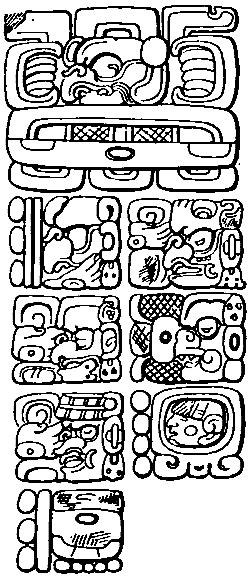
Stone inscriptions help explain why the date mattered. Stela C at Quiriguá, in present-day Guatemala, records the mythical creation date; Monument 6 at Tortuguero, in Mexico, refers to the later thirteen-baktun completion. These are historical sources requiring specialist interpretation, not ready-made disaster forecasts. The Smithsonian’s account finds no evidence that such inscriptions announced a catastrophic termination of the world. The essential distinction is between reaching a significant numbered interval and exhausting the capacity to count further days. A calendar milestone does not stop time. [1]
The esoteric narrative developed through modern reinterpretation. Some accounts imagined a destructive planetary encounter; others expected a change in human consciousness. Those claims were not interchangeable, and neither followed automatically from the inscriptions. In December 2012, the Library of Congress highlighted epigrapher Mark Van Stone’s conclusion that contemporary society had generated the apocalypse stories, with little foundation in established Maya evidence. The episode shows how a precise-looking date can give speculative narratives a misleading impression of scholarly certainty. [3]
Scientists also addressed the astronomical claims directly. NASA’s Jet Propulsion Laboratory explained that the alleged approaching planet Nibiru lacked credible observational evidence and that supposed galactic alignments supplied no mechanism for a predicted disaster. These responses challenged specific assertions, rather than dismissing every cultural or spiritual meaning attached to calendars. The much-publicized date passed without the foretold global destruction. This outcome did not invalidate Maya mathematics; it exposed predictions incorrectly attributed to Maya knowledge in the first place. [4]
Equally important are living Maya voices. The Smithsonian’s Living Maya Time project presents people from different Maya communities discussing the date, their heritage and cultural renewal. Their perspectives resist the treatment of the Maya as a vanished civilization speaking with one mysterious voice. For readers today, 2012 remains a useful case study in how worldwide media can transform a cultural milestone into a universal prophecy. A responsible remembrance therefore values historical evidence, listens to the communities concerned, and leaves room for personal reflection without presenting modern spiritual interpretations as ancient facts. [5]
A Feng Shui interpretation: renewal without catastrophe
The connection between the Maya calendar 2012 and Feng Shui proposed here is a contemporary comparison, not a documented historical influence. Maya calendrical traditions and Chinese Feng Shui developed in different cultural settings. None of the historical sources above establishes that Feng Shui predicted the 2012 phenomenon or that Maya specialists used its methods. The useful meeting point is a question: how can people respond thoughtfully when a cycle appears to end?
Feng Shui traditionally considers the relationship between people, places and their surroundings, using ideas such as qi and the complementary qualities of yin and yang. Read symbolically, a transition need not signify destruction: quieter and more active phases can belong to a continuing process. Applied to 2012, this offers an alternative personal response to apocalyptic anxiety. Instead of expecting a cosmic event to reorganize life, one can choose modest, deliberate changes in everyday space. [6]
For example, a household might mark a seasonal turning point by clearing an obstructed entrance, repairing a neglected object, or arranging seating to make conversation easier. These are practical suggestions inspired by a philosophy of balance, not ancient Maya rituals or scientifically established methods for controlling destiny. A calm reading corner and a welcoming communal table also give reflection and social activity their own appropriate places.
This interpretation has limits. A calendar date alone cannot supply the orientation, layout and environmental context needed for a particular Feng Shui assessment. Nor should Chinese concepts be imposed on Maya monuments as their hidden explanation. The most constructive lesson is ethical: welcome renewal, respect distinct traditions, and test extraordinary predictions against evidence. Balance begins with attentive choices in the world we actually inhabit.
Let’s discuss about this here…
Sources and image credit
- Smithsonian — The meaning of 2012
- Smithsonian — Maya calendar converter
- Library of Congress — Trending: the end of the world (20 December 2012)
- NASA/JPL — 2012: a scientific reality check — Don Yeomans (10 November 2009)
- Smithsonian — Maya opinions on 2012
- The Metropolitan Museum of Art — Nature within Walls: the Chinese Garden Court (p. 16)
What Is Feng Shui? — Explore the basics and ask questions in our forum.