 English
 Français
 Deutsch
 Italiano
 Español
 Português
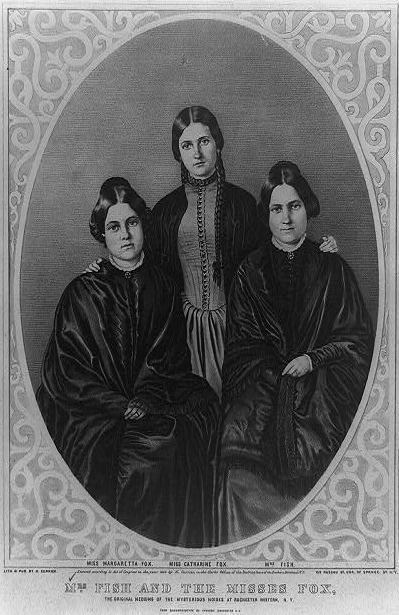

The historical event: Hydesville and the rise of modern Spiritualism
A small house, a lasting controversy
On 31 March 1848, events in a modest house at Hydesville, in western New York, helped set modern Spiritualism in motion. Two young sisters, Margaret, usually called Maggie, and Catherine, known as Kate, became associated with mysterious knocking sounds. Their family and visitors interpreted these sounds as replies from an invisible intelligence. The incident became a founding story for a movement that would cross national borders and bring questions about death, evidence and religious authority into ordinary homes. Its historical importance lies in that transformation. A local claim became a public conversation about whether the dead could communicate with the living. [1]
There are two different questions here. The first asks whether the sisters and their supporters made these claims and whether those claims influenced society. Documents, publications and surviving portraits establish that history. The second asks whether spirits actually produced the noises. The existence of a report does not establish its supernatural explanation. Keeping those questions separate allows us to understand the event without either endorsing a haunting or dismissing everyone who found meaning in it. It also provides the foundation for the Feng Shui reflection below: environments shape experience, but an emotionally powerful experience does not automatically establish its cause.
How knocking became a message
Accounts of the Hydesville episode describe noises that seemed to respond to questions and to repeat requested numbers. The apparent move from random sound to responsive communication was decisive. A knock could be unsettling; a knock that appeared to answer a question could be understood as a voice. Visitors supplied questions, interpreted sequences and helped turn an uncertain sensation into a shared narrative. The story eventually attached the sounds to an allegedly murdered peddler. That identification belongs to the reported spirit narrative, rather than to an independently established solution of a murder. Claims about later bones should be treated with the same caution. [2]
Consider what this process required. A group had to agree that a sound counted as a response, accept a coding system and remember a sequence accurately. Those are human acts of interpretation. Even when every participant is sincere, such acts can magnify coincidence and reduce attention to unsuccessful exchanges. This observation does not reconstruct precisely what happened on every evening in 1848. It explains why a historian should ask how the communication was organized, who supplied information, which answers were preserved and which alternatives were tested. A convincing story and a controlled demonstration are different kinds of evidence.
Why Rochester mattered
The surrounding region offered unusually fertile ground for religious experimentation. Western New York became known as the Burned-Over District because of its intense revival activity. Rochester combined commercial growth, migration and networks of reform. The Erie Canal helped move people, goods and ideas; religious and political gatherings offered places where new convictions could find an audience. Caitlin Powalski’s study in Rochester History places Spiritualism within this changing social landscape, alongside abolition, women’s rights and challenges to established religious structures. The Fox episode did not arrive in an empty intellectual world. It entered a region already debating who could speak with authority. [3]
That context helps explain expansion without making expansion inevitable. A striking claim needs people willing to repeat it, rooms in which strangers can encounter it and networks that carry news beyond a village. Rochester offered those conditions. The historical question becomes more interesting when we move beyond the image of two girls in a haunted bedroom. Who arranged introductions? Who lent social credibility? Who supplied a meeting place? A movement grows through such practical decisions. Its spiritual vocabulary may concern invisible worlds, but its circulation depends on visible relationships, transport, hospitality, print and the work of organizing audiences.
The Posts and the politics of listening
Amy and Isaac Post were central connectors in Rochester’s reform networks. The University of Rochester’s account of their papers documents connections with abolitionists and advocates of women’s rights, as well as their involvement in Spiritualism. Their home served the Underground Railroad, and their correspondence linked private life to major public causes. Their interest in the Fox sisters therefore matters as more than a colorful anecdote. It shows how a new spiritual claim could enter a network already accustomed to questioning established hierarchies. The archive also preserves letters that reveal the sisters as young people with ordinary emotional needs. [4]
It would nevertheless be misleading to make all Spiritualists progressive, or to treat reform as proof that spirit communication was real. Shared supporters do not make two propositions logically dependent. A person could favor abolition and be mistaken about a séance, just as someone could expose deception while defending unjust social arrangements. The valuable connection is historical: some participants found religious independence and social independence mutually attractive. Listening to an unexpected speaker could become a challenge to authority. Yet that opening also required critical judgment about whose voice was actually being heard and whose interests shaped the message.
From household gathering to public performance
In November 1849, public demonstrations at Rochester’s Corinthian Hall helped move the rappings from domestic rumor to civic spectacle. Committees attempted to discover their source. Contemporary supporters emphasized that investigators had failed to explain what they heard. This failure became part of the sisters’ reputation. But the logical distinction remains essential: an observer’s inability to detect a method is not proof that no ordinary method exists. Public demonstrations also changed the conditions of belief. Strangers, publicity, expectation and the prestige of an investigation could make an event feel more authoritative than a private conversation. [2] [3]
A household gathering and a ticketed demonstration produce different responsibilities. In a home, participants may prioritize consolation or friendship. In a public venue, spectators may expect entertainment, revelation or an answer to a controversy they have read about. Organizers must manage space, timing and reputation. Critics may arrive determined to expose a trick; supporters may feel that a challenge attacks their deepest convictions. Under those conditions, disagreement is rarely about a sound alone. It concerns trust, identity and who has the right to define reality. The room becomes a stage on which a much wider argument is performed.
A movement larger than its founders
The Fox sisters became professional mediums, and Spiritualism developed through sittings, lectures, publications and networks extending beyond the United States. Different participants approached it as religion, investigation, consolation or spectacle. The movement should not be reduced to a single doctrine or a precise membership figure, especially when contemporary estimates served promotional or polemical purposes. Its international reach is more securely understood through the circulation of practices and arguments. A repeatable social form mattered: people could assemble around a table, ask questions and interpret responses. The founding story could travel without the original Hydesville house or the sisters being present. [2] [5]
This portability is one reason the episode belongs to world cultural history. It did not need the resources of a state or an established church to spread. Domestic furniture, conversation and printed accounts could provide an infrastructure. At the same time, local communities adapted the practice to their own religious assumptions and social conditions. An account of origins should therefore avoid implying that every later spiritual practice descended unchanged from one evening in New York. Hydesville became an influential reference point, while the wider movement accumulated other leaders, competing explanations and institutions with lives of their own.
Consolation, authority and vulnerability
The attraction of communication with the dead is understandable without accepting that it occurs. Bereavement creates questions that ordinary conversation cannot resolve: whether a relationship continues, whether a loved person suffered and whether something important remained unsaid. A gathering that appears to answer those questions can offer an intense sense of connection. The historian should distinguish this human need from the truth of any particular message. Comfort is a real experience, but feeling comforted cannot independently authenticate the claimed speaker. Likewise, identifying an unreliable method does not make a bereaved person’s love or grief foolish.
Mediumship could also change who was permitted to address an audience. A woman presenting a message as coming from beyond ordinary society occupied an unusual position: she might speak publicly while attributing authority to another voice. That arrangement could create opportunity, but it could also leave the speaker dependent on managers, audiences and expectations of repeated wonders. The sisters’ story invites attention to this tension. Visibility does not necessarily equal autonomy. When a person’s livelihood and reputation depend on extraordinary claims, admitting uncertainty becomes costly, and observers should examine incentives as carefully as the performance itself.
The confession of 1888 and its limits
On 21 October 1888, Maggie publicly denounced Spiritualism at New York’s Academy of Music and demonstrated how bodily joint movements could produce rapping sounds. Reuben Briggs Davenport’s contemporary book, The Death-Blow to Spiritualism, presented the exposure as decisive; the Library of Congress preserves the 1888 publication. Its aggressive title signals a polemical intervention, rather than a neutral transcript of the whole movement. Maggie subsequently withdrew her confession in 1889. Both the confession and the reversal belong in a responsible account. Omitting either would make the history simpler at the cost of accuracy. [2] [5]
The reversal does not erase the significance of a demonstrated ordinary way to produce sounds, and the confession cannot by itself reconstruct every incident over forty years. A careful conclusion is narrower: the rappings were not secure proof of communication with the dead, and the public record contains explicit testimony of deception. Assessing that conclusion does not require diagnosing the sisters from a distance or treating their personal difficulties as an argument. Their changing statements should be compared with contemporary evidence, the circumstances of performance and the difference between showing that something can be done and proving how each earlier instance occurred.
The room as a historical participant
The domestic setting also changes what we notice about historical evidence. A table can be a surface for meals, an object around which a family negotiates decisions, or the central prop in a séance. Its meaning depends on the activity and the expectations brought to it. Treating furniture as part of the story does not attribute intention to wood. It recognizes that people organize their relationships through material surroundings. The same room can encourage intimacy at one moment and amplify social pressure at another.
For a reader encountering this history today, a useful exercise is to separate an observation from the conclusion attached to it. “Several people reported a knocking sound” describes testimony. “The sound came from a deceased person” adds a causal interpretation. “An investigator did not explain the sound” describes the limits of an inquiry. “No ordinary explanation is possible” makes a much stronger claim. Moving between those statements without noticing the difference is how uncertainty hardens into apparent certainty. Historical writing should keep those transitions visible, especially where a dramatic origin story has acquired the familiarity of a legend.
This approach leaves space for wonder as a human response. Wonder can motivate better questions, closer listening and further reading. It becomes less useful when it demands that a community stop examining evidence in order to preserve the emotional force of a cherished narrative.
What the sources can actually establish
Different sources answer different questions. A historical marker identifies a commemorated place and date. A university archive documents people, correspondence and networks. A local scholarly history reconstructs regional conditions. A contemporary polemic reveals the language and conflict of its own moment. None of those sources becomes a laboratory demonstration merely because it is old or preserved by a respected institution. Their strongest combined contribution is a history of claims, responses and consequences. Reading them together makes it possible to distinguish an event’s social reality from the supernatural interpretation attached to it.
The lasting lesson of Hydesville concerns both curiosity and responsibility. People can take unusual experiences seriously enough to investigate them without treating the first explanation as established fact. They can respect mourning without selling certainty. They can ask what a room, an audience and a story contribute to perception without assuming that every participant is dishonest. The Fox sisters helped make the ordinary home a disputed threshold between visible and invisible worlds. That threshold remains culturally powerful. For Chibagua, it opens a useful question: how can we arrange spaces that welcome memory, conversation and reflection while preserving freedom to question what we experience in daily life?
Applying Feng Shui: a contemporary interpretation
A Feng Shui reading of Hydesville must begin with a clear boundary: this is a contemporary comparison, not a documented explanation of the 1848 events. The cited historical sources do not establish that the Fox family practiced Feng Shui or that Chinese geomancy shaped the rappings. Feng Shui developed in Chinese traditions concerned with the relationship between people, sites, orientation and environmental conditions. Its language of qi should not be equated with the spirits claimed by nineteenth-century American mediums. The comparison becomes useful when it asks how a setting can support attention, emotional steadiness and respectful relationships among living people.
Start with the actual room. Unfamiliar sounds, poor visibility, crowded seating and blocked movement can make a space uncomfortable and can complicate interpretation. A practical response is to inspect ordinary causes of noise, provide comfortable light and keep routes to the door clear. In a Feng Shui vocabulary, this can be discussed as supporting a settled, unobstructed environment. The observable benefits come from usability and comfort; they do not demonstrate an invisible energy mechanism. The Hydesville story reminds us that interpreting atmosphere should never replace examining floorboards, furniture, temperature changes or other everyday features of a building.
Yin and yang offer a second, symbolic lens. Remembrance and quiet reflection may be associated with yin qualities; conversation, daylight and ordinary activity may be associated with yang qualities. The aim is a livable relationship between them, rather than an instruction to maximize one side. A space used to remember someone can include a photograph or meaningful object while remaining connected to daily life. Residents should decide together what feels supportive. No arrangement should turn a bedroom into a place where a person feels obliged to remain vigilant for signs or frightened to sleep peacefully.
The five phases can likewise serve as a reflective vocabulary rather than a literal diagnosis of the Fox home. Wood can suggest growth, Fire expression, Earth steadiness, Metal discernment and Water contemplation. These associations can guide questions: does a gathering allow people to speak, pause, disagree and recover their composure? They do not justify assigning a historical event to a compass sector from incomplete information. Without a reliable plan, orientation and a clearly specified method, an elaborate directional prescription would invent precision. Even with those data, symbolic interpretation would remain distinct from evidence that spirits caused a sound.
A useful application today is a small, welcoming place for conversation or remembrance: stable seating, a clear entrance, adequate light, a valued object and room for everyone to leave or decline participation. Ask whether the arrangement helps people feel included and whether different beliefs can coexist without pressure. Change what residents find unsettling, and assess the result through their reported comfort and everyday use. This gives the Feng Shui comparison an ethical purpose. The goal is a home that supports the living while honoring memory, with openness to meaning and enough clarity to distinguish an interpretation from an established fact. Its value rests in care, consent, proportion and daily experience.
Sources and further reading
- William G. Pomeroy Foundation — The Fox Sisters (historic marker)
- Smithsonian Magazine — The Fox Sisters and the Rap on Spiritualism
- Caitlin Powalski — Radical Transmissions: Isaac and Amy Post, Spiritualism, and Progressive Reform in Nineteenth-Century Rochester (Rochester History, 2009)
- University of Rochester — Online Archive Provides a Window on Abolition, Women’s Rights, other Progressive 19th Century Movements (2012)
- Reuben Briggs Davenport — The Death-Blow to Spiritualism (1888), Library of Congress
What Is Feng Shui? — Explore the basics and ask questions in our forum.