 English
 Français
 Deutsch
 Italiano
 Español
 Português

A celestial event that changed the debate
In the closing months of 1680, a brilliant comet transformed the night sky into a public spectacle. Gottfried Kirch discovered it on 14 November; it became known as the Great Comet of 1680, or C/1680 V1. Its exceptional appearance invited competing explanations. For astronomers, it offered observations to compare and a trajectory to investigate. For people accustomed to reading unusual celestial events as signs, its presence raised questions about danger, divine intention and the future. The episode matters internationally because it brought a shared astronomical phenomenon into arguments about knowledge, belief and authority. [1][2]
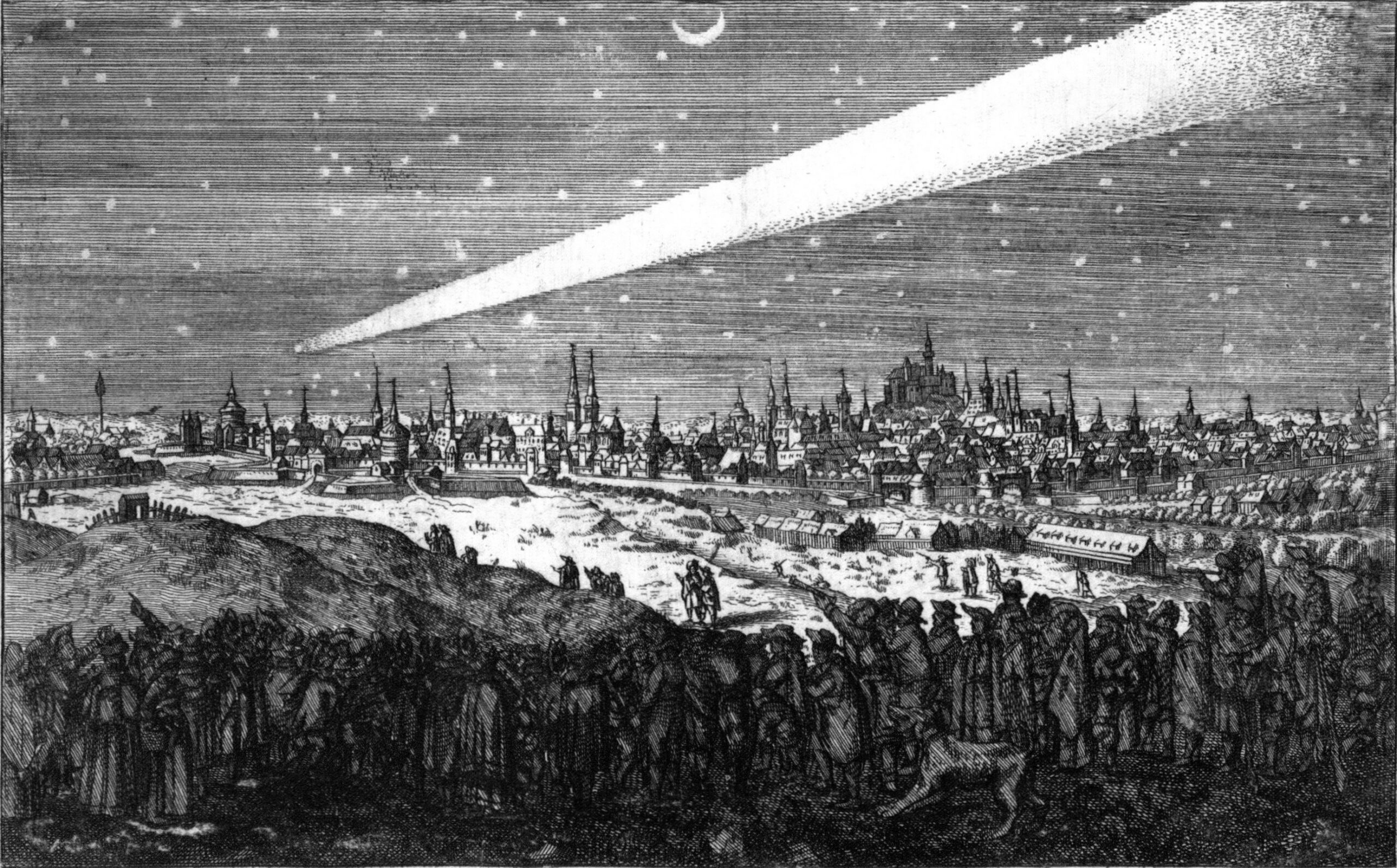
The surviving illustration reproduced here places the comet above Nuremberg. Printed in 1680, this anonymous broadside image makes the distant sky part of a recognisable human landscape. Rooftops and a conspicuous tail invite viewers to connect everyday life with an extraordinary occurrence. Yet an image is evidence of representation, not a statistical record of everybody’s beliefs. We should neither assume that every spectator panicked nor treat a dramatic composition as proof of a supernatural message. The distinction helps us read historical esotericism without repeating its claims as established facts. [3]
The scientific story was also an argument rather than an instant revelation. The Newton Project records correspondence in 1681 between Isaac Newton and John Flamsteed about the comet seen before and after its passage near the Sun. Flamsteed maintained that the appearances belonged to the same object. This question mattered: connecting separate observations required an account of motion, not simply a memorable description. The Fitzwilliam Museum explains that Newton subsequently applied gravitation in the Principia of 1687 to the comet’s highly elongated, almost parabolic path around the Sun. The spectacle became material for mathematical astronomy. [1][4]
Meanwhile, Pierre Bayle made the comet an occasion for challenging superstition. His reflections, published in 1682, examined the claim that comets announce calamities. Rather than accepting an impressive sight as a warning addressed to humanity, he questioned the reasoning that converts coincidence into prediction. The discussion extended beyond astronomy into morality and religious authority. Cardiff University preserves a 1708 English edition in its collections; the Wellcome Collection also catalogues a later English work drawing on Bayle’s response to the 1680 comet. These records show that the controversy continued through print across languages and generations. [5][6][7]
Its enduring importance therefore lies in the coexistence of several ways of knowing. Astronomical measurement investigated physical motion; philosophical criticism tested arguments; esoteric interpretation sought hidden correspondence between sky and society. Those activities could overlap in the same historical world without having equal evidential force. A comet’s appearance does not establish that it caused a war, predicted a death or communicated an instruction. Looking back, we can appreciate the awe and imaginative power of the event while retaining that boundary. The Great Comet of 1680 is a revealing historical encounter between an observable sky and humanity’s persistent desire to make uncertainty meaningful. Its value today is not a catalogue of fulfilled predictions, but a record of how people negotiated uncertainty. Reading the surviving documents together lets us distinguish the physical event from the meanings subsequently attached to it.
A Feng Shui interpretation
Feng Shui provides a comparative lens for this story, not a documented explanation of the comet or an influence demonstrated in the European sources above. Its concern with the relationship between people and their surroundings invites a useful change of scale: instead of asking what disaster the sky predicts, ask how an overwhelming event changes attention, behaviour and the experience of a place. [8]
Through a symbolic yin–yang reading, the dark, relatively quiet night and the conspicuous moving light form a contrast between stillness and activation. That contrast can represent the need to balance excitement with rest. It does not mean that the comet possessed a measurable Feng Shui force or altered every household’s fortune. Similarly, the five phases can supply a vocabulary for reflection, but assigning the comet to Fire is a modern metaphor based on its appearance, not an astronomical classification or a universal traditional rule.
A practical interpretation begins with the observer’s room. Keep a clear route to a window, reduce distracting clutter and arrange seating so that watching the sky feels comfortable and secure. Avoid glare and maintain ordinary ventilation. These modest choices support attention without promising supernatural protection. No charm, mirror or water feature is required to neutralise a celestial threat.
The lesson is one of proportion: let wonder stimulate curiosity, then return to the immediate environment where choices are possible. Bayle’s criticism encourages us to test frightening claims; a thoughtful Feng Shui practice encourages us to cultivate a setting that supports composure. Together, as a contemporary comparison, they suggest responding to uncertainty with observation, balance and deliberate action.
Sources
- Fitzwilliam Museum: the comet and Newton
- NASA: the Great Comet
- Wikimedia Commons: historical image and public-domain status
- Newton Project: chronology and correspondence
- Stanford Encyclopedia of Philosophy: Pierre Bayle
- Cardiff University: historical editions on superstition
- Wellcome Collection: the 1750 comet dissertation
- Spurlock Museum: Feng Shui and environment
Let’s discuss about this here…
What Is Feng Shui? — Explore the basics and ask questions in our forum.