 English
 Français
 Deutsch
 Italiano
 Español
 Português
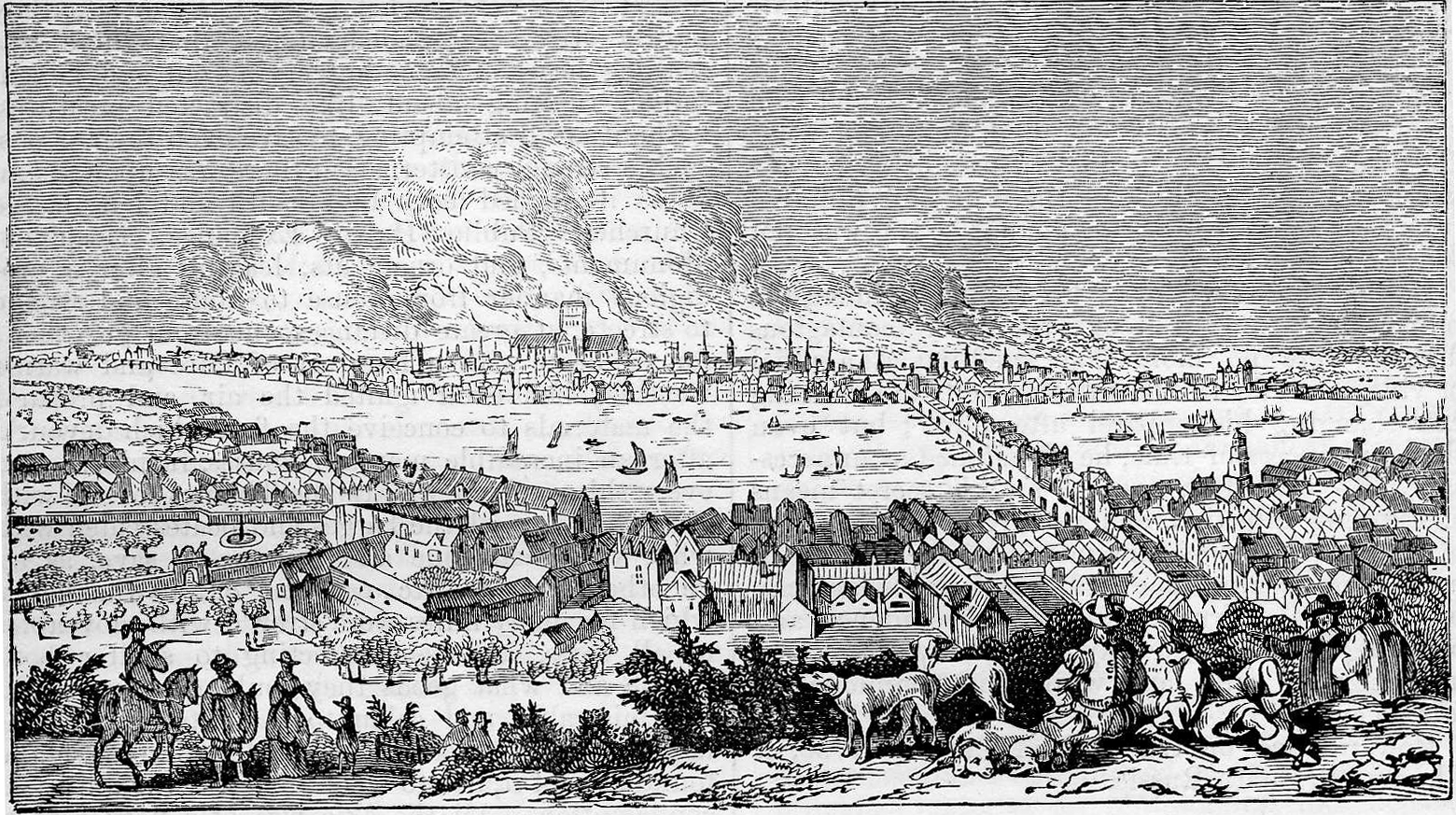

London in flames: what happened in September 1666
Shortly after midnight on Sunday, 2 September 1666, a fire broke out in the bakery of Thomas Farriner on Pudding Lane, near London Bridge. London was then a dense city of timber-framed houses, narrow lanes and crowded wharves. A hot, dry summer had left buildings and stored goods especially vulnerable. A strong easterly wind helped carry sparks from one roof to another. The city had no modern fire brigade: people fought the flames with buckets, hooks, ladders and attempts to pull down buildings and create firebreaks. [1][2]
The blaze spread for several days. Its course was shaped by the built environment as much as by the wind: closely packed houses, combustible materials and limited access made it difficult to reach the fire. Authorities debated demolishing buildings to stop it, while residents tried to salvage possessions and escape. The fire reached its height on 4 September and was brought under control by 5 September. Contemporary accounts describe panic, smoke and an immense movement of people and goods. Exact losses vary by source; thousands of homes and many churches and civic buildings were destroyed, and a very large part of the population was left without shelter. [1][2]
The disaster did not begin as a supernatural event. The most accepted account traces the ignition to the bakery, but the precise sequence and responsibility were debated at the time. Rumours of foreign plots spread amid the political tensions of the Second Anglo-Dutch War. The National Archives preserves accusations, proclamations and reports that reveal how fear produced competing explanations. These documents are evidence of what people believed and said; they do not establish a conspiracy. Separating the physical cause from later interpretation helps us read both the event and its memory more responsibly. [1]
Rebuilding reshaped London. Parliament passed the Rebuilding Act in 1667, requiring new houses to use brick or stone and setting rules for street widths, building heights and construction. Plans by Christopher Wren and John Evelyn proposed a more regular city, with broad avenues and squares, but property boundaries and the urgent need to rebuild meant that much of London rose again along its old street pattern. St Paul’s Cathedral and many parish churches were rebuilt; the process took decades. The fire also accelerated changes in building regulation, insurance and organized firefighting. [3]
The event’s esoteric afterlife comes from the human search for meaning in catastrophe. Fire has long carried associations of destruction, purification and transformation. In 1666, religious and political observers could frame the disaster as divine warning, punishment or a sign of upheaval. Such explanations belong to the history of belief, not to proof of a hidden cause. The fire’s documented consequences—displacement, loss, rebuilding and new rules—are enough to explain why it became a powerful symbol of an old city ending and a new one taking shape.
A Feng Shui interpretation: when fire overwhelms a place
This is a modern comparative reading, not a claim that seventeenth-century Londoners practiced Feng Shui or that Feng Shui can explain the fire. Feng Shui draws on Chinese traditions concerned with place, qi, yin–yang and the five phases (wood, fire, earth, metal and water). These are relational patterns for thinking about change, not a simple set of physical substances. [4]
Read symbolically through this framework, London in 1666 shows an imbalance of conditions that allowed a small ignition to become a citywide crisis: combustible “wood” everywhere, lanes that restricted movement, dense activity and too few effective buffers. The image of Fire consuming Wood is a metaphor for cascading vulnerability, not a historical diagnosis. A Feng Shui question might be: how does a place circulate people, air, resources and help, and where does it become blocked or overexposed?
The rebuilding offers a second lens. Brick and stone, wider routes, regulated structures and later fire services can be read as “Earth” and “Metal” qualities of containment, boundaries and organization. They did not make London invulnerable, but they changed how risk could be managed. In practical Feng Shui, this encourages attention to clear circulation, safe exits, sensible storage and materials suited to their setting. Symbolic balance should support, never replace, engineering and fire-safety standards.
The deeper lesson is not that catastrophe was destined, but that environments shape how harm spreads and how recovery becomes possible. A resilient home or community combines warmth and vitality with calm planning, accessible routes and shared responsibility. The Great Fire can therefore prompt a grounded esoteric reflection: transformation is meaningful when people turn loss into wiser care for the places they inhabit.
Let’s discuss this in the forum…
Sources
- The National Archives: Great Fire of London—examine the evidence
- London Fire Brigade Museum: The Great Fire
- UK Parliament: The 1666 Act to rebuild the City
- Cambridge University Press: Feng Shui cosmological principles
What Is Feng Shui? — Explore the basics and ask questions in our forum.