 English
 Français
 Deutsch
 Italiano
 Español
 Português
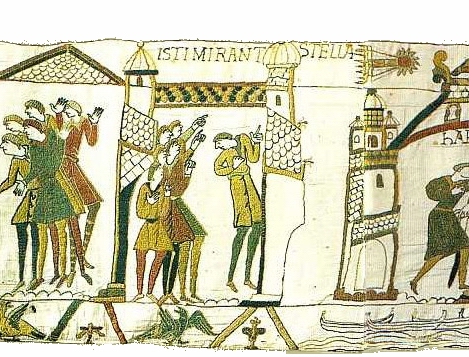

1066: a conquest beneath an extraordinary sky
In the spring of 1066, a striking comet appeared above a kingdom already facing an uncertain succession. Edward the Confessor had died in January, and Harold Godwinson had become king of England. William, duke of Normandy, challenged his position. The luminous visitor, now identified as Halley’s Comet, entered a world in which unusual events in the heavens could be read as messages about earthly authority. Its importance was therefore both astronomical and cultural: people observed a real object, then interpreted it through their expectations and fears. [1][2]
The year’s decisive political event came on 14 October, when William defeated Harold at the Battle of Hastings. Harold died, and William’s coronation followed on Christmas Day. Yet the outcome had not been inevitable. England had also faced an invasion by Harald Hardrada of Norway and Harold’s brother Tostig. Their victory at Fulford on 20 September was followed by defeat at Stamford Bridge five days later. These competing campaigns remind us that armies, leadership and circumstances explain the struggle more directly than a celestial omen. [1][2]
The Bayeux Tapestry preserves the best-known visual connection between the comet and the conquest. Strictly speaking, it is an embroidery, with narrative scenes worked onto a long linen ground. In scene 32, a group looks upward and points towards the remarkable object. The Latin inscription, “ISTI MIRANT STELLA”, identifies their wonder at the star. The image records the cultural force of looking at the sky, while the surrounding narrative connects that wonder to the insecurity of royal power. It is an interpretation in thread, not an astronomical photograph. [3][4]
Chronology matters. The comet appeared in the spring, several months after Harold’s coronation, although its placement in the embroidered narrative associates those events closely. English Heritage stresses that the work was not intended as a complete historical account: the northern battles are absent. The University of Chicago Library also draws attention to ships in the lower border, which anticipate the Norman invasion. Such choices show how images can organize the past around an outcome already known to their makers. [2][4]
The esoteric dimension lies in this search for hidden correspondence between heaven and political life. A comet could signify a change of ruler, but the meaning was not necessarily identical for every observer. What threatened one claimant could encourage another. Modern scholarship on the tapestry emphasizes this political and retrospective use of celestial imagery. Calling the scene an omen therefore describes a historical belief; it does not establish that the comet predicted a death or selected the rightful king. Nor should medieval omen-reading be confused with a single, uniform occult doctrine. [5]
Today the same object belongs to a different explanatory framework. Halley’s Comet follows a recurring orbit, and its bright appearance results from the behavior of a comet near the Sun, rather than an intention directed at human affairs. The enduring fascination of 1066 comes from holding these perspectives together: an observable natural event, a violent contest for power, and a story that made the sky speak about history. Reading them separately allows wonder without surrendering judgment, and gives the tapestry value as evidence of meaning-making as well as of memory. [1]
A Feng Shui reading: responding to change
The connection proposed here is a modern philosophical comparison, not evidence that Harold, William or the embroiderers practiced Feng Shui. Chinese geomancy and medieval European omen traditions have different histories. Columbia University’s account explains Feng Shui through the relationship between place, qi and yin–yang patterns; that shared interest in human surroundings permits comparison without making the traditions identical. [6]
Through this lens, the comet scene invites reflection on how an unexpected external event changes the atmosphere within a community. The same sky could provoke fear, hope or fascination. A Feng Shui interpretation can ask how people recover a sense of orientation when familiar structures become uncertain. It cannot calculate the result of Hastings or transform a remembered omen into a reliable forecast.
Yin and yang offer a language for balancing observation and action. Quiet attention allows a surprising event to be examined; decisive activity addresses the practical situation. In this reading, either unchecked alarm or passive fatalism disturbs that balance. Harmony means responding proportionately, while recognizing that this is our interpretation rather than a documented medieval explanation.
A practical application is to create a calm place for reading and discussion: comfortable light, unobstructed movement and a stable surface for comparing sources. A reproduction of the tapestry can encourage curiosity if its historical context accompanies it. It should not be sold as protection against celestial danger.
Finally, no compass-sector prescription follows from the image alone. The useful lesson is attentiveness to context: distinguish an event from the story attached to it, and arrange shared spaces so that evidence, reflection and conversation remain possible.
Let’s discuss about this here….
Sources and further reading
- NASA — John Uri (2021)
- English Heritage — 1066
- Wikimedia Commons — Bayeux, 32
- University of Chicago Library — Bayeux
- Michael Lewis & Simon Portegies Zwart (2025), pp. 128–138
- Columbia University — Asia for Educators
What Is Feng Shui? — Explore the basics and ask questions in our forum.