 English
 Français
 Deutsch
 Italiano
 Español
 Português
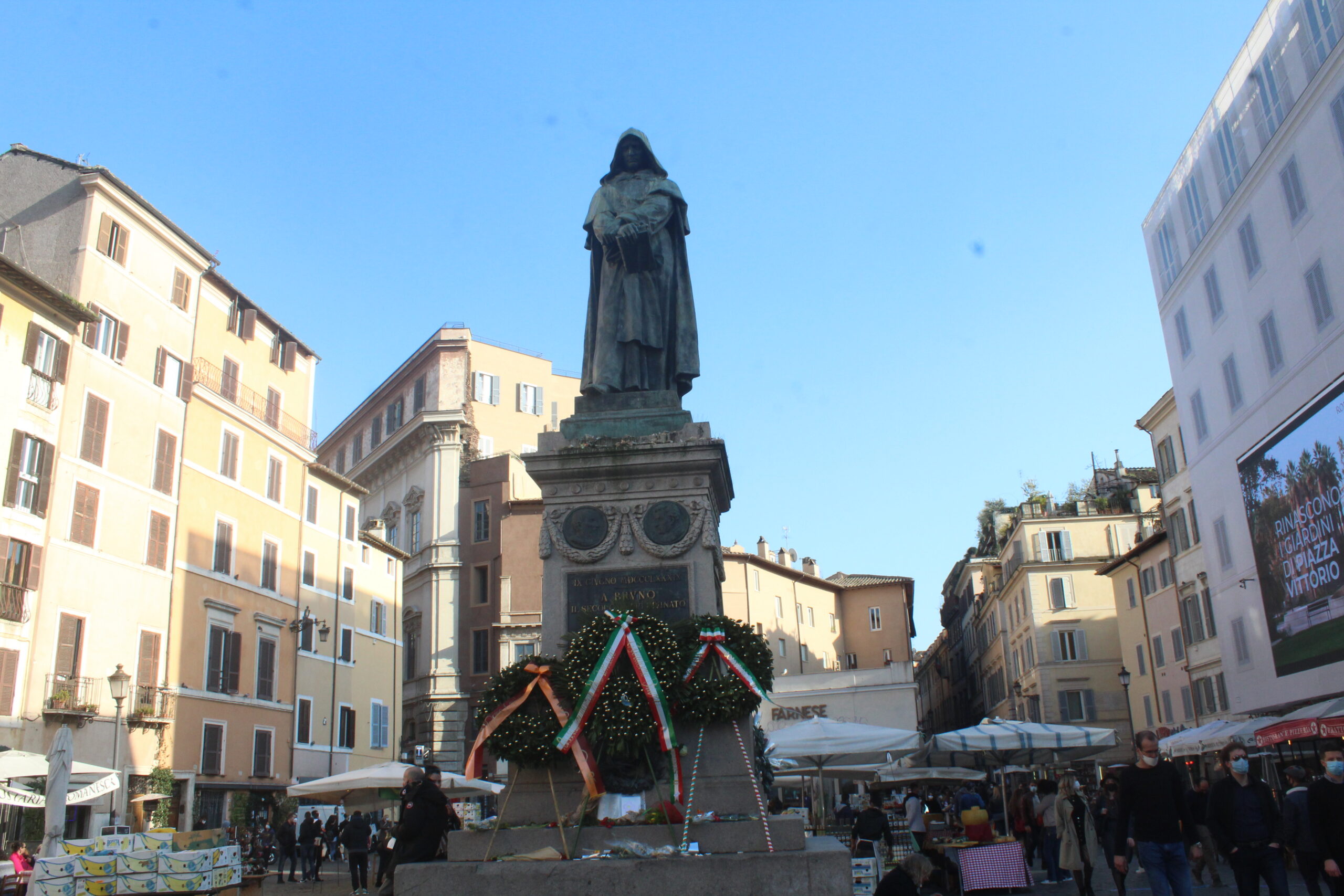

The historical event: Rome, 17 February 1600
On 17 February 1600, Giordano Bruno was burned at the stake in Rome’s Campo de’ Fiori after condemnation for heresy. His death became an internationally recognised symbol of the dangers of coercing belief. Yet describing him simply as a modern scientist executed for discovering other planets distorts both his thought and his trial. Bruno was a Renaissance philosopher whose investigations joined cosmology, religion, memory and ideas about hidden natural relationships. Understanding that combination makes the event more revealing than a familiar story of science confronting superstition. [1, 2]
Born near Nola in 1548, Bruno entered the Dominican order in Naples and received a theological education. Conflicts over doctrine preceded his departure from religious life and years of travel. In France, England and German-speaking territories he taught, published and sought patrons. His skill in the art of memory attracted particular attention. This was a cultivated discipline for arranging and recalling knowledge through striking images and ordered structures, rather than a supernatural ability demonstrated by experiment. His mobile career also exposed him to rival religious authorities and precarious forms of intellectual protection. [2]
The esoteric dimension deserves precision. Renaissance Hermeticism drew on writings attributed to Hermes Trismegistus; Neoplatonic traditions explored relationships between unity, intellect and the natural world. Bruno adapted these resources rather than merely repeating a single secret doctrine. His memory writings and work on magic considered imagination, transformation and connections among things. “Occult” in this setting referred to hidden properties and causes, not automatically to the modern entertainment category. His search for an interconnected universe therefore belonged to philosophical and religious debates as well as to the history of esotericism. [3, 4]
Bruno also defended an infinite universe containing innumerable worlds, challenging a closed cosmic hierarchy. Such arguments were philosophical proposals, not observations establishing the existence of modern exoplanets. His return to Italy brought him into the household of the Venetian nobleman Giovanni Mocenigo, who wanted instruction in memory. Mocenigo denounced him, and Bruno was arrested in 1592. Transferred to Rome in 1593, he faced a prolonged inquisitorial process. Theology, the soul and his understanding of divinity mattered alongside cosmological questions. Reducing the proceedings to support for Copernicus hides this wider conflict. [1, 2]
The surviving evidence also sets limits: the final list of eight propositions demanded for retraction has not survived. We should therefore avoid claiming complete certainty about every decisive charge. In January 1600 the Roman authorities ordered Bruno handed over for punishment, and his execution followed in February. The case demonstrates how institutions could make the boundaries of acceptable knowledge a matter of life and death. It does not establish that all his philosophical claims were scientifically correct, nor does respect for his fate require endorsing his magical theories. [1]
The square later acquired another historical layer. Ettore Ferrari’s monument to Bruno was inaugurated there on 9 June 1889, supported by international committees and entangled in liberal and anticlerical politics. The pictured statue is this later memorial, not a depiction made during the execution. Its presence transformed the site into a place for remembering intellectual persecution. The event’s worldwide significance thus includes both a Renaissance trial and subsequent debates about conscience, public commemoration and who has the authority to define truth. [5]
A Feng Shui interpretation: space, memory and balance
There is no documented historical link in the sources used here between Bruno’s trial and Chinese Feng Shui. The following reading is a contemporary comparison, not a claim that he practised Feng Shui or that a site’s qi caused his death. The traditions emerged in different settings. Their useful meeting point is the question of how surroundings, images and orientation shape human attention and our experience of a place.
Through a Feng Shui lens, Campo de’ Fiori can be considered as a setting where movement, openness and a strong central marker organise perception. A monument draws the eye and gives memory a location. That resembles, at a broad level, the use of meaningful spatial anchors in a reflective interior. Bruno’s art of memory offers a comparison concerning attention; it should not be treated as the same system as the bagua or Chinese cosmology.
Yin and yang provide another interpretive vocabulary: contemplation and activity, quiet remembrance and public exchange need room to coexist. The five phases can serve as metaphors for changing relationships, rather than literal explanations of a judicial killing. Calling the execution “excess Fire” would confuse a symbolic reading with historical causation and risk aestheticising violence.
A practical response is to create a reading or discussion area with comfortable light, an unobstructed entrance and seating that supports conversation. Include a book or image that invites questions, while avoiding visual overload. These choices can support comfort and reflection without promising invisible protection. The ethical lesson is to let an ordered space sustain curiosity, disagreement and dignity. Here, balance means making room for people to think freely together.
Sources and further reading
- Stanford Encyclopedia of Philosophy — Giordano Bruno
- University of St Andrews, MacTutor — Giordano Bruno
- Internet Encyclopedia of Philosophy — Giordano Bruno
- Frances A. Yates, The Art of Memory, chapter IX (1966), Warburg Institute
- Roma Capitale, Sovrintendenza Capitolina — Monumento a Giordano Bruno
Let’s discuss about this here….
What Is Feng Shui? — Explore the basics and ask questions in our forum.