 English
 Français
 Deutsch
 Italiano
 Español
 Português
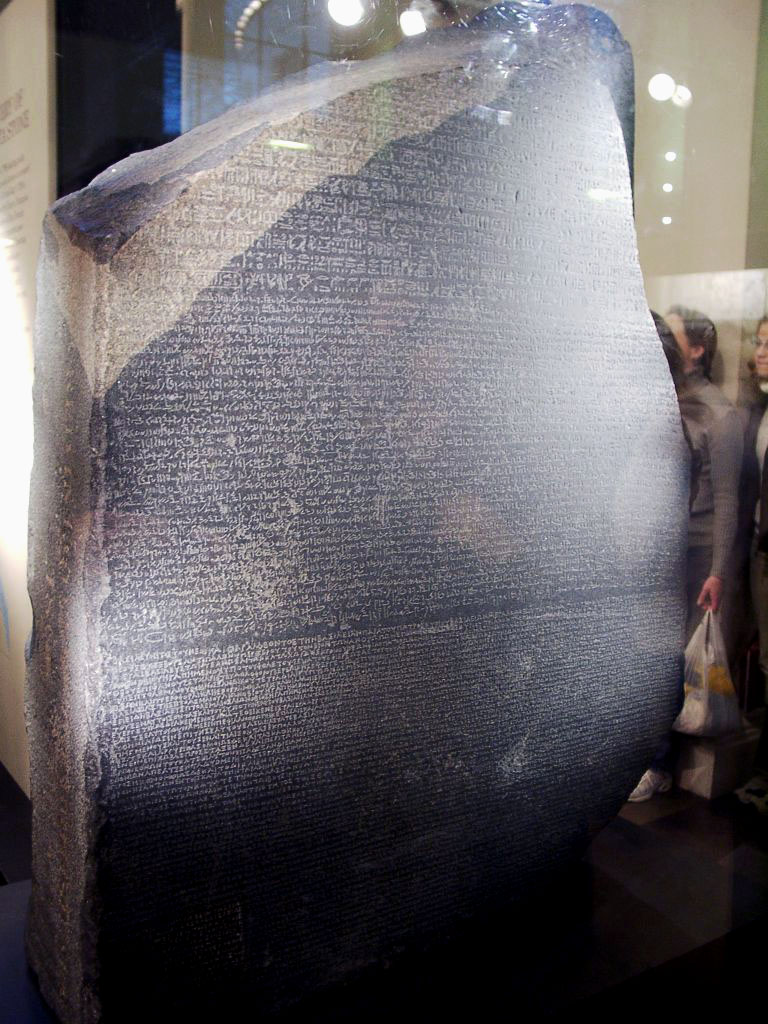

1799–1822: how a discovery transformed the reading of ancient Egypt
In July 1799, during Napoleon’s military expedition to Egypt, French troops working near Rashid, known in Europe as Rosetta, uncovered an inscribed stone reused in a fortification. Its importance lay in an unusual combination: versions of a royal decree appeared in hieroglyphic, demotic and Greek scripts. Scholars could read Greek, allowing them to compare a known text with Egyptian writing they could not yet fully understand. The discovery became a turning point in the international history of knowledge, although decipherment would require decades of work. [1]
The document was far older than the expedition. Dated to 196 BCE, it recorded a priestly decree concerning Ptolemy V. Its setting was political and religious: royal authority, temple institutions and public commemoration reinforced one another. The surviving fragment was therefore neither a book of spells nor a universal manual of secret wisdom. Its three scripts addressed different reading traditions. Crucially, these represented two languages, Egyptian and Greek, rather than three separate languages. Understanding that distinction prevents a familiar misunderstanding of the monument. [2]
The esoteric connection belongs partly to the history of its interpretation. Before decipherment, some European writers treated hieroglyphs primarily as compressed images of profound religious truths. Renaissance and early modern symbolic readings encouraged the belief that Egyptian signs concealed an exceptional wisdom accessible through allegory. Athanasius Kircher’s seventeenth-century interpretations exemplify this approach. Such readings reveal European intellectual ambitions, but they cannot be accepted as translations merely because they sound spiritually meaningful. An attractive symbolic explanation still needs evidence connecting signs with actual words. [3]
The stone helped redirect that problem toward comparison and language. Copies enabled scholars in different places to examine the inscriptions. Thomas Young made important advances, while Jean-François Champollion combined comparison of names and inscriptions with extensive linguistic work, especially on Coptic. His 1822 announcement marked a decisive breakthrough; subsequent research continued to develop the system. Hieroglyphs could express sounds as well as words and ideas. They were not simply a gallery of pictures, each carrying one timeless mystical meaning. The breakthrough depended on multiple documents, predecessors and sustained testing. [2] [4]
That change did not erase Egyptian religion or ritual. Instead, readable texts made it possible to study them with greater precision, alongside administration, royal titles and everyday concerns. Modern readers gained access to a complex civilization rather than an imagined storehouse of undifferentiated secrets. The discovery and decipherment also unfolded within imperial competition. Following the French defeat in Egypt, the stone passed into British possession and reached the British Museum in 1802. Its scholarly significance should be considered together with that history of military power and removal. [1] [5]
The lasting lesson is methodological. Sacred meaning and linguistic function can coexist, but neither licenses unlimited interpretation. To understand an inscription, researchers compare recurring forms, contexts and alternative explanations. To understand its modern reception, historians ask who promoted a reading and why. The Rosetta Stone therefore offers an unusually useful esoteric topic: it shows how hidden knowledge can become accessible through patient collaboration, while reminding us that fascination with mystery must remain accountable to the people, languages and circumstances that produced an object.
A Feng Shui interpretation: context before symbolism
The relationship to Feng Shui proposed here is a modern comparison, not a documented influence on the 1799 discovery or the 1822 decipherment. Egyptian religious traditions and Chinese Feng Shui developed in different historical settings. Their symbols should not be treated as interchangeable fragments of one proven secret system.
Feng Shui traditionally considers the relationship between people and their surroundings through ideas such as qi, yin and yang, orientation and the five phases. Applied reflectively, that emphasis on relationships suggests a useful analogy: a sign, like a room, cannot be understood from one isolated feature. Its position, companions and purpose matter. Champollion’s achievement invites us to examine context before assigning symbolic meaning.
A yin–yang reading can frame the balance between receptivity and inquiry. Wonder makes us attentive to a monument; disciplined comparison challenges the stories we project onto it. These are complementary attitudes in this interpretation. Neither attitude is a physical explanation of decipherment, and describing knowledge as flowing qi remains a philosophical metaphor rather than a measurable historical mechanism.
For a practical application, arrange a study space with clear access, comfortable lighting and a stable place for source material. Display a reproduction of the stone with its date, language information and provenance. Let it encourage learning rather than promise wealth or supernatural protection. No reliable conclusion about a room’s auspicious compass sectors follows from this photograph alone.
The ethical interpretation is equally important: respect cultural differences, acknowledge the object’s movement through conquest, and leave room for competing perspectives. Harmony here means connecting curiosity, evidence and responsibility. It does not mean proving that Egyptian hieroglyphs originated in Feng Shui.
Sources and further reading
- Linda Hall Library — The Rosetta Stone
- British Museum — Hieroglyphs: unlocking ancient Egypt
- Jean Winand, Université de Liège — Les hiéroglyphes avant Champollion
- Bibliothèque nationale de France — L’aventure Champollion
- Cambridge University Library — A game of stones
Let’s discuss about this here….
What Is Feng Shui? — Explore the basics and ask questions in our forum.