 English
 Français
 Deutsch
 Italiano
 Español
 Português
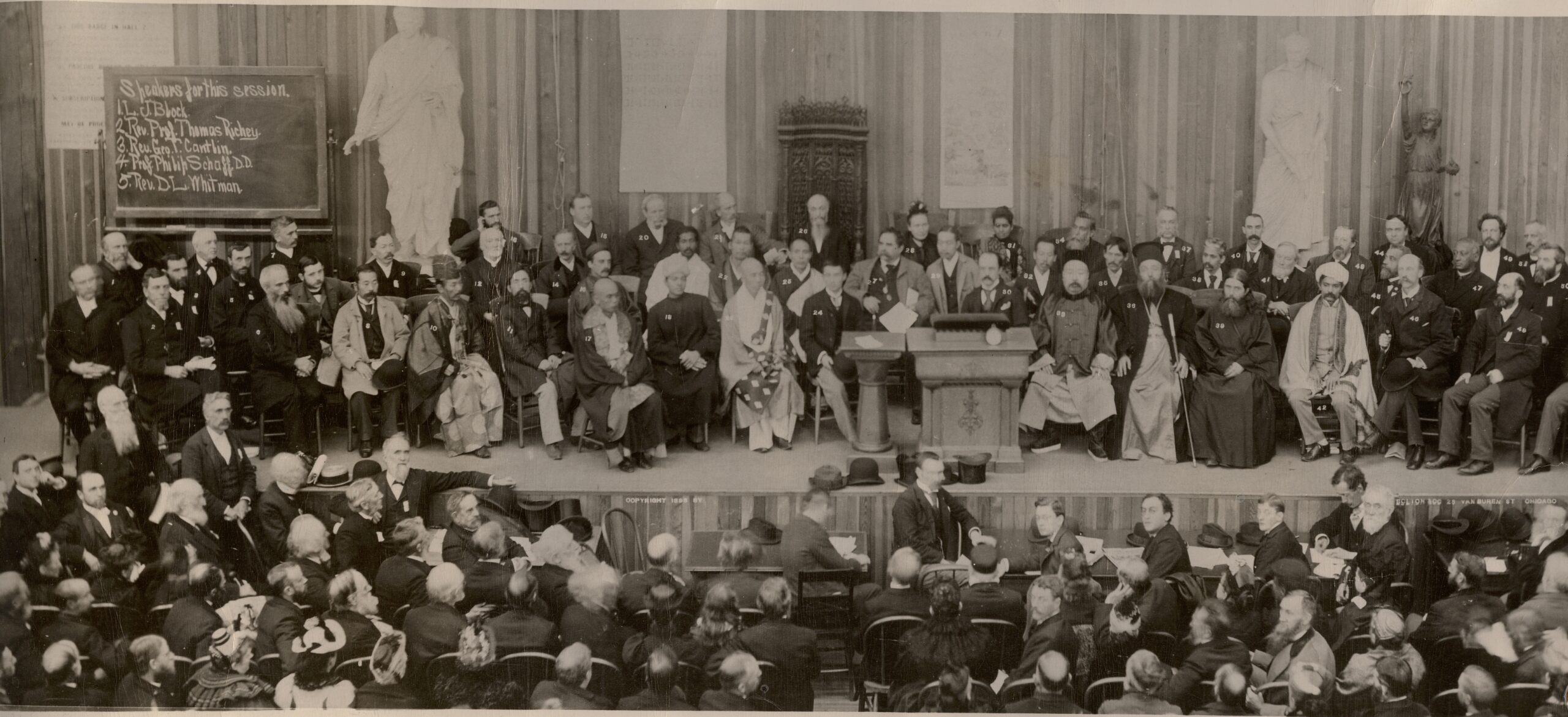

The historical event: spiritual encounter on a world stage
In September 1893, Chicago hosted a gathering with consequences far beyond the United States. The World’s Parliament of Religions opened on 11 September at the Permanent Memorial Art Palace, now the Art Institute of Chicago, during the World’s Columbian Exposition. Over seventeen days, religious representatives addressed audiences about belief, ethics and humanity’s future. Its importance lay in public encounter: traditions frequently described by outsiders could now speak through some of their own representatives. The Parliament’s institutional history identifies it as a foundational moment for the modern interfaith movement. [1]
The setting mattered. A world’s fair presented technological progress and competing visions of civilization to an international public. Within that atmosphere, the Parliament asked whether spiritual life could also be discussed across national and religious boundaries. Hindu, Buddhist, Jain, Jewish and Christian voices, among others, shared a prominent platform. Swami Vivekananda became especially memorable for presenting Hindu thought to American listeners. His reception demonstrated that visitors were not simply exhibits: they could become persuasive teachers and challenge an audience’s expectations. [1,2]
An explicitly esoteric strand appeared in the associated Theosophical congress, held on 15–17 September. Its published proceedings, preserved by the Library of Congress, document the Society’s presentations and identify William Quan Judge and Annie Besant among its leading participants. Theosophical speakers proposed that different religions could be understood through an underlying spiritual wisdom. Their claims went beyond comparative description into metaphysics: humanity, nature and ethical development were interpreted as parts of a larger spiritual order. These were the movement’s teachings, rather than experimentally demonstrated discoveries. [3]
That distinction helps explain the congress’s appeal. It offered an intellectual bridge between religious traditions at a time when many people were reconsidering inherited authority. Discussion of shared wisdom also raised practical questions about conduct. Besant’s contribution on ethics placed service to others and moral development within the movement’s spiritual vision. Studying the proceedings lets us separate what participants actually argued from later romantic accounts of a secret, unanimous gathering. The esoteric congress belonged to a varied public religious event; it did not define every delegate’s position. [3]
The wider Parliament also had substantial limits. Its organizers’ language often assumed a Christian framework, even while welcoming other faiths. Harvard’s Pluralism Project describes both the ambition of universal fellowship and the exclusions that undermined it, including the marginal position of African American voices and the treatment of Native Americans at the fair. Agreement about human dignity did not eliminate unequal authority. Some speakers challenged prejudice directly, making disagreement an essential part of the event rather than a failure of dialogue. [2]
Chicago 1893 therefore matters as a contested meeting, not a discovery that all religions are identical. It made spiritual comparison visible to a broad public while exposing the difficulties of genuine reciprocity. For readers interested in esotericism, its enduring question is how a search for unity can remain accountable to evidence, cultural context and the people whose traditions are being compared. [1–3] Its legacy asks communities to combine spiritual curiosity with patient listening and responsibility for the terms of encounter.
A Feng Shui interpretation: harmony without erasing difference
Feng Shui offers a useful interpretive lens for this event because it asks how people relate to their surroundings. Its traditional vocabulary includes qi, yin and yang, and relationships among orientation, landscape and built form. Here, those ideas serve as a modern philosophical comparison. The historical sources cited above do not establish that Feng Shui directed the Parliament’s organization, that its hall received a formal consultation, or that Theosophy and Chinese geomancy share a single origin.
Consider first the threshold. Entering a room means moving from outside difference into a temporary shared setting. In a contemporary Feng Shui inspired design, a legible entrance and unobstructed circulation could express welcome. Yet a clear doorway cannot compensate for exclusion from the speaking platform. The Parliament reminds us that spatial hospitality and social hospitality need to support each other.
Yin and yang suggest a second comparison: receptive listening and active speech should alternate. A room dominated by one voice may appear orderly while preventing meaningful exchange. Balanced lighting, comfortable seating and opportunities for quieter discussion can help people participate. These are practical design proposals, not evidence that an invisible energy determined the historical outcome.
Finally, harmony need not mean uniformity. A shared meeting room can retain a calm visual center without appropriating sacred objects from every tradition as decoration. Ask participants which symbols belong, leave room for different practices, and assess whether everyone can enter, hear and respond. This reading interprets Chicago’s spiritual ambition through the ethics of place: cultivate conditions for relationship while respecting distinct histories. No Bagua diagnosis or auspicious direction can responsibly be inferred without a reliable plan, orientation and a specified method.
Sources and further reading
- Parliament of the World’s Religions — 1893 Chicago.
- Harvard Pluralism Project — Parliament of Religions, 1893.
- The Theosophical Congress, 15–17 September 1893: Report of Proceedings and Documents. Library of Congress; 1893.
Let’s discuss about this here…
What Is Feng Shui? — Explore the basics and ask questions in our forum.