 English
 Français
 Deutsch
 Italiano
 Español
 Português
1614: the manifesto that made a hidden brotherhood famous
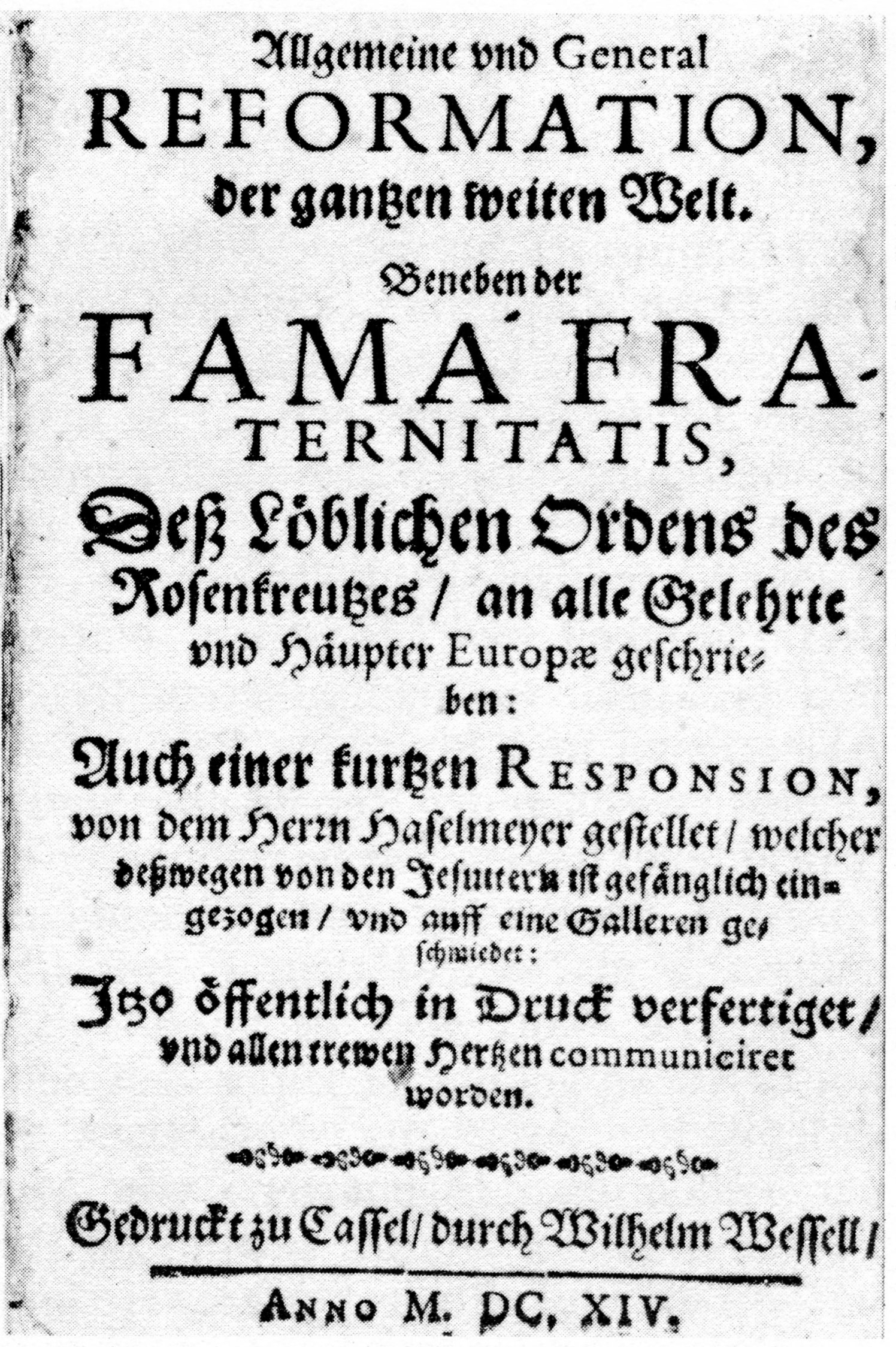
In 1614, a small German publication in Kassel helped turn an imagined hidden fraternity into an international intellectual sensation. Its best-known text, the Fama Fraternitatis, announced a brotherhood of the Rosy Cross devoted to renewing knowledge and human life. The event was not a world congress or a political revolution. It was a publishing breakthrough whose controversy crossed European borders and whose symbols later entered international esoteric culture. Its importance lies in the remarkable distance between the modest printed object and the ambitious transformation it promised. [1, 2, 3]
The manifesto appeared in a world where Christian religious reform, medical controversy and the study of nature were closely connected. Its authors did not divide science and spirituality in the way many readers do today. They imagined that better knowledge of creation could accompany moral and religious renewal. Manuscript copies circulated before publication; printing enlarged the audience and gave readers something they could cite, dispute and answer. A further manifesto, the Confessio Fraternitatis, followed in 1615, while the allegorical Chymical Wedding of Christian Rosenkreutz appeared in 1616. [1, 2, 3]
At the centre of the Fama stands the story of a traveller usually known as Christian Rosenkreutz. According to the narrative, journeys eastward brought him learning that European scholars resisted when he returned. He therefore gathered a small fraternity committed to study and service. Its rules included treating the sick without payment, adapting to local dress and meeting regularly. These details matter because the promised wisdom was presented as a discipline of conduct and cooperation, rather than simply a collection of spectacular powers. They belong to the manifesto’s account, not to an independently verified biography. [4]
The most memorable episode describes the rediscovery of the founder’s concealed vault after 120 years. Books, inscriptions, geometrical arrangements and extraordinary illumination turn the chamber into an image of preserved wisdom. The tomb functions as a miniature ordered universe: knowledge survives apparent loss and becomes available when the time is right. This is the esoteric heart of the story. Hidden space, symbolic reading and spiritual readiness reinforce one another. The narrative invites interpretation, but its vividness does not establish that archaeologists discovered such a chamber or that its marvellous objects existed. [2, 4]
The response was real, even where the brotherhood remained elusive. Readers wrote defences, objections and appeals for contact. Historian Lyke de Vries records that the controversy had generated more than four hundred texts by 1625. Admirers saw the possibility of a generous reform of learning; opponents feared religious error, deception or intellectual disorder. The puzzle of unidentified authors helped the debate travel. A reader could encounter the fraternity through a book without ever meeting a member, an especially powerful situation in the expanding culture of European print. [1, 3]
Modern scholarship associates the manifestos with the Lutheran intellectual milieu around Johann Valentin Andreae, while distinguishing questions of authorship from proof of the fraternity described. Later organisations adopted Rosicrucian names and imagery, but those borrowings do not themselves demonstrate an uninterrupted institution beginning in 1614. The historical achievement is more securely understood as the creation of an enduring symbolic vocabulary: the hidden school, the recovered wisdom and the reform of the self alongside society. Studying the event requires holding two things together—respect for what the symbols meant to believers, and careful scrutiny of what the surviving documents actually prove. [1, 2]

A Feng Shui interpretation: relationship, renewal and limits
The Rosicrucian manifesto and Feng Shui can be compared through their interest in relationships between people, place and a larger order. This is a modern interpretive comparison, not evidence of a historical connection. The sources used here do not establish that the manifesto’s authors knew Chinese geomancy, or that its symbolic vault followed a Feng Shui method.
Feng Shui traditionally concerns the siting and orientation of spaces for the living and the dead, understood through landscape, qi and cosmological relationships. A university museum’s account of Chinese burial traditions illustrates this spatial emphasis. The Fama’s vault offers a useful contrast: its geometry organises a literary revelation. Both invite attention to meaningful space, but their cultural frameworks and purposes remain distinct. [5]
Read symbolically, the opening of a sealed chamber suggests a movement from concealment toward circulation. A Feng Shui-inspired reflection might ask where learning, conversation or care has become blocked in our own surroundings. Making a reading area usable, clearing a passage or arranging seats so people can converse turns the theme of renewal into an ordinary spatial practice. These are reflective applications, not techniques documented in the manifesto.
Yin and yang can also provide a vocabulary for balancing inward study with outward service, privacy with participation, and preservation with change. Neither pole should erase the other. The manifesto’s ideal of sharing knowledge becomes a prompt to examine whether our rooms and institutions support both contemplation and community.
The limit matters: no bagua placement can authenticate a secret brotherhood, and no arrangement of objects proves a supernatural promise. The most constructive connection is ethical and interpretive—cultivating attentive relationships with our environment while allowing historical evidence to remain independent of spiritual meaning.
Sources and further reading
- John Henry — “Rosicrucian”, The Cambridge Descartes Lexicon, Cambridge University Press (2015).
- Susanna Åkerman — “Three phases of inventing Rosicrucian tradition in the seventeenth century”, Cambridge University Press (2007).
- Lyke de Vries — Reformation, Revolution, Renovation, introduction, Brill (2022).
- Fama Fraternitatis (1614), Thomas Vaughan translation: historical primary text, reproduced by the Confraternity of the Rose Cross.
- National Taiwan University, Graduate Institute of Art History — Feng Shui and Tomb Quelling Deities.
Let’s discuss about this here…
What Is Feng Shui? — Explore the basics and ask questions in our forum.