 English
 Français
 Deutsch
 Italiano
 Español
 Português
Feng Shui and climate resilience meet in a question larger than interior decoration: how should people inhabit an environment that is changing around them? News from 8–11 October connects planetary weather, household resources and collective responsibility. This analysis uses Feng Shui as a philosophical lens for thinking about those connections.
The recent events behind this analysis
WMO’s 8 October update forecasts a strengthening El Niño and shifting rainfall. Seasonal outlooks do not replace local warnings. [1]
On 11 October, UNDP described overlapping energy, climate and debt pressures on developing economies. [2]
The UN’s 10 October account describes Japan’s media campaign for collective climate action. [3]
The interpretation below is original editorial analysis. Feng Shui does not cause El Niño, forecast disasters or replace meteorology, engineering and public policy. It offers a cultural vocabulary for examining relationships between people and place.

A detailed Feng Shui interpretation
1. Why wind and water belong in this debate
Feng Shui literally joins wind and water. Its traditions concern the relationship between habitation, landscape and the conditions that sustain life. Those words invite a change in scale: a home is situated within a street, a watershed and a wider atmosphere. The climate debate therefore has a meaningful connection to its central concerns, although the two use different methods. Meteorology measures physical processes; Feng Shui interprets the qualities and relationships of places. Reading them together can encourage attention without pretending that symbolic language explains a warming ocean. The useful question is what a place asks of its inhabitants, and what responsibilities inhabitants have toward that place.
2. A historical connection, without romanticizing it
Historian BuYun Chen documents connections between Feng Shui, forestry and governance in the Ryukyu Kingdom. [4] This establishes that the tradition has a landscape dimension beyond objects placed inside rooms. It does not mean that an older society possessed today’s climate science or a universally just social order. Our contemporary interpretation should preserve that distinction. Traditions can offer questions worth asking while their practical recommendations remain open to scrutiny. If a landscape is described as protective, we should ask who receives protection, who maintains it and whose work becomes invisible. Cultural respect is compatible with examining evidence and power rather than treating the past as an infallible manual.
3. Qi as a language of relationships
In Feng Shui, qi is often described as vital breath or energy. Here it serves as a philosophical way to think about continuity, circulation and interruption. It should not be relabeled as electricity, atmospheric pressure or a measurable climate variable. Consider a neighborhood where a shaded path links homes, a library and a public meeting place. A contemporary analogy of nourishing flow asks whether people can move, rest and meet there with dignity. A disconnected or inaccessible route raises a different question. This reading connects material infrastructure with lived experience, while leaving claims about temperatures, flood levels and structural safety to the relevant measurements and qualified professionals.
4. Water: movement needs room and limits
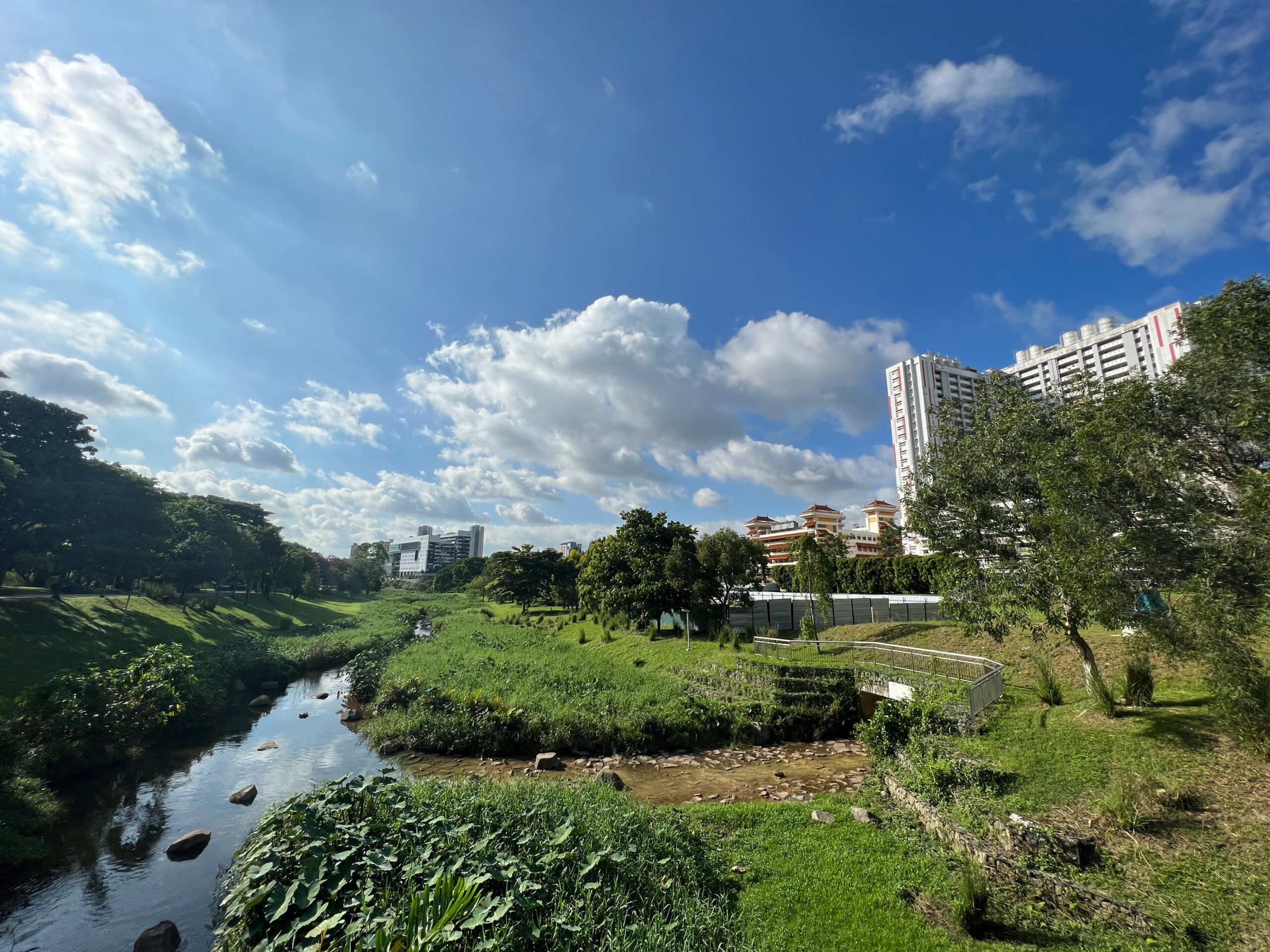
The word water can symbolize adaptability, but actual water requires careful management. A symbolic appreciation of a river should lead to observation of its banks, access routes and changing conditions, rather than an assumption that every waterfront is auspicious. In the photograph, the river and vegetation offer a starting point for contemplation; the image alone cannot establish flood performance. A responsible modern application asks where runoff goes and whether a project transfers difficulty downstream. It also asks whether residents receive understandable information about their surroundings. In this interpretation, harmony is a relationship that must be maintained, not a promise that danger disappears when a decorative fountain is installed.
5. Yin and Yang: comfort depends on context
Yin and Yang describe complementary, changing tendencies rather than moral categories. We can use them to examine exposure and shelter, activity and rest, openness and enclosure. A lively square may need quieter edges; an inviting building may also need protected places to pause. During heat, shade may matter more than bright exposure, while another season or local climate presents different needs. There is no universal instruction to maximize sunlight, airflow or water. The philosophical lesson is responsiveness. Design should begin with the particular place and the people who use it. Balance involves changing relationships over time, so a solution deserves reassessment when circumstances and users change.
6. The Five Phases as an editorial checklist
The Five Phases—Wood, Fire, Earth, Metal and Water—can organize reflection without becoming a scientific model. In an explicitly modern analogy, Wood asks about living systems and renewal; Fire about energy demand and intensity; Earth about stability and the ground beneath daily life; Metal about tools, maintenance and institutions; Water about circulation and reserves. These associations are a thinking exercise, not a traditional prescription for this El Niño. They expose omissions: a spectacular green project may neglect maintenance, or efficient equipment may remain unaffordable. No color, compass sector or arrangement can cancel planetary warming. The value lies in asking more complete questions before making material decisions.
7. Economic pressure makes balance a social question
Reading the economic warning through Feng Shui changes the meaning of an apparently harmonious home. A beautiful room may still depend on fragile resources, insecure access or unaffordable running costs. The contemporary sociological question is whether households have the means and authority to adapt their surroundings. Owners, tenants and people in temporary accommodation do not have identical choices. A philosophy that speaks only to consumers purchasing objects misses this difference. Our interpretation places affordable services, maintenance and shared facilities inside the discussion of supportive environments. This is a normative argument about fairness; it is not a financial forecast, and it does not imply that poverty reflects a person’s energy or spiritual failure.
8. Collective action and the meaning of belonging
Climate communication raises a question about the spaces in which people imagine a shared future. A meeting room, courtyard or community garden can become a place where concerns are heard and responsibilities negotiated. A Feng Shui reading can ask whether that setting invites participation or reinforces exclusion. Who can enter? Is the language accessible? Can someone with limited mobility attend? Are quieter voices given time? These practical questions turn harmony into a public relationship. Participation must also influence decisions rather than serve as a pleasant ritual. A community cannot be called balanced merely because its public space looks attractive while its residents have little say over what happens there.
9. From contemplation to accountable practice
A useful exercise begins with observation rather than purchases. Walk through a familiar place and note where people pause, where access is difficult and where information is missing. Ask residents what the space means to them before imposing a design interpretation. Then distinguish changes an individual can make from those requiring a landlord, municipality or specialist. Select a modest improvement with a clear purpose, such as making a shared meeting space easier to use, and agree who will maintain it. Assess the result through feedback and appropriate evidence. Feng Shui and climate resilience become connected through this discipline of attention, not through guarantees about outcomes or compulsory spiritual beliefs.
10. Harmony means responsibility over time
The recent news invites us to understand resilience as a relationship among landscapes, institutions and everyday lives. Feng Shui can contribute a vocabulary of interdependence, timing and care, provided its symbolic claims remain clearly identified. Its most useful contemporary interpretation is neither fatalism nor a promise of total control. It is a willingness to notice limits, adjust practices and share responsibility. Communities need reliable forecasts, sound infrastructure and fair decisions as well as places that feel meaningful. A philosophical reading becomes worthwhile when it helps people ask who is protected, who pays, who participates and what must be cared for long after the headline has passed.
Sources and further reading
[1] WMO: strengthening El Niño (08/10/2026).
[2] UNDP: compounding crises and developing economies (11/10/2026).
[3] UN: Japan’s collective climate campaign (10/10/2026).
[4] BuYun Chen: Feng Shui, forestry and governance in Ryukyu (2023).
Let’s discuss about this here….
What Is Feng Shui? — Explore the basics and ask questions in our forum.