 English
 Français
 Deutsch
 Italiano
 Español
 Português

The event: astronomy, history and esoteric meanings
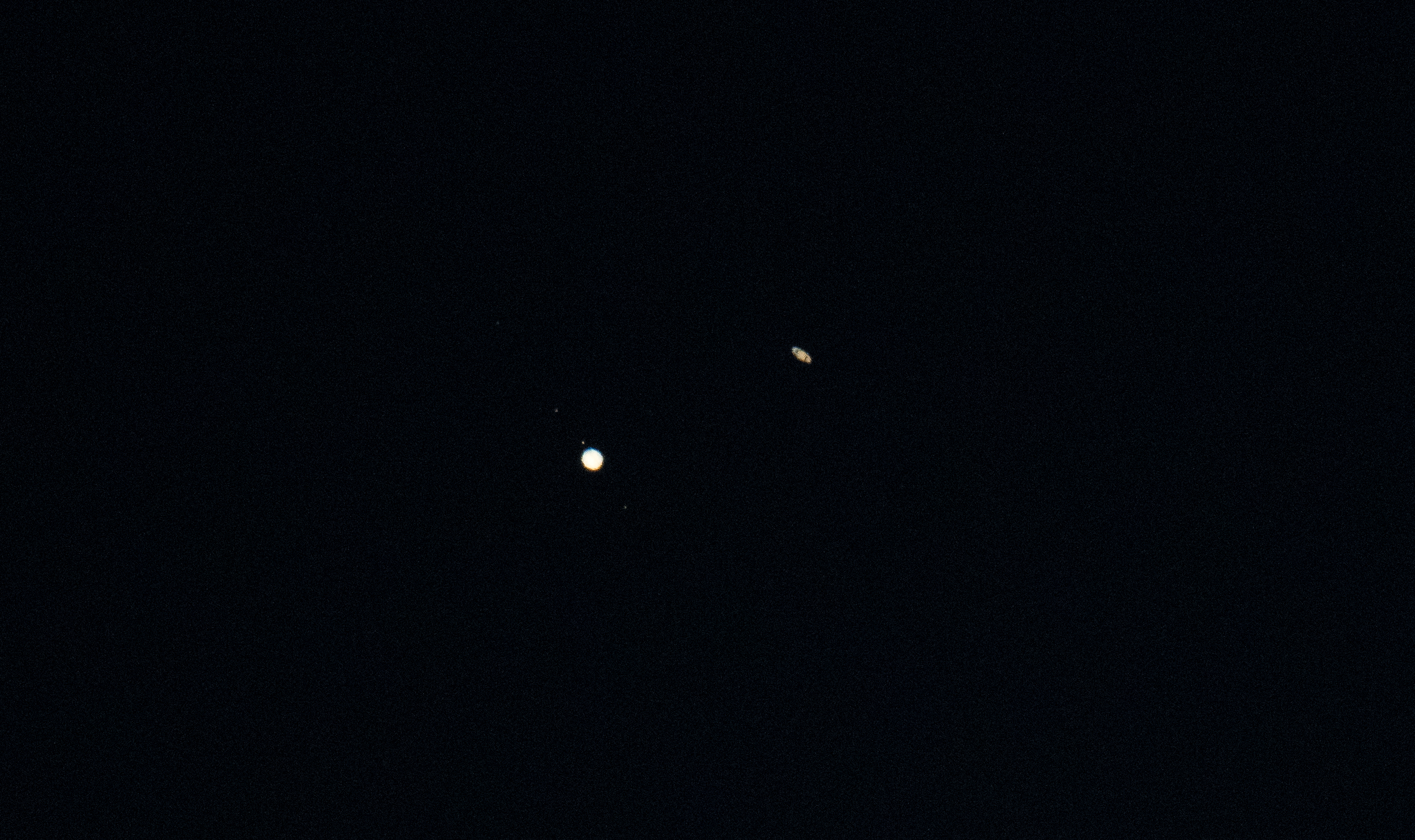
On 21 December 2020, Jupiter and Saturn appeared exceptionally close together in the evening sky. This Great Conjunction became an international observing event, bringing a predictable astronomical alignment into conversations about renewal, astrology and humanity’s place in the cosmos. Its coincidence with the December solstice gave it particular symbolic appeal. The historical importance lies in the unusual view and its cultural reception, rather than a demonstrated change in earthly affairs. The astronomical record and the esoteric interpretations therefore deserve separate, equally careful explanations. [1, 2]
A conjunction describes an apparent meeting on the celestial sphere as seen from Earth. The planets did not collide, exchange positions in space or become one object. Their different orbital speeds brought their lines of sight close together: Jupiter circles the Sun in roughly twelve years, Saturn in roughly thirty. Their apparent meetings recur about every twenty years. What distinguished 2020 was a separation of approximately one tenth of a degree, equivalent to about one fifth of the full Moon’s apparent diameter. Both planets could fit into the same small telescope’s field of view. [1, 2]
The closeness also connected modern observers with much earlier skies. Comparable proximity had occurred in 1623, but observing conditions made that encounter difficult. The last similarly close, readily observable meeting was in 1226. These dates explain the widespread descriptions of an encounter unseen for centuries; they do not mean that Jupiter and Saturn had avoided conjunctions throughout that interval. Clear weather, a sufficiently open horizon and local sunset conditions still determined who actually saw the 2020 display. A global event did not guarantee an identical experience at every location. [1, 3]
The spectacle was documented through photographs, telescope observations and online outreach. At the William Herschel Telescope on La Palma, an image was obtained during testing of a new optical corrector. Separately, researchers from the University of Exeter and Exeter Science Centre developed public activities around a live telescope broadcast. Claire Davies later described that project in Astronomy & Geophysics. These records show how the conjunction was both a scientific observation and a shared public occasion, with remote participation extending access beyond those able to stand beside a telescope. [4, 5]
Its esoteric resonance belongs to another interpretive tradition. In Western mundane astrology, Jupiter–Saturn conjunctions have been read as markers of collective cycles, political changes and shifts in cultural emphasis. Astrologers group zodiacal signs into elemental triplicities; discussions of the 2020 meeting in Aquarius drew on this symbolic framework. Such readings describe a belief system, not a physical explanation of historical events. Nor should an alignment in Aquarius automatically be equated with the start of an objectively dated Age of Aquarius. Astronomical measurement and astrological periodization answer different questions. [6]
The solstice added a second layer of meaning. It marked winter’s turning point in the Northern Hemisphere and summer’s in the Southern Hemisphere. The conjunction itself resulted from planetary motion, whereas the seasonal turning resulted from Earth’s axial tilt. Their shared calendar date was a coincidence, not proof of a hidden causal link. Remembering both hemispheres also prevents a northern winter metaphor from becoming a supposedly universal experience. The event remains a useful historical example of how one observable sky can support scientific curiosity, collective memory and diverse spiritual reflections without making those approaches interchangeable. [1, 2]
A Feng Shui interpretation: cycles, place and balance
The relationship to Feng Shui is interpretive rather than a documented cause of the conjunction or a universal rule triggered by it. Feng Shui considers relationships between people, buildings and their surroundings; its language includes qi, yin and yang, directional patterns and changing conditions. A sky event can prompt reflection within that worldview, but the astronomical sources do not establish that the alignment changed a home’s qi or required a particular remedy. The following reading is Chibagua’s symbolic analysis, informed by traditional spatial ideas. [7]
First, the conjunction invites attention to cycles. Yin and yang describe complementary tendencies within change: stillness and activity, shelter and openness, darkness and light. The December solstice offers a seasonal illustration, provided local climate and hemisphere are respected. At home, the useful question is whether daily rhythms receive appropriate support. A quieter resting area, controlled evening lighting and a clear route through shared rooms can express balance through ordinary spatial choices. These suggestions do not depend on planetary influence.
Second, apparent closeness without physical merger offers a metaphor for harmonious relationships. Two distinct planets shared a view while retaining their separate paths. Likewise, a household can provide places for gathering alongside boundaries for privacy. The bagua can serve as a traditional framework for reflecting on how space supports different aspects of life; it should not be treated as an astronomical map of this conjunction.
Finally, observation itself depended on place: horizon, orientation, light and weather mattered. This provides a concrete bridge to Feng Shui’s interest in environmental context. Begin with the actual site and people’s needs. Use celestial symbolism to ask thoughtful questions, then assess changes through comfort, accessibility and lived experience rather than promises of guaranteed fortune.
Sources and further reading
- NASA — The ‘Great’ Conjunction of Jupiter and Saturn (2020)
- NASA/JPL — What’s Up: December 2020
- Royal Astronomical Society — Jupiter and Saturn come together in rare ‘Great Conjunction’ (2020)
- Isaac Newton Group of Telescopes — The Great Conjunction of Jupiter and Saturn (23 December 2020)
- Claire L. Davies — Sharing the great conjunction, Astronomy & Geophysics 62(2), 2.29–2.31 (2021), DOI: 10.1093/astrogeo/atab056
- Skyscript — Great Conjunction (astrological tradition)
- Carnegie Mellon University-hosted LuBan project — Feng-shui (traditional spatial concepts)
Discuss this article in the forum
What Is Feng Shui? — Explore the basics and ask questions in our forum.