 English
 Français
 Deutsch
 Italiano
 Español
 Português

The historical event: a hidden archive re-enters the world
In June 1900, the Daoist priest Wang Yuanlu uncovered a concealed doorway at the Mogao Caves near Dunhuang, in northwestern China. Behind a wall in the passage of Cave 16 lay a small chamber now called Cave 17, or the Library Cave. Bundles of manuscripts, paintings, prints and textiles had survived there for centuries. The discovery transformed the study of the Silk Roads: it restored voices from communities whose religious life, practical knowledge and cultural exchanges had otherwise become difficult to reconstruct. Its significance became international through the materials’ later dispersal and study. [1, 2]
Dunhuang was an oasis where routes connecting China and Central Asia converged. Travellers carried beliefs and artistic practices as well as merchandise. The Buddhist sanctuaries at Mogao developed over many centuries, producing an exceptional landscape of painted and sculpted devotion. UNESCO emphasises their importance to transcontinental exchange. The Library Cave therefore belonged to a living cultural setting, rather than to an isolated secret society. Wang, who had taken responsibility for restoring the site, encountered the hidden entrance while work was under way there. [1, 2]
The archive’s spiritual importance lies partly in the variety of surviving evidence. Buddhist scriptures appear alongside other religious and everyday writings. The International Dunhuang Programme identifies divination texts from Turkic, Tibetan and Chinese traditions, as well as ritual prayer sheets called dharani. These provide a concrete connection with esoteric practices, rather than merely the attraction of a hidden room. Yet a text recording divination does not prove that it predicts the future, and an incantation is evidence of devotional practice rather than demonstrated supernatural protection. The archive documents how people interpreted uncertainty, sought reassurance and transmitted specialised knowledge across communities. [4]
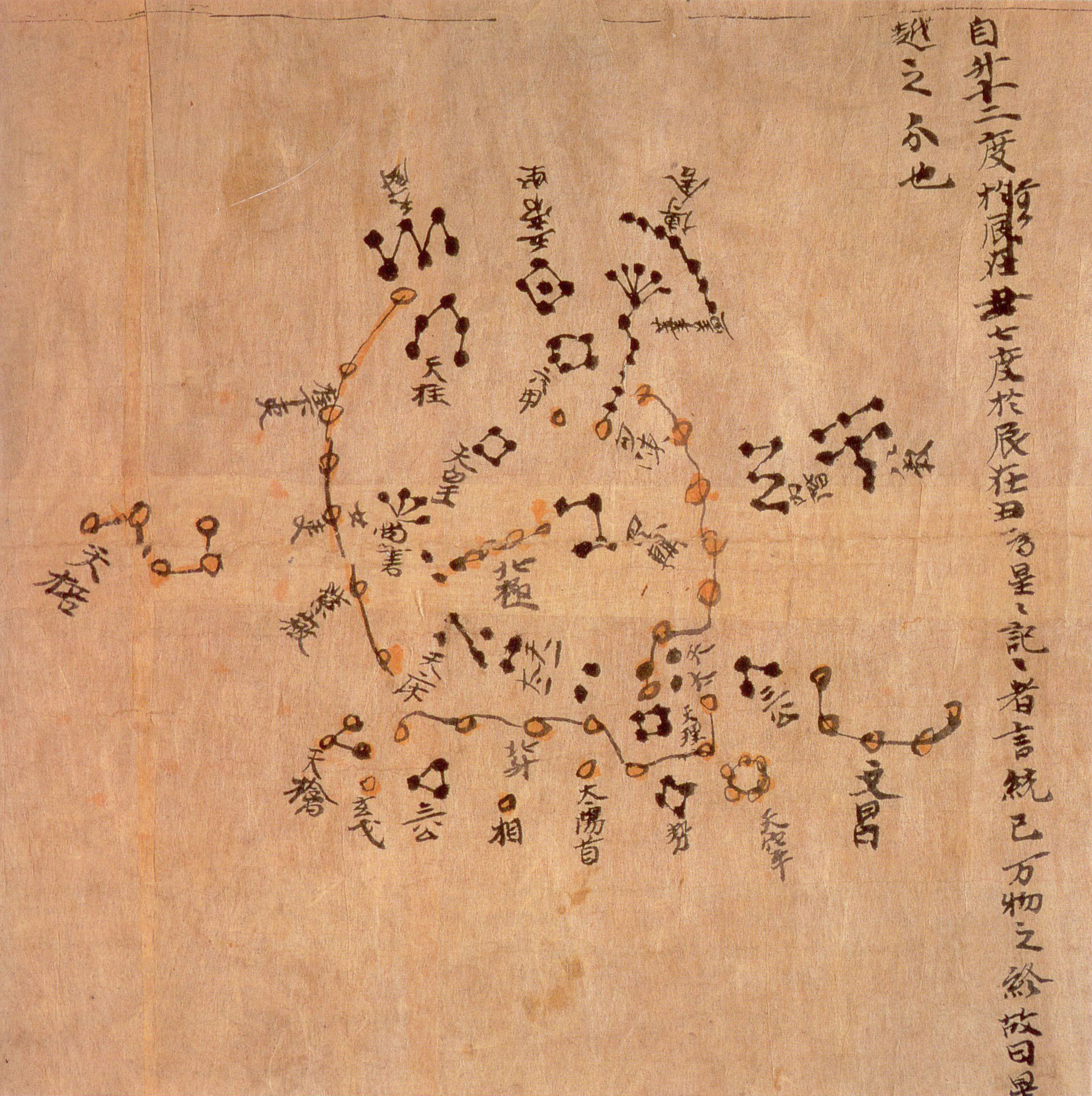
One especially striking object is the Dunhuang Star Chart, now British Library Or.8210/S.3326. The International Dunhuang Programme dates it to the second half of the seventh century and describes its exceptional place among surviving manuscript sky maps. The illustrated circumpolar detail accompanying this article shows a sky organised through named stellar groupings. It is evidence of systematic celestial knowledge, not a modern horoscope. Readers should resist treating every Chinese diagram of heaven as a Feng Shui plan: astronomy, divination and spatial traditions can share cultural assumptions without becoming identical disciplines. [3]
The revelation did not immediately produce secure, coordinated protection. Wang sought official attention, but the archive subsequently attracted foreign expeditions. Aurel Stein obtained substantial material in 1907; Paul Pelliot acquired further manuscripts in 1908. In 1910, the Qing government ordered remaining material transferred to Beijing. These movements made study possible in different institutions while separating objects from their original setting and from one another. Their history raises enduring questions about unequal bargaining power, custody, access and responsibility toward the communities connected with sacred heritage. [1, 5]
Dunhuang’s discovery matters worldwide because it complicates a simple story of separate civilisations. Languages, images and religious practices crossed borders long before modern globalisation. Today, international cataloguing and digitisation help researchers reconnect dispersed evidence, although digital access cannot restore a lost archaeological arrangement. Nor does discovery explain with certainty why the chamber was originally sealed: that remains a separate historical problem. The strongest lesson is methodological. Preserve context, compare sources and leave uncertainty visible. Hidden knowledge becomes useful history when it can be examined, questioned and shared responsibly. [6, 7]
A Feng Shui interpretation: protection, orientation and balance
Feng Shui offers a way to reflect on the relationship between people and their surroundings. Here it is an interpretive comparison, not evidence that Feng Shui caused the 1900 discovery or governed the original sealing. No building survey, reliable compass orientation or documented consultation has been established for this article. Assigning a precise bagua sector or a Flying Stars chart would therefore manufacture information rather than explain the evidence.
A landscape-oriented reading draws attention to shelter and exposure. A rock-cut chamber suggests enclosure, backing and protection; an oasis suggests the importance of water and sustaining movement. These are useful parallels with traditional concerns about terrain and qi, understood within that tradition. They do not establish that the cave was designed according to a particular school. The archive’s physical survival is instead connected with documented dry conditions and prolonged enclosure. [1]
Yin and yang provide another reflective vocabulary. Darkness, stillness and storage can symbolise a yin emphasis; discovery, circulation and public learning can symbolise yang. Neither should be reduced to good or bad. Excessive exposure can damage fragile objects, while total restriction prevents shared understanding. In this analogy, harmony means measured access with conservation, rather than a claim that opening a door released a measurable spiritual force.
For a home library or meditation corner, translate that balance into practical choices: provide comfortable light, a stable seat, clear routes and suitable storage. Protect delicate paper from moisture and direct sun. Leave enough openness for use without sacrificing a sense of refuge. A star-chart reproduction may invite contemplation, but it needs no magical promise. The most responsible interpretation joins care for place with care for knowledge.
Sources and further reading
- British Library / International Dunhuang Programme — Discovering Cave 17
- UNESCO World Heritage Centre — Mogao Caves
- International Dunhuang Programme — The Dunhuang Star Chart
- International Dunhuang Programme — What was stored in Cave 17?
- International Dunhuang Programme — IDP Collections in China (historical overview)
- International Dunhuang Programme — History of the IDP
- International Dunhuang Programme — The Mysteries of Cave 17
Let’s discuss about this here…
What Is Feng Shui? — Explore the basics and ask questions in our forum.