 English
 Français
 Deutsch
 Italiano
 Español
 Português
A route connects places, but its meaning is more than the line between a beginning and an end. It can make a next step understandable, allow a person to continue at an appropriate pace or require them to interrupt someone else’s activity for guidance. It can offer a choice without making that choice obvious. Chibagua proposes the Gentle Route as a contemporary interpretive concept organised around orientation, passage, pause and return. Gentle does not mean a physically obstructed, universally slow or decorative path. It describes a way of examining movement without treating every person as a unit that should be pushed through a place as quickly as possible. The concept is not an ancient Feng Shui doctrine, an accessibility certification or a guarantee of health or calm. Its questions belong to actual people, permissions and activities.

1. A line on a plan does not describe the whole journey
Imagine a plan showing the shortest route from a room’s entrance to a reading table. The line looks direct and efficient. A newcomer arrives, sees several tables and does not know which activity is current. A familiar participant understands the destination but wants to consult a reference before joining. A person carrying the group’s materials needs to understand where they belong afterward. All three use the same place. Their journeys are not described fully by the shortest line. The Gentle Route begins with these differences in purpose and understanding. It asks what movement connects, how the next step becomes intelligible and what expectations accompany the passage.
Distance can matter, but it is not the only question. A longer route is not automatically thoughtful; a shorter route is not automatically coercive. A direct passage may be exactly what someone needs. A choice of destination may be useful when it is real, permitted and understandable. The concept rejects universal praise for either winding or straight arrangements. A decorative detour can make a task more difficult. An apparently efficient sequence can ignore a legitimate need to orient oneself. Describe the actual journey before deciding its quality. Where does the person intend to go? What information is necessary? Who can explain? What other activities and permissions matter along the way?
A plan remains useful as one account of relationships, but it should not become a substitute for experience. The route is lived through movement, decisions, encounters and sometimes return. A person may recognise something an observer missed. Their account can challenge the first proposal without proving that the entire place is wrong. The philosophical contribution is modest: keep the line connected to the activities it serves. We can appreciate geometry while allowing people to describe what the journey asks of them. A gentle interpretation makes those requirements more precise, rather than assuming that a visually smooth route has already made every next step understandable or appropriate.
2. A contemporary extension with a cultural orientation
Columbia University’s Feng Shui teaching guide places the subject in a cultural study of landscape, people and varied approaches to place. Its Chinese cosmos materials provide historical orientation to qi, yin and yang and cosmological relations. These sources encourage a serious distinction between cultural traditions and modern interpretive proposals. They do not establish the Gentle Route as an ancient teaching or prove that a curve produces a particular state of mind. Chibagua’s concept is contemporary. Its connection with Feng Shui concerns a reflection on how people inhabit and move through places. The historical vocabulary should invite study, rather than settle today’s practical permissions through an authority it has not supplied.
The Stanford Encyclopedia of Philosophy entry on phenomenology offers a separate limited orientation. It describes philosophical attention to experience from a first-person perspective, including the meaning things have in experience and embodied or social activity. This provides a reason to study accounts of lived movement rather than reduce a journey to its appearance. It does not empirically validate our route proposal or diagnose how any visitor experiences a room. Phenomenology contains different methods and interpretations. We use this reference as an invitation to further reading, not as proof that all participants must share one experience or that a spatial arrangement determines it.
The Gentle Route therefore keeps its own questions explicit. Orientation asks how a person understands the next step. Passage asks what continuing movement permits and requires. Pause asks whether an appropriate interruption can occur without becoming obstruction or obligation. Return asks whether changing one’s mind or revisiting a reference is intelligible within the legitimate use. Those are proposed modern questions, not a historical formula. Where physical access, building safety or a specialised adaptation is concerned, the applicable expertise and requirements remain necessary. A philosophical metaphor cannot certify them. Our contribution is to connect a route’s visible form with its purposes, permissions and described experience, while keeping technical claims and historical claims distinct from that reflection.
3. Orientation concerns meaning, not only visible direction
A person sees a passage but does not know what lies at its end or whether they may continue. An arrow is visible, yet the activity it identifies is unclear. Another person understands the purpose from habit and considers the route obvious. The Gentle Route separates noticing a direction from understanding its meaning. A next step can be physically visible without being socially intelligible. Which table belongs to today’s reading? Are the materials available? Is the adjoining room reserved? A useful account includes these questions. It does not blame the newcomer for failing to infer rules that familiar participants have learned over time.
A brief explanation can make the invitation clearer: this is the current discussion, these references are freely available and that area remains reserved. The explanation does not have to turn the place into a system of instructions for every possible action. It should be proportionate to the actual activity. Sometimes a simple indication works; sometimes a person offers orientation; sometimes existing information already suffices. We cannot decide universal intelligibility from a picture. Ask what participants understand and where uncertainty remains. A route becomes more legible when its destination and permitted use are clear, not merely when a sign attracts attention.
The continuing work matters. If a visitor repeatedly needs explanation, who provides it and can they still participate in their own activity? A new sign may need updating. A verbal explanation may depend on someone remaining available. These costs belong to the proposal. The concept follows the information beyond its initial appearance. A helpful orientation can reduce uncertainty while creating a task that needs an agreement. A gentle route is therefore neither a perfectly self-explanatory room nor an endlessly attentive host. It is a specific arrangement whose next step can be understood with realistic support, appropriate permissions and a willingness to hear the experience that shows what the first explanation did not include.
4. Passage is a relationship among activities
A route through a room can pass beside a current discussion, personal materials or another legitimate use. The person moving has a purpose, but the people already there have purposes too. The Gentle Route considers these relationships without treating passage as the automatic priority over everything else. A common movement may be necessary; a particular excursion may be optional. A protected area may have understandable limits. The question is what route belongs to the actual use and what expectations should be communicated. A line on a plan cannot grant authority over personal objects or decide that every activity beside it must disappear.
This does not justify physical obstruction or replace relevant access and safety requirements. It keeps the philosophical proposal within its scope. Where a physical arrangement needs technical assessment, use the appropriate requirements and qualified knowledge. Within an ordinary agreed activity, participants can clarify sequence, destination and the relation to nearby uses. A reading gathering may need references reachable without assuming permission to examine a resident’s collection. A person may need to move through a common area without becoming available for every conversation along it. Passing a meaningful object does not automatically require comment or disclosure. The route can connect places without activating every relationship visible beside it.
A practical change can be limited. Clarify which materials belong to the activity, revise when a particular movement occurs or ask permission for a reversible arrangement. Review whether the current use remains possible and whether another person has inherited unexplained work. The route becomes more honestly described when passage, protection and participation are considered together. We do not call it gentle because it looks soft or curved. We ask whether its claims are understandable and appropriate. A direct path can meet that description, while a picturesque detour may not. The account follows what people can legitimately do, not a stylistic image that assigns the same meaning to every passage.
5. Gentle does not mean requiring everyone to move slowly
A person may want to reach a destination directly. Another wants a moment to orient themselves. Another has a task that needs a different sequence. The Gentle Route should not turn slowness into a moral requirement. It asks whether appropriate movement can be understood without assuming a universal pace. A fast transition can be legitimate; a pause can be legitimate; a particular activity may require timing. The concept considers these differences through actual purposes and agreements. It does not diagnose a person’s state from speed, and it does not promise that slow movement will create calm, concentration or a better relationship to qi.
A gathering sometimes includes an expected sequence. People need to know where to arrive and when the discussion begins. Clear timing can support participation. The difficulty arises when the organiser treats every moment of orientation as failure or every direct passage as lack of appreciation. A route’s purpose should not be confused with a desired emotional performance. A guest need not stop at each display to demonstrate care. A person who needs explanation need not hurry to confirm that the room is obvious. A specific request can be discussed without classifying one participant as rushed and another as appropriately philosophical.
The proposal is therefore about intelligible choice within legitimate conditions. If a task cannot wait, explain why. If an offered stop is optional, keep it optional. If several movements do not fit simultaneously, acknowledge the limit and discuss practical timing rather than claiming a universal harmonious pace. The route can remain direct and comprehensible while allowing relevant variations. Its gentleness belongs to the way expectations are made precise and experiences are heard. The arrangement does not own the visitor’s pace. Nor does individual preference erase shared needs. A philosophy of movement grows by describing that relationship, rather than prescribing one ideal rhythm that everyone must enact whenever they enter a place.
6. A pause is not an obstacle placed in a route
A place may offer an opportunity to consult a reference, ask a question or decide whether to continue. The Gentle Route calls this an appropriate pause only when it is actually compatible with the legitimate passage and activities. It does not recommend placing objects in required movement areas to force people to slow down. A pause is a permitted interruption, not a barrier used to manufacture an experience. The distinction matters because an attractive idea about contemplative movement can become a practical difficulty. A physical obstruction does not become desirable merely because someone describes it as thoughtful friction or symbolic protection.
A pause can be informational rather than spatial. Before a discussion begins, someone clarifies which references are optional. A visitor understands that they may consult a text later. The person’s movement can continue while a future possibility remains open. In another situation, an agreed place and moment for a question may be useful. Specific physical adaptations require appropriate knowledge; our metaphor is not a technical design rule. The philosophical question is whether the interruption is meaningful, permitted and proportionate, and whether it leaves other legitimate uses possible. An invitation to stop must also allow continuing where stopping is genuinely optional.
Maintenance and timing belong to this question. Who explains the pause, keeps the reference available and knows when it no longer fits the activity? A possibility that becomes compulsory changes its relationship. A stop that blocks another person’s task may need a different moment. The concept does not insist that every route contain a pause. Some ordinary journeys need clear uninterrupted continuation. Others benefit from an understandable option. The answer comes from the activity and participants. Gentle movement includes the freedom to recognise when pausing is useful and when it is unnecessary, instead of using an ideal of slowness to justify interventions that people did not request or permit.
7. Returning can be part of a journey rather than evidence of failure
A newcomer reaches the discussion and realises they need to consult the reference they passed. A participant changes their mind about an optional activity. Someone returns to clarify information before continuing. These ordinary movements can be described as part of the route rather than automatic failures of orientation. The Gentle Route asks whether a legitimate return is intelligible. Where may the person go, which materials are available and what activity remains protected? The question does not require unlimited movement through every space. It recognises that understanding and choice sometimes develop during the journey rather than being complete at its beginning.
An organiser can clarify a return without demanding an explanation of private motives. These books remain available after the reading; the next activity begins elsewhere; that collection stays protected. The information gives a specific option. It avoids turning every change of mind into a test of loyalty or competence. At the same time, a return may affect a shared commitment. If someone accepted a role needed now, a change needs understandable communication. The concept distinguishes a free option from a responsibility. It does not make all expectations disappear. It keeps their actual consequences precise so that a person can revise a choice without pretending the revision has no effect on others.
This question expands a route beyond a one-way arrow. A place of learning can support revisiting, asking again and arriving at a different understanding. The practical form may be simple: a clear reference and an agreed later moment. It may need no new furniture. Review whether the option was understood, whether other uses remained possible and whether a person had to carry excessive explanatory work. A route is not more gentle merely because it contains many choices. Too many unexplained possibilities can obscure the next step. It becomes more intelligible when the relevant choices and responsibilities are clear, including the ordinary possibility that a person will return to something before they can continue.
8. A choice must be real and understandable
A room appears to offer several destinations, but all except one are actually reserved. Another place offers optional references, yet visitors are expected to examine them before joining. The Gentle Route asks whether a choice is real in the relevant sense. An apparent option is not enough. The person should understand what is available, what is required and what consequence follows. This is a contemporary interpretive question, not a legal ruling about every setting. It aims to keep the invitation’s language consistent with the practical permissions. A route can look open while its expectations remain narrow and unspoken.
Fewer options can be perfectly appropriate. A current activity has a particular destination; protected places remain outside it. Clarity about those limits can be more useful than pretending every direction is equally available. The concept does not demand maximum choice. It asks for the relevant choice to be intelligible. A visitor may be told that today’s reading begins here and that later consultation is optional. A participant may be told that a task must be completed before a shared next step. Such explanations distinguish purpose from decorative possibility. They let a person understand the route without guessing which visible invitation secretly carries an obligation.
Review follows actual experience. Did people understand the option? Could they decline where it was free? Did a required task have its reason and timing explained? Did an organiser need to correct the same misunderstanding repeatedly? These questions can lead to a proportionate adjustment. They do not produce a universal score of autonomy. A clearer invitation may be enough. A proposal might also be withdrawn when the intended choice is not practically available. The philosophical contribution is honest description: a route should not advertise freedom that the activity cannot provide, nor hide a legitimate limit behind an aesthetic image of effortless openness.
9. A familiar route and an intelligible route are different
Regular participants know where to go, how to use materials and when a room changes activity. Their movement looks effortless. A new person lacks that history and asks questions. The Gentle Route treats the difference as information about familiarity, not as evidence that one person understands harmony and another does not. Habit can support continuity. It can also make missing explanations difficult for an organiser to notice. A path becomes socially intelligible through information that a plan and a familiar observer may not contain. The next step should be examined from the relevant participants’ accounts, without presuming their private experience from their visible hesitation.
The response may preserve the familiar arrangement while adding a small orientation. The current table is named; available references are identified; a reserved area is explained. The aim is not to eliminate history or regulate every movement. It is to distinguish what is already known from what a new person needs to learn. A person may prefer a direct explanation rather than an elaborate set of signs. Another may need information they can consult at their chosen moment. The actual invitation and capacity for support should guide the answer. Familiar ease is valuable, but it should not become proof that everyone has received the same knowledge.
Continuing work must remain realistic. A change should not require one participant to escort every movement unless that role has genuinely been agreed. A visible indication may need maintenance, and a repeated explanation may need a different form. The route is gentle when support is understandable and proportionate, not when an invisible helper absorbs every gap. A relevant later review can ask whether new participants could continue and whether the arrangement stayed useful for the regular group. The concept leaves room for several accounts and limited answers. It does not turn one newcomer’s experience into a universal verdict, but it does let that experience add something the habitual view had missed.
10. Movement can carry work as well as people
A journey through a place may involve retrieving books, restoring materials or carrying information between activities. A visitor sees an uncluttered route, while someone else repeatedly moves what the activity needs. The Gentle Route includes that continuation. A clear path may be useful, but its maintenance does not happen automatically. Who keeps materials available, explains their location and returns them afterward? A change that improves one person’s journey can add work to another. The concept asks us to describe this transfer rather than call every visible simplification a reduction of effort. A route connects tasks as well as destinations.
This does not condemn organisation or every relocation. Materials can be unnecessary or better arranged elsewhere. A chosen role can support a valuable activity. The question is whether its scope is recognised and practicable. If all references are removed for a clear appearance, participants may need repeated retrieval. If someone becomes responsible for those requests, did they agree? If a route’s orientation depends on constant personal explanation, can the explainer still participate? Such questions follow direct and foreseeable consequences. They prevent the route from being assessed only at the moment when it looks ready, before its ongoing tasks and effects are known.
A proportionate answer may preserve an available reference, simplify the preparation or clarify a time for restoring the place. It may retain a selected responsibility with understandable limits. There is no universal assignment formula. The relationship belongs to the real group, permissions and activities. A review can recognise that a visually unchanged route now carries a clearer agreement, or that an attractive proposal is too demanding to continue. Both findings matter. The Gentle Route deepens a philosophy of movement by keeping its visible passage connected to the work that makes passage useful. It asks who is moving, toward what, under which expectations, and what continues after the person reaches the destination.
11. A route should not turn private life into a public exhibition
A route through a shared home can pass near a resident’s desk, photographs or unfinished letter. That proximity does not make these things an invitation to examine them. The Gentle Route distinguishes being able to pass from being invited to participate. A person may welcome a guest to a meal while keeping a personal project outside the visit. The guest needs enough orientation to reach the agreed destination without having to interpret every object along the way as available for discussion. The resident also needs an arrangement that does not depend on repeatedly apologising for ordinary private activity.
Consider a fictional household that hosts a small reading group. Its most direct route to the meeting room passes beside a table used for correspondence. Moving the whole table before every meeting is burdensome. Asking guests to use another route may create difficulties elsewhere. The group should examine its actual options rather than assume that privacy always demands removal. An understandable agreement about the destination, a different position for sensitive papers, or another arrangement chosen by the person concerned may help. The appropriate response depends on the home and its users. Nothing in the concept licenses a host to disregard physical access or emergency requirements.
The same distinction applies to a visitor who pauses. A pause to find the meeting information does not create permission to read a nearby document. Likewise, an object that happens to be visible need not become a required conversation. A respectful route allows attention to remain relevant to the journey. This matters because a philosophy of openness can otherwise become a demand that everyone disclose their life through the arrangement of their space. Openness should have a purpose and limits. A place can be hospitable while recognising that some relationships are not part of the current visit.
12. A garden image invites interpretation without becoming a design rule
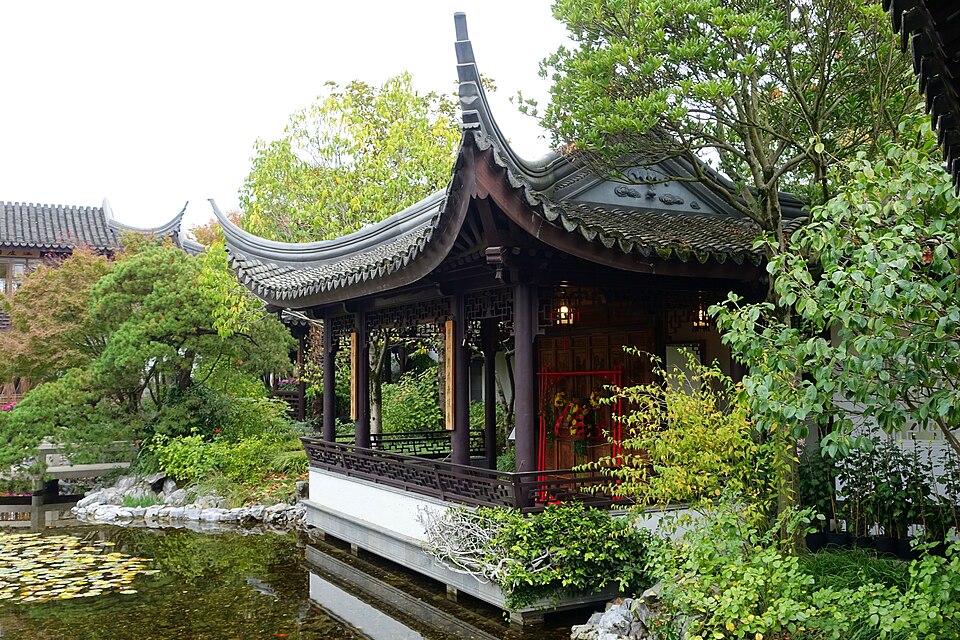
The photograph accompanying this article shows a pavilion, bridge and pond in Lan Su Chinese Garden in Portland. It offers a visible example of movement among distinct features. A bridge connects locations; a pavilion suggests a place whose use differs from crossing. The photograph may encourage a reader to notice relationships between passage and staying. It cannot tell us every visitor’s experience, the garden’s complete circulation arrangement, or whether a particular design would suit another site. It is an illustration, not evidence that a curved route produces a universal emotional effect.
Looking at the image, a reader might ask which feature first draws attention and how the visible relationships make the scene legible. Another reader may attend to the water or the surrounding planting. These interpretations need not agree. The exercise becomes more useful when it returns to actual circumstances: what destination is relevant, what may be approached, and what permissions or information shape the visit? A photograph provides only a selected view. Features outside its frame may be decisive for someone using the real place. We should resist turning an attractive composition into a comprehensive instruction.
In a small apartment, adopting the image literally could consume space without answering any useful question. The transferable idea is modest: different activities can have different relationships to movement, and a journey can include a chosen occasion to stay. Even that idea must be tested in context. A household might improve orientation with a clear explanation rather than a new physical feature. The garden remains culturally situated and materially specific. Respecting that specificity gives the illustration more meaning than treating it as a catalogue of objects to imitate.
13. Case study: arriving at a community reading session
Imagine a fictional community association that organises a weekly reading session. Its entrance leads to a room containing a reference shelf, a central table and an organiser’s working area. Regular participants know that books on the shelf may be consulted, that the central table is used for the current discussion, and that the organiser’s papers are reserved. New visitors see the same room but do not know these distinctions. Some stop near the working area because it looks like a reception desk. Others take a book to the table and discover that the group has already selected a different text.
The association first describes the situation without blaming newcomers. Its own familiarity has hidden the orientation work that each new person must perform. The desired destination is participation in the reading session, but participation can begin through several legitimate actions. A visitor may want to consult the reference material before joining, sit down immediately, or learn whether the session suits their interests. The organisers decide which choices they can actually offer. They avoid announcing an optional preliminary activity if the session later treats it as compulsory preparation.
A limited revision explains the current session at the point where visitors ordinarily seek information. It distinguishes the common references from the organiser’s working papers and indicates how a visitor can ask a question. The association retains a way to consult material without interrupting the discussion. It also states what happens if someone decides not to participate. This does not require a theatrical welcome or a journey through every feature of the room. It requires a relationship between the information offered, the choices available and the activity underway.
After two sessions, the organisers review concrete experiences. One visitor found the reference option useful; another wanted a quicker answer about the meeting’s timing. A regular participant noticed that handling preliminary questions repeatedly interrupted their preparation. The arrangement is revised again to clarify who handles that task and when. The Gentle Route has not proved that the association is inclusive in every respect. It has made a specific sequence more understandable and exposed a responsibility that previously remained invisible. That is a substantial outcome without claiming a transformation of every participant’s feelings.
14. Case study: moving between domestic activities
In a second fictional example, two residents share a small room for eating, occasional work and storing materials for a creative project. One person prefers to put the room in order before dinner; the other wants to preserve the sequence of an unfinished task. A route to the dining position passes the project materials. What looks like clutter to one resident functions as an arrangement of references for the other. Neither description alone settles the relationship. The question concerns passage, available space, continuing work and the responsibilities that a proposed change would create.
They begin by distinguishing what must remain available for legitimate movement from what can be reconsidered. Technical requirements, where relevant, require appropriate knowledge rather than philosophical guesswork. Within their actual options, they identify a small selection of materials whose order matters and other objects that can be moved without disrupting the task. They also clarify who restores the working arrangement and when. The route should not become usable only because one person performs unacknowledged preparation every evening. Nor should preserving a project indefinitely eliminate the other person’s agreed use of the room.
Their first agreement is a trial. The project’s current references remain together in a chosen place, while the dining arrangement is prepared at a known time. They include a way to ask for an exception without treating every exception as a moral failure. A deadline week differs from a habitual claim over the room. After trying the arrangement, they discover that the chosen storage position makes returning to the work difficult. They change it. This finding does not mean that respect for the project was mistaken; it means that their first proposal did not adequately account for continuation.
The Gentle Route helps them interpret movement as a sequence that includes departure from work, participation in dinner and possible return. It does not decide whose preferences should prevail. Its value lies in asking what each stage requires and how the costs are distributed. A harmonious presentation cannot replace that discussion. A photograph of an orderly room would show only one moment, while the important relationship unfolds across several activities and times.
15. Case study: a visitor who needs to leave and return
A fictional workshop offers a discussion followed by practical work. Participants may need to leave the activity temporarily to make a call, consult a personal reference or attend to another commitment. The organiser says that leaving is allowed, but the route back is unclear. Returning participants do not know whether to interrupt for instructions, resume their previous place or wait until the group changes tasks. The stated freedom exists, yet using it involves uncertainty. A participant may remain present merely to avoid the awkwardness of returning.
The organiser considers the sequence from the participant’s perspective without pretending to know everyone’s reasons. No one must disclose a private explanation simply to understand the ordinary return procedure. Some stages of the workshop may involve legitimate constraints, and these should be stated accurately. If joining a practical task after it has begun requires a further explanation or cannot occur immediately, the organiser should clarify that condition. An unrestricted promise would be misleading if the activity cannot support it.
The revised arrangement explains how a returning participant can identify the current stage and obtain relevant instructions. It names a person or reference that can realistically provide that information. It also avoids making another participant abandon their work every time someone returns. During review, the group asks whether the procedure worked when actually used. If nobody used it, that absence cannot prove that the arrangement was successful or unnecessary. It may remain an untested proposal. The organiser can record that limit without pressuring participants to demonstrate its use.
Here the Gentle Route concerns continuity through an interruption. The aim is not to eliminate every consequence of leaving. It is to make those consequences understandable and proportionate to the activity. A person’s temporary absence should not automatically be interpreted as indifference, and returning should not require a performance of guilt. These are contemporary ethical questions about participation. They do not derive their authority from a claim that an ancient spatial formula guarantees modern social behaviour.
16. Time belongs to the route
A route may be physically available while its destination is unavailable at the relevant time. A reference room might be open only before a session; a host may be able to answer questions after preparing an activity but not during preparation. Orientation therefore includes timing. The Gentle Route asks when a choice exists, how long an activity is expected to take, and what changes if someone arrives at a different moment. These questions do not require precise prediction of every journey. They require honesty about conditions that materially affect participation.
Suppose a community organiser tells visitors that they can consult the reference table whenever they wish. In practice, the table is cleared during the main activity. The difficulty is not necessarily the decision to clear it; the activity may need the space. The difficulty lies in the promise. A more accurate description explains the available period and any later alternative. Someone who arrives late can then understand the current arrangement without being treated as inattentive for expecting an option that was advertised without a limit.
Time also affects responsibility. Preparing a route or information point takes effort at a particular moment. A proposal that appears easy during a planning discussion may conflict with the organiser’s existing work. Review should therefore include the sequence of preparation, use and restoration. If the arrangement depends on one person arriving much earlier, that cost deserves discussion. A gentle journey for the visitor should not rest on an unexplained demanding journey for somebody else. The concept remains relational because it considers both the visible passage and the work that supports its availability.
17. Practising observation without scoring other people
A useful exercise begins with one ordinary, agreed journey: entering a room to consult a book, moving from a work position to a shared meal, or finding information before joining an activity. Describe the destination and the permissions that already exist. Do not assume that every visible object is available or that another person’s activity can be reorganised for the exercise. Where technical access or safety is involved, use relevant requirements and qualified knowledge. The philosophical exercise concerns meanings and agreements within appropriate conditions.
Next, describe the information needed along the sequence. What does a newcomer need to know before making a choice? Where could the person pause without imposing an unwanted task or interfering with legitimate passage? What happens if they decide to return to an earlier stage? These are questions, not a checklist that gives a room a universal score. Write down uncertainties as uncertainties. If you do not know whether an activity can be interrupted, ask the person responsible rather than inventing an answer from the appearance of the space.
Propose one limited revision and identify its maintenance. An explanation, an agreed time or a clearer distinction between common and reserved material may be more useful than moving furniture. Agree how the proposal can be reconsidered. During review, ask about actual experiences without demanding that everyone report the same benefit. An arrangement may help one journey and complicate another. That finding calls for thought, not for averaging away the difference. The exercise succeeds when it produces clearer understanding and a revisable decision, even if the group ultimately retains its earlier arrangement.
18. Recognising the limits of the concept
The Gentle Route is a framework for interpretation, not a certification of accessibility, a building specification or a treatment for distress. A clear explanation cannot correct every physical barrier. A welcoming agreement cannot replace an emergency provision. Nor does an attractive journey demonstrate that everyone feels welcome. These limits are not reasons to abandon philosophical reflection. They establish where reflection can contribute and where another form of knowledge, authority or practical work is necessary.
The concept also has social limits. A person may lack the authority to change a route, the resources to create another option, or the capacity to maintain additional information. Saying that a journey should be gentle does not make those constraints disappear. A responsible proposal recognises the available scope and avoids blaming individuals for conditions beyond their control. A small clarification may still matter, but it should be described as a small clarification. Modest evidence supports modest conclusions.
There are situations in which choices must be constrained for legitimate reasons. The relevant question is then how accurately those constraints are explained and how their consequences are addressed. Gentleness does not mean that all destinations are open to all people at all times. It means that movement should not be burdened with avoidable confusion, concealed demands or unnecessary judgments about the traveller. Whether a particular demand is necessary requires contextual reasoning. The framework invites that reasoning; it does not predetermine the answer.
19. Connections with Chi, Bagua and the wider collection
Within Chibagua’s contemporary interpretation, Chi can prompt attention to what continues across a sequence: an activity, a relationship, a responsibility or a returning task. This is a philosophical use of the term, with its cultural context kept visible. It does not equate Chi with a measurable property of a corridor. The Gentle Route asks how a journey supports or disrupts continuity in circumstances that can actually be described. An unfinished task, for example, may require references to remain understandable when a person comes back.
Bagua can serve here as a map of questions rather than a device that determines a traveller’s fortune. A reader might reconsider the same route through the concerns of participation, care, memory or shared responsibility. Different questions reveal different relationships; they do not create a universal answer from a diagram. The method is most useful when the questions return to actual users, permissions and activities. A symbolic interpretation that ignores those circumstances risks becoming an attractive explanation of a place nobody really uses in the described way.
The Gentle Route develops earlier ideas in the collection without replacing them. The Hospitable Threshold concerns arriving and departing; this article follows the sequence beyond that initial transition. The Restorative Interval concerns an occasion to pause; here a pause must remain compatible with passage and the possibility of continuing. The Shared Centre concerns a common reference; a route connects people with that reference under specific conditions. These concepts can work together while retaining distinct questions. Their usefulness depends on whether the distinctions help people understand a concrete situation, not on multiplying philosophical labels.
20. A conclusion that remains open to the next journey
A route is gentle when its purpose, permissions and relevant choices are understandable, when opportunities to pause are real rather than obstructive, and when returning can be considered without needless judgment. This is an aspiration to examine, not an outcome that a name guarantees. The simplest-looking route may work well; another situation may require a different sequence. Curves, decorative objects and visual simplicity have no automatic moral status. What matters is the relationship between a journey and the people, activities and responsibilities it connects.
The contemporary contribution of the Gentle Route is to include orientation, passage, pause and return in one conversation. It asks what a person needs to understand before moving, what others need while the person passes, what a chosen pause involves, and how continuation remains possible. It also asks who prepares and maintains those conditions. The answers may reveal a useful physical revision, a clearer agreement or a limit that must be acknowledged. None should be treated as a universal prescription for every home or community.
Readers can begin with one real sequence and one honest question. They need not redesign an entire place or turn their life into a display of philosophical consistency. A small, revisable agreement can expand understanding when it makes a previously hidden relationship visible. Feng Shui philosophy, approached with cultural care and a clear distinction between historical sources and contemporary proposals, can encourage such attention. Chibagua’s Gentle Route offers one way to continue that inquiry while leaving room for the next person, the next activity and the next reconsideration.
Sources and image credit
- Columbia University, Teaching Guide: Feng Shui. Cultural and historical orientation; the Gentle Route is Chibagua’s contemporary proposal.
- Columbia University, The Chinese Cosmos. Background for distinguishing culturally situated cosmological ideas from modern practical interpretation.
- Stanford Encyclopedia of Philosophy, Phenomenology. Background for the brief discussion of meaningful first-person experience; it does not validate the practical proposals or imply clinical or physical performance claims.
- Daderot, Lan Su Chinese Garden photograph, Wikimedia Commons. Released under CC0 1.0. The image illustrates relationships among passage and places to stay; it is not a universal design model.
What Is Feng Shui? — Explore the basics and ask questions in our forum.