 English
 Français
 Deutsch
 Italiano
 Español
 Português
Imagine arriving home after an absence. The room has not moved, yet returning to it is an activity with its own requirements. You need somewhere to begin, a way to recover unfinished things, and permission to discover that your needs have changed. A place can welcome an initial visit and still be difficult to return to. This article introduces chi, also written qi, through cultural context and then develops a new Chibagua concept: the Rhythm of Return. It asks how places make repeated participation possible through preparation, use, pause, care and renewed access. The concept is our contemporary philosophical proposal, not an ancient Feng Shui doctrine or a method for measuring invisible energy. Its subject is the difference between constant movement and a relationship that can continue without exhausting the conditions on which it depends.

1. A place is more than its busiest moment
A photograph of a lively room can encourage the assumption that vitality means visible activity. People are speaking, a table is occupied, doors are open and movement fills the scene. Nothing in that image tells us whether the room will remain usable afterward. Someone must clear a surface, preserve unfinished work, restore an essential object or find a moment of quiet. The lively scene depends on a less visible interval. If the interval is repeatedly neglected, the next activity may become more difficult. A philosophy concerned with vitality should therefore include what happens when the visible excitement ends.
The Rhythm of Return begins by changing the question. Instead of asking only whether a room encourages action now, we ask whether people can come back to it under reasonable conditions. Coming back may mean resuming a book, preparing another meal, welcoming the next visitor or recovering a private moment. Each example contains a relation between one use and another. The room is not a container that remains untouched while life occurs inside it. Its availability is affected by use, and its meaning develops through the ways that use is continued, concluded or renewed.
This does not make a quiet room philosophically superior to a busy one. A celebration may be exactly what the inhabitants want. The question concerns whether the relationship includes the work and space that make further participation possible. A temporary disruption can be welcome when people know how it will be handled. An apparently calm arrangement can be burdensome when someone must constantly repair it in secret. We need an account broad enough to include celebration and preparation, solitude and reopening, disruption and the resources required to respond.
Our inquiry is therefore temporal. A place has an earlier condition, a present use and a possible return. Looking across these moments reveals something that a single attractive arrangement cannot show. The new concept offers a way to describe that sequence without ranking rooms by their appearance. It asks what must remain available, what may be transformed and whose contribution links one moment to the next.
2. Introducing chi without reducing its cultural range
Chi is frequently introduced through the English word energy. Columbia University’s Fengshui teaching guide uses that introductory rendering. Its material on Chinese cosmology also discusses the difficulty of translation and presents qi within a larger historical worldview. The important lesson for this article is modest: the term has a cultural range that cannot be exhausted by a household slogan. A beginner can use an introductory translation while recognizing that deeper study may complicate it. The word should remain connected to that history rather than becoming a decorative synonym for whatever the writer happens to prefer.
This article does not attempt to reconstruct every interpretation of qi. Nor does it claim that an ordinary description of room use measures qi as a physical substance. When a person says a place feels lively or draining, they are reporting experience. The experience may be worth examining, but the report does not automatically establish a technical explanation. We can ask what happens, when it happens and what supports it without pretending to possess a measurement that we have not performed.
The Rhythm of Return uses chi as a philosophical prompt toward sustaining and renewing participation. That is Chibagua’s interpretive decision. The cultural sources provide background; they do not endorse the new concept or its examples. Readers interested in a particular historical practice should study that practice on its own terms. Readers interested in our proposal can judge whether it helps them describe their place more clearly. These are related interests, but their responsibilities differ.
This distinction allows the article to be both respectful and original. Respect does not require repeating familiar claims without scrutiny. Originality does not require pretending that a modern framework was always present in the tradition. We can acknowledge an inherited vocabulary and state openly what we are adding. The concept succeeds, if it succeeds, through the understanding it brings to a specific relationship between people, activities and place.
3. What does the Rhythm of Return mean?
Return is not simply arriving at the same coordinates twice. Someone can enter the same room and find that it no longer offers access to an activity they value. The materials have been moved, an agreement has changed, or the time previously available has disappeared. Conversely, a changed room can support a meaningful return when the important relationship has been preserved. The object positions differ, but the person can still recognize how to participate. Our concept concerns this renewed participation rather than exact repetition of a visual scene.
Consider an unfinished drawing. Returning to it requires more than preserving the sheet. The person needs to find it, understand where they stopped and have enough opportunity to begin again. A surface can be cleared beautifully while making that return difficult. A modest folder with a clear destination may protect the activity better than an impressive display. The philosophical issue is continuity across an interval: how does an earlier action remain connected to a later possibility without demanding that the whole room stand still?
Return also includes consent. Someone may choose not to resume an earlier activity. A place that insists upon repetition can become a burden rather than a support. The Rhythm of Return offers a possibility, not a command. Its questions should help people decide what they want to carry forward and what they are ready to conclude. A meaningful past does not create an unlimited obligation to reproduce itself. The ability to begin differently belongs alongside the ability to resume.
We therefore distinguish returning, repeating and restarting. Returning preserves a recognizable relationship; repeating reproduces a particular action; restarting begins after a break that may have lost some continuity. None is universally better. The distinctions help us understand what a place asks of its inhabitants. A framework expands comprehension when it makes those differences discussable, especially when several people share the resources needed for their different forms of return.
4. The five moments of the Rhythm of Return
Our proposal describes five moments: readiness, participation, pause, renewal and invitation. These are not the traditional five phases of wuxing, and their number creates no historical equivalence. They are a practical structure created for this article. Readiness means that a place offers conditions for beginning. Participation is the activity itself. Pause leaves an interval that does not necessarily erase the activity. Renewal addresses what must be restored or changed. Invitation makes further participation understandable and optional. The moments can overlap, and some situations need simpler language.
At a shared worktable, readiness might include an available surface and recognizable materials. Participation involves the work performed there. Pause may involve keeping unfinished work in a way that others understand. Renewal could include clearing debris, returning tools or adjusting an expectation that proved unrealistic. Invitation means that the next person can recognize whether the place is available and how their use fits. The framework includes physical conditions and social agreements because neither alone explains the whole relationship.
The order is not a rigid cycle imposed on every activity. Someone can pause and then decide that no return is wanted. Another person can enter during renewal and help change the arrangement. A household may have several overlapping sequences. The framework becomes unhelpful if its categories obscure these differences. Its purpose is to reveal the neglected moment, not to make every experience fit a perfect diagram. We should be able to modify the description when the place gives us better information.
The central question is whether one moment consumes the possibility of another without that consequence being acknowledged. A busy use that leaves no reasonable renewal may borrow effort from someone else. An expectation of constant readiness may prevent inhabitants from using their home freely. A pause treated as abandonment may destroy unfinished work. Naming the moments helps us compare these demands and discuss what a sustainable relationship would require.
5. Readiness in the Rhythm of Return is not permanent perfection
Readiness can be mistaken for a room kept immaculate at every moment. That interpretation gives priority to a hypothetical next activity over the one actually occurring. A household becomes a permanent waiting room for visitors, while its inhabitants hesitate to use their own surfaces. The Rhythm of Return asks for appropriate readiness, not universal readiness. A place needs to be available for a particular use under understandable conditions. It does not need to support every imaginable activity at once or remain visually untouched by ordinary life.
For example, a corner used for sewing can remain visibly occupied while being ready for the person who uses it. The needed materials are identifiable, incomplete work is protected and the next step is understandable. The same corner may not be ready for another task, and that limitation may be entirely reasonable. In a shared setting, the issue is whether access and transitions have been agreed. Readiness belongs to a relationship between a place and its participants, not to an abstract appearance of emptiness.
This distinction changes the conversation about disorder. A surface holding active work is different from a surface whose contents have no clear future. The difference cannot always be read from a photograph. We need to ask what is happening and whose task is involved. The new concept does not require celebrating every accumulation. It asks us to identify the relationship before deciding what should happen to its materials. A useful response can preserve an activity while making its boundary clearer.
Appropriate readiness also has limits of resources. A small room may require a transition before another use can begin. Acknowledging that interval is more honest than pretending that the space offers instant availability. If the transition repeatedly falls to one person, that responsibility belongs in the agreement. Readiness should support participation, including the participation of the people who prepare the setting, rather than becoming an invisible demand that they must satisfy indefinitely.
6. Participation in the Rhythm of Return changes the place
Use is not a disturbance that occurs after a perfect design has been completed. It is part of what gives the design meaning. A table becomes marked by projects, a route is understood through movement, and a room acquires associations through encounters. These changes are not automatically losses. They can make a place more recognizable and valued. The Rhythm of Return considers participation a source of information: what does actual use reveal that the initial plan did not include?
Imagine a newly arranged reading corner. Its owner discovers that the intended shelf is inconvenient at the moment of choosing a book. Another resident notices that the chair complicates an evening task. A child uses the low surface for a different purpose. These experiences show relationships that were absent from the attractive starting image. The appropriate response is not necessarily to restore the image after every deviation. It may be to examine which changes improve use and which create difficulties that need discussion.
Participation also changes meaning. An inherited table may carry one story before a gathering and additional stories afterward. A place used for quiet work may become associated with helping someone learn. Such meanings do not require a universal symbolic classification. They emerge through the people and events that make the place particular. A philosophy of renewal should leave room for this accumulation of significance, rather than assuming that return always means removing every trace of what happened.
The question is how participation affects future access. Some traces are welcome, some are inconvenient and some need agreement. A mark valued by one person may trouble another; a completed project may deserve a temporary display without claiming permanent ownership of a shared surface. Our framework holds appreciation and responsibility together. It asks what the use contributed, what it changed and what must be considered before the next invitation becomes possible.
7. Pause is a meaningful part of the Rhythm of Return
A pause can look like nothing happening. That appearance hides its role in connecting activities. A person sets aside a task because another responsibility begins, because they need time to think or because the material requires a later decision. The interval does not necessarily mean failure or abandonment. It can preserve an unfinished relationship. A place that permits pauses gives people a way to stop without losing everything needed to return. That possibility is different from requiring permanent activity.
Consider someone writing a difficult letter. The work may benefit from being left alone for a while. The setting need not keep the entire desk reserved indefinitely, but the draft should remain recoverable if the person wants to resume. A folder, an agreed storage place or an explicit understanding can support the pause. The philosophical question is what should remain connected across the interval. The answer may concern materials, memory, privacy or the right not to finish immediately.
Pauses require communication in shared places. One person sees a half-finished project; another sees a surface that seems unused. Both can act from reasonable assumptions and still conflict. A small signal or conversation can make the situation clearer. It should not give the first person unlimited rights over common space, nor allow the second to erase the task without consultation. The framework asks how a pause is recognized, how long it is reasonable in that context and what alternatives exist.
A place that cannot accommodate any pause may repeatedly force people to start from nothing. A place that treats every pause as an indefinite reservation may exclude others. The Rhythm of Return attends to the difference. It does not prescribe a universal duration. It asks for arrangements that keep unfinished participation understandable and negotiable. The interval becomes part of the place’s life, deserving attention rather than being classified automatically as either inactivity to eliminate or privacy that no one may question.
8. Renewal in the Rhythm of Return includes work and responsibility
Renewal is the moment when conditions for further use are restored, adapted or reconsidered. It may involve cleaning, putting something away, replacing a consumed resource or changing an expectation. The word can sound gentle while the work is demanding. We should therefore ask who performs it. If an arrangement depends on someone repeatedly renewing the setting without acknowledgment, its apparent ease is misleading. The place may support the visible participants while burdening the person who makes their repeated participation possible.
A shared kitchen provides a clear example. Preparing a meal changes the availability of tools and surfaces. Returning them to use requires effort. An attractive photograph after cleaning does not show how responsibilities were distributed. Our concept asks whether renewal is included in the understanding of the activity. Does the person who uses something recognize what their use leaves behind? Can responsibilities be discussed and adjusted? The answer concerns a relationship, not the moral worth of a tidy or untidy individual.
Renewal can also be excessive. A rule requiring every object to return to a precise display after any small use may create more labor than the household wants. The effort should be compared with what it preserves. Some arrangements are worth careful maintenance because people value them. Others can be simplified. The framework does not assume that a more elaborate setting is a better setting. It asks whether the commitment remains acceptable under real conditions, including periods when time or resources are limited.
This makes renewal a philosophical question about sufficiency. What needs to be restored for the next use, and what is merely an expectation inherited without discussion? The distinction can release people from maintaining an appearance that no longer serves them. It can also explain why a small act of care matters. Renewal is not automatically erasure. It can preserve traces, adapt conditions and acknowledge contributions while leaving the place available for its continuing life.
9. Invitation in the Rhythm of Return makes returning optional
A place can be physically available and socially difficult to enter. Someone does not know whether the chair is reserved, whether a conversation welcomes interruption or whether tools may be shared. Invitation concerns this legibility. It does not mean every place must be open to everyone at every moment. It means that the relationship between availability and participation should be understandable to those concerned. Privacy, ownership and shared access need language or signals that people can reasonably interpret.
In a family room, a familiar arrangement may be obvious to long-term residents but confusing to a visitor. An invitation can be a spoken explanation, an accessible place for ordinary belongings or a clear distinction between shared and personal materials. The gesture should suit the circumstances. A beautiful entrance without understandable expectations may still make someone hesitant. A modest space can be welcoming when the person knows where to begin and whom to ask.
The Rhythm of Return includes renewed invitation because circumstances change. A person returning after an absence may not know that an earlier agreement has been revised. A place that welcomes continuity should allow that information to be received without embarrassment. Similarly, an earlier participant may no longer want the same relationship. Invitation must not become pressure. Preserving the possibility of return differs from insisting that people continue a role they have outgrown or a routine they no longer choose.
We can evaluate invitation by asking whether a participant understands the available options. Can they enter, pause, decline or suggest a change? The framework does not require limitless flexibility. It asks for clarity about the actual possibilities and constraints. A legible boundary can be kinder than an ambiguous promise. The place supports return when people can recognize how they relate to it now, rather than being expected to remember an unspoken rule or repeat a past role automatically.
10. A worked example: the kitchen that borrows tomorrow
Imagine a fictional household that enjoys preparing an elaborate meal together. The evening feels generous and animated. By the end, however, every practical surface is occupied and the next morning’s routine has become difficult. One person rises early and restores the room before the others notice. The celebration was real, and so was the hidden transfer of work. The Rhythm of Return asks us to describe both without treating either as the whole truth of the kitchen.
Begin with readiness. What was available before the meal, and what did the participants assume would be available afterward? Participation reveals which tools and surfaces the meal required. Pause concerns what can safely wait and what needs attention sooner. Renewal identifies the work and the person carrying it. Invitation asks whether the next user can recognize how to begin. The five questions expose the relation between a memorable evening and an ordinary morning. They do not require concluding that the elaborate meal should never happen again.
A useful response might be an agreed division of renewal, a simpler preparation on particular evenings or an explicit decision to accept a delayed reset. The best choice depends on the people and resources involved. If the same person must always restore the room, the arrangement should not be described as effortless communal vitality. If everyone genuinely values the occasion and accepts its consequences, its temporary disorder may be reasonable. Our concept helps name what the activity asks of tomorrow.
After another meal, the household can review whether the agreement worked. Perhaps the distribution was clear but a particular task remained difficult. Perhaps the real problem was timing rather than the number of objects. The evaluation should include the person who used the kitchen next. A setting supports sustainable participation when the later experience belongs in the conversation, not only the pleasure of the first event.
11. A worked example: learning that survives interruption
A second fictional example involves someone learning a new craft at a shared table. Their work develops over several sessions. Clearing everything after each attempt leaves the room available, but makes every return feel like a restart. Leaving everything spread out preserves the project and excludes other uses. The difficulty concerns how to carry learning across an interval without making the shared setting permanently unavailable. A simple verdict about tidiness does not describe that relationship.
The learner identifies what must be preserved: perhaps the order of materials, an unfinished sample and a note about the next step. Not every tool needs to stay on the table. Other inhabitants describe when they need the surface and what effort they can reasonably contribute to a transition. Together they can consider a portable arrangement or a bounded storage place. Its purpose is not to purchase a perfect system, but to preserve the particular continuity that the task needs.
The Rhythm of Return also asks what renewal means for learning. Sometimes the learner should not restore the original arrangement because experience has revealed a better sequence. A repeated mistake may suggest a change in how materials are presented. An unfinished attempt can become useful evidence rather than something to hide. Return then includes understanding, not simply the restoration of object positions. The place helps the learner recognize where they stopped and what they now know.
The agreement needs review if the project grows or the shared table acquires another use. A successful arrangement does not create an unlimited claim on space. It creates a relationship in which continuity and shared availability can be described together. The example shows how a place can support development through interruption. It need not demand constant production, and it need not erase learning whenever another activity begins.
12. Movement and circulation are not the same as hurry
Movement is easy to notice; its purpose is less obvious. A person repeatedly crosses the room, but the movement may result from missing support rather than a satisfying activity. Another person remains still while doing something deeply valued. Our contemporary use of chi should not assume that more visible motion means more vitality. The Rhythm of Return asks what movement enables and whether the activity can renew itself under acceptable conditions.
Consider a route between a reading place and a shelf. Walking to choose another book can be a welcome part of the experience. Repeatedly leaving the chair because every necessary item is misplaced may be frustrating. The same physical movement has different roles. To distinguish them, describe the activity and the participant’s experience. A circulation plan alone cannot tell us whether the movement is chosen, necessary, avoidable or burdensome.
Hurry can conceal renewal. The next activity begins before the previous one releases its demand, and people improvise around the unresolved transition. A room looks continuously active while becoming harder to use. The answer need not be a slower pace for everyone. It may be a clearer sequence or fewer overlapping expectations. A person with limited time should not be blamed for failing to maintain an ideal rhythm that the household’s demands make impossible.
Our concept therefore connects movement with purpose, renewal and participation. It does not classify stillness as stagnation or movement as success. A useful question is whether an activity leaves a possible next moment that the inhabitants understand. Sometimes that means continuing; sometimes it means pausing; sometimes it means concluding. Sustainable flow, in this article’s philosophical sense, includes the freedom to stop as well as the possibility of beginning again.
13. Familiarity can support return without fixing the room
Familiarity helps people understand where to begin. They recognize a surface, an object or a route and do not need to interpret the entire setting again. This is one reason a small stable feature can matter more than an ambitious redesign. The Rhythm of Return asks what kind of recognition supports participation. The answer might be a consistent place for shared materials, a valued view or an agreement that remains understandable through changes elsewhere.
Familiarity becomes restrictive when every alteration is treated as betrayal. A room’s earlier arrangement may no longer fit current activities. Preserving all positions can undermine the very relationship people hoped to retain. A person may value being able to read by the window more than the exact location of one chair. Recognizing the underlying relationship makes thoughtful adaptation possible. Return can preserve meaning without reproducing every detail.
There is also a difference between familiarity for one person and legibility for others. Long-term residents may understand a complicated arrangement that a newcomer finds confusing. The appropriate response is not automatically to erase its character. A small explanation or a clearer shared boundary may be enough. The framework asks whose recognition is being supported and whose interpretation requires help. A place’s history can remain present while access becomes easier to understand.
This approach gives memory a practical role. A meaningful object can connect earlier and later uses without deciding all future activity. Its position and care may change while its story continues. We should ask what people want to preserve rather than assume that permanence is the only form of respect. The room supports return when recognition and adaptation can coexist, allowing a familiar relationship to remain alive under circumstances that do not remain identical.
14. Absence changes the meaning of return
A person who returns after an absence brings new experience. The room may feel familiar, yet its routines have changed. Objects have new uses, other inhabitants have different expectations, or the returning person now wants something else. The Rhythm of Return should make these changes discussable. It does not ask the household to freeze during an absence, and it does not require the returning person to accept every new condition without information.
Consider a shared room used differently while someone is away. On their return, a previously personal corner has acquired another role. The issue is not necessarily whether the new use is aesthetically better. It concerns agreement, expectation and participation. What was understood before the absence? What changed, and why? Which relationship can continue, and what requires a new decision? These questions make the transition more precise than a general declaration that the room’s energy has changed.
Absence can also reveal unnecessary obligations. A person discovers that a routine they once maintained is no longer wanted. Returning should not automatically restore that responsibility. An invitation includes the possibility of reconsidering a role. The place can carry history while allowing the participants to decide what should continue now. A philosophical account becomes coercive if it uses the importance of continuity to demand repetition without consent.
Our proposal understands return as a meeting between recognition and change. The earlier relationship matters, but it is not the only information. A new agreement may preserve what people value more effectively than reinstating the old arrangement. The framework helps participants ask what they are returning to and what they are free to renegotiate. The place remains meaningful through this conversation, not because it has escaped time.
15. The garden illustrates pauses within a route
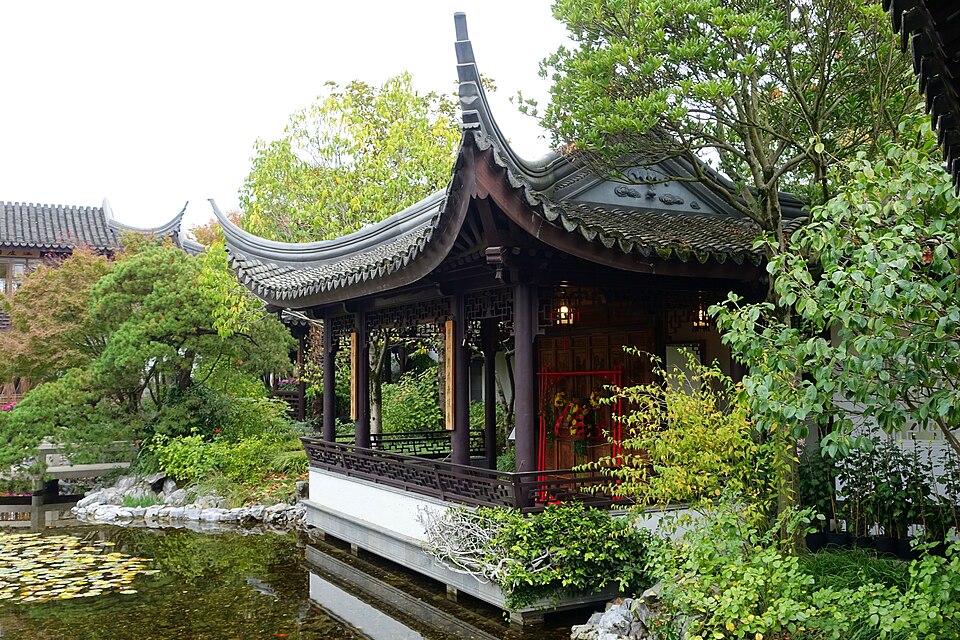
The photograph in this article shows a pavilion, bridge and pond in Lan Su Chinese Garden, Portland. We use it as an illustration of approach, pause, outlook and continued movement. A route does not need to be imagined as a demand to keep walking. A sheltered place can invite a different moment within the sequence. This is our reading of the image, not a technical assessment of the garden or proof that its design follows our newly proposed concept.
The image also helps us see the limits of a single frame. We do not know from the photograph who maintains the route, which conditions change with weather or how different visitors experience access. A pause that looks inviting in an image may involve questions that only actual use can answer. The Rhythm of Return includes those missing relationships. The visible scene prompts inquiry rather than supplying a complete verdict.
Return in a garden can be meaningful even when the scene changes. A visitor recognizes a place and notices something different. This contemporary reflection connects familiarity with transformation: the route offers continuity, while the experience does not need to repeat exactly. We can appreciate that possibility without claiming a universal traditional meaning for each object in the photo. The particular place should remain more than a generic symbol attached to an article.
The photograph is by Daderot and available under CC0. Its source and licence are displayed alongside it. Giving that information preserves the connection between image, author and place. The freely reusable photograph supports transparent learning, while the caption makes its role clear. It is an invitation to look and ask, not a substitute for cultural study or for the experiences of the people who use and care for the garden.
16. Unequal rhythms require a shared conversation
People do not arrive with identical schedules or resources. One person has time to restore a setting immediately; another must leave for a responsibility elsewhere. One can easily carry materials; another needs the arrangement to reduce unnecessary movement. The Rhythm of Return should accommodate these differences in its description. It becomes unfair if it assumes a single ideal rhythm and then judges everyone who cannot follow it as careless or philosophically deficient.
A shared agreement needs to distinguish willingness, capacity and authority. Someone may be willing to change a space without having permission to move its contents. Another may control the layout while rarely performing its renewal. A third may know a practical difficulty that others have never noticed. These positions affect what a proposal can reasonably ask. The conversation should include the people whose contribution makes the next use possible, not only those who choose the visible arrangement.
Fairness does not necessarily mean identical tasks or timing. Participants may prefer different contributions. The relevant question is whether the arrangement is understood and acceptable, and whether changes in circumstance can be acknowledged. An agreement that once worked may become burdensome. The framework should help name that change without turning a practical difficulty into a character judgment. The place supports continuing participation when adaptation remains possible.
This is where our contemporary philosophical proposal has an ethical commitment. Vitality should not be described only from the perspective of the person whose activity is most visible. Renewal, pause and access matter too. A room’s apparent success can depend on unacknowledged work. Bringing that relationship into the account expands comprehension: we begin to understand not just how the place looks, but how its continuing availability is made and whose life carries that responsibility.
17. A small experiment in renewed participation
Choose one activity that people return to, such as reading, preparing a meal or working on a project. Describe one complete sequence in ordinary language. What makes the beginning possible? What changes during use? What remains when the activity pauses? What must be renewed? How does the next person recognize availability? Keep the exercise small. Its purpose is understanding, not an exhaustive monitoring system for the whole home.
Ask affected people to amend the description. They may identify a missing interval, an unrecognized task or a different experience of the same route. These corrections are valuable. The framework should not require every observation to confirm its initial interpretation. It is legitimate to discover that a simpler description works better. The new concept belongs to the conversation and should remain accountable to what participants actually tell us.
If a possibility emerges, select a modest, safe and reversible trial within the participants’ resources and authority. It might be a clearer place for incomplete materials, an agreed reset or a revised expectation of immediate availability. Do not alter another person’s possessions without participation. The exercise does not require unfamiliar building work or a purchase. Sometimes the useful action is to clarify responsibility or recognize that a constraint cannot be solved by the room alone.
After the next use, compare expectation and experience. Did returning become easier, and for whom? Was a burden reduced or simply transferred? What should remain, change or end? Keep the parts that help and revise the rest. The exercise is useful when the relationship between interpretation and action becomes clearer. It can stop when it has served that purpose, leaving people free to live their place rather than constantly assess it.
18. A renewed understanding of vitality
The Rhythm of Return expands our contemporary inquiry by refusing to make visible movement the only sign of a living place. Readiness, participation, pause, renewal and invitation describe connections between moments. They make room for unfinished work, familiar meaning, changed circumstances and shared responsibility. The framework does not measure qi or replace historical Feng Shui study. It names the contribution that Chibagua proposes to a philosophical conversation about sustaining participation.
Chi remains part of a cultural vocabulary larger than our application. The sources below offer starting points for learning about that context. Our examples should not be mistaken for traditional placement rules or guarantees of unrelated outcomes. Their value lies in the questions they make clearer. A kitchen, reading corner or garden can reveal different relations between use and renewal. No single arrangement has to become the answer for every person or place.
The concept’s most important distinction is between repeating an image and renewing a relationship. A room can change and still support return. A room can remain visually identical while the relationship becomes less accessible or more burdensome. Looking across time helps us understand the difference. It also makes care visible: what seems like an effortless continuation may depend on someone’s work, agreement or willingness to adapt.
The enduring invitation is to ask what the next participation requires and whose contribution makes it possible. Preserve what people value, allow what needs to change and keep return optional. A place supports philosophical vitality when its inhabitants can understand these relationships and negotiate them with care. The result is not endless movement or permanent perfection. It is a more attentive way to connect beginning, living, pausing and coming back, while allowing the place and its people to remain capable of becoming different.
Sources and further study
- Columbia University, Asia for Educators: Fengshui teaching guide. Introductory vocabulary and the wider historical range of Feng Shui.
- Columbia University, Living in the Chinese Cosmos: Basic Concepts. Context for qi and the difficulties of rendering historical concepts in English.
- Internet Encyclopedia of Philosophy: Yinyang. Further study of relational concepts in Chinese philosophy; it does not endorse the Rhythm of Return.
- Wikimedia Commons: Daderot’s photograph of Lan Su Chinese Garden. Image provenance and CC0 dedication.
What Is Feng Shui? — Explore the basics and ask questions in our forum.