Tag: Geopolitics

Explore geopolitics through Chibagua’s sourced current-event analyses and Feng Shui philosophy. Read the articles and join the community discussions.

  • Oil Flows Around Hormuz Recover Amid War: A Feng Shui Reading of Bottlenecks, Adaptation and Energy Security

    Middle Eastern oil exports have returned to or exceeded pre-war levels even as attacks and conflict continue around the Strait of Hormuz. The recovery is a story of rerouting, protection and concentrated risk rather than a return to normal. Feng Shui philosophy offers a careful vocabulary for thresholds, flow and resilience—without romanticising war or replacing security analysis. This is an interpretive essay about relationships between people, systems and environments. Feng Shui does not cause, predict or scientifically explain the event; factual claims remain grounded in the cited reporting.

    The verified event and the reporting boundary

    Reuters reported that late-September crude exports exceeded pre-war levels for four consecutive days, while tanker attacks increased. Associated Press described alternative pipelines and a protected Hormuz route helping restore exports; DW reported the recovery and continuing danger. Kpler provides market background on the conflict’s oil and gas implications. Reporting checked on 5 October 2026; the situation remains volatile. [S1] [S2] [S3] [S4]

    Chart showing ship transits through the Strait of Hormuz
    Chart of commercial ship transits through the Strait of Hormuz. Wikideas1, CC0 1.0, via Wikimedia Commons. License and source.

    1. Why this event belongs in a discussion of place

    Feng Shui begins with relationship: a room depends on entrances, routes, maintenance and the people who use it. Public events reveal the same hidden dependencies at another scale. The useful question is not which decoration symbolises the news, but which relationships keep ordinary life workable, who can use them, and where pressure accumulates.

    Hormuz is a global threshold: immense movement is concentrated in a narrow passage. Feng Shui treats entrances as places where direction, speed, visibility and safety must be negotiated. A threshold can be productive without being robust. When a whole system depends on one narrow route, impressive throughput may coexist with deep vulnerability.

    2. Chi as an analogy for movement, not a causal claim

    Traditional language about chi directs attention to movement, gathering and obstruction. Here “flow” is a transparent analogy, not a statement that money, votes, ships or fuel are identical to qi. The analogy is valuable only when it sharpens evidence-based questions: what moves, through which route, under whose rules, toward whom, and at what cost?

    3. Yin and yang: holding tension without false equivalence

    Yin and yang describe interdependent tendencies rather than teams of good and evil. Stability and change, protection and openness, urgency and patience may all be necessary. Balance is not a bland midpoint and it does not make unequal harms equivalent; it is the capacity to respond without allowing one tendency to erase every other need.

    Alternative pipelines and protected routes resemble circulation paths added around a stressed doorway. Redundancy can reduce immediate obstruction, yet it also has environmental, political and human costs. A balanced reading asks whether resilience merely protects volume or also protects crews, coastal communities, consumers and the possibility of a less carbon-intensive future.

    4. The five phases as a diagnostic sequence

    The five phases can be used as a sequence of questions rather than a prediction. Wood asks what can grow; fire where intensity and visibility rise; earth what supports daily life; metal which rules and structures organise action; water how adaptation and uncertainty are managed. This contemporary exercise must remain distinct from technical traditional calculations.

    5. A bagua reading of connected life areas

    A bagua reflection links livelihood, knowledge, relationships, support, recognition, creativity, family and health around a centre. It does not map nations or leaders onto “lucky corners”. Its value is relational: pressure in one domain often travels into others. Policy and news become spatial when they alter journeys, rest, access, conversation and the use of shared rooms.

    6. Thresholds, centres and bottlenecks

    Feng Shui pays close attention to doors, corridors, junctions and the open centre. A threshold that carries too much traffic becomes fragile; a blocked centre makes every route harder. This offers a disciplined way to notice concentration and bottlenecks, while technical causes still require economics, law, engineering or political analysis.

    7. Scale, power and ethical responsibility

    Spatial advice must never blame individuals for collective conditions. A household cannot rearrange away war, unemployment, institutional polarisation or a global supply shock. Responsibility follows power: governments, companies and institutions must address the systems they control. Personal practice can support clarity, accessibility and mutual care, but it cannot replace public action.

    8. A practical reflection for homes and communities

    A constructive response begins with a real routine. Identify one route, shared surface or decision point affected by the event; ask who uses it, who waits, and who does invisible maintenance. Make one small reversible change—clear information, an agreed meeting place, a calmer transition, or a backup plan—and discuss it with everyone affected.

    For households, the event may appear through transport prices, delivery uncertainty or anxiety about war. Do not store fuel unsafely or make panic purchases. Instead, map essential journeys, identify one realistic alternative, keep emergency information accessible, and preserve a calm shared space for decisions. Safety guidance and public authorities take priority over symbolism.

    9. What to observe over the next week

    For seven days, record where friction appears and whether it is reduced or merely transferred to someone else. Separate observation from interpretation. Avoid panic buying, unsafe work, financial speculation or symbolic remedies presented as guarantees. If building, electrical, legal or financial issues arise, consult a qualified professional.

    10. A responsible conclusion

    A responsible Feng Shui reading ends with clearer relationships rather than certainty. It asks whether flows reach people, whether centres remain usable, whether reserves and alternatives exist, and whether change preserves dignity. The event should be judged through evidence as it develops; philosophy contributes questions, attention and an ethic of care.
    Sources and further reading

    Let’s discuss about this here….

  • Kyiv’s Disrupted Bridges: Feng Shui, Connection and the Ethics of Care

    A bridge is more than a line across water. It connects a home to work, a person to relatives, and a neighbourhood to the services that make ordinary life possible. Recent attacks disrupting bridges in Kyiv offer a difficult but important occasion to reflect on connection through Feng Shui philosophy. Human safety and the lived consequences of war come first. This article does not attribute violence to bad chi or suggest that victims could prevent attacks by rearranging their homes.

    The verified event and the reporting boundary

    AP reported closures affecting three Kyiv bridges on 2 October 2026; DW also covered the disruption. [S1] [S2] For longer-term context, UN human-rights monitors documented civilian hardship from attacks on energy infrastructure in February 2026. [S3] That UN report concerns a different period, not these bridge attacks. Reporting checked on 4 October; this article provides no live route or safety information.

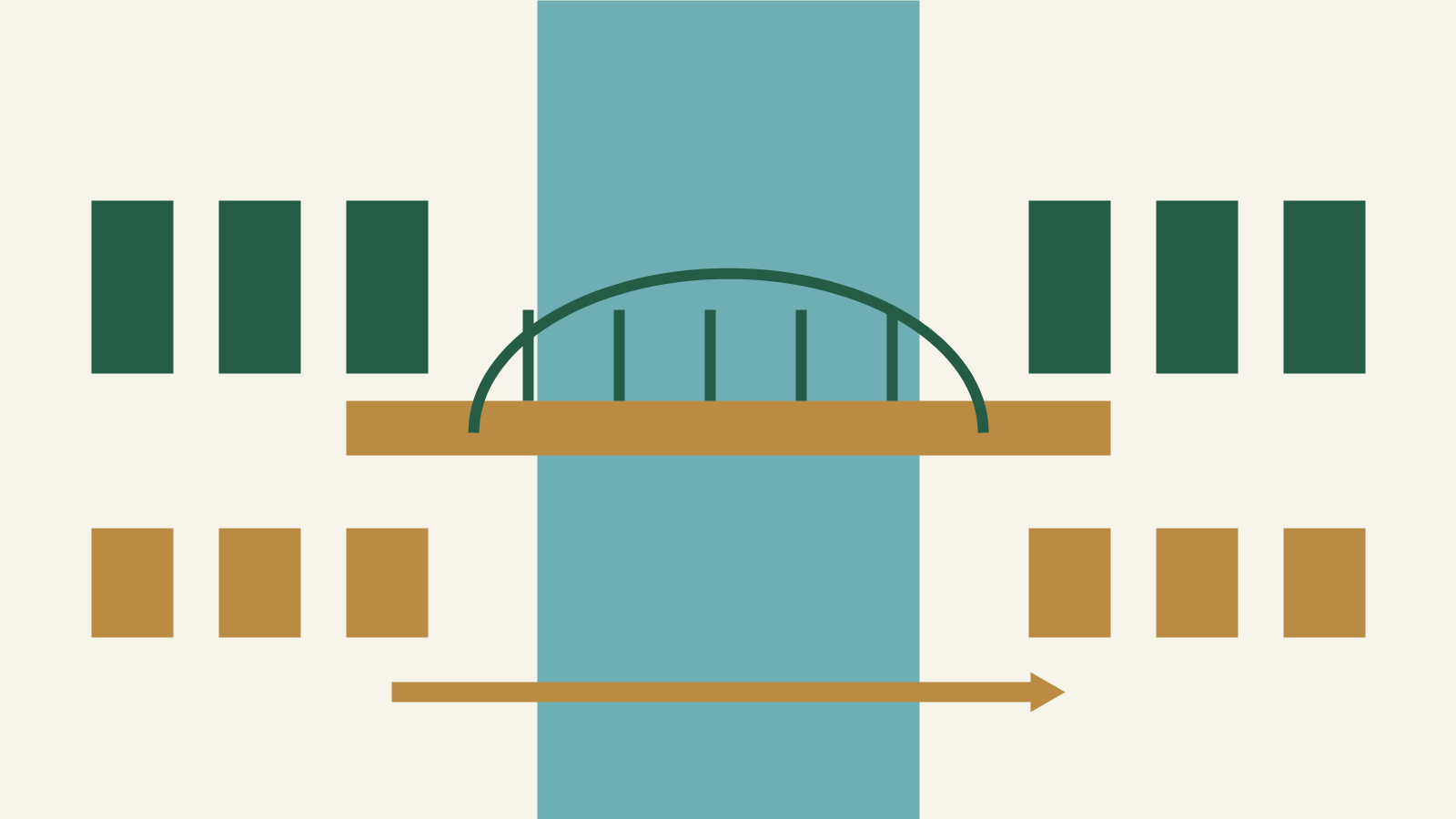
    Original conceptual illustration of a bridge joining two city districts with alternative paths
    A bridge connects places and the routines of their inhabitants. Original conceptual illustration, not an image of damage in Kyiv. Chibagua, CC0 1.0. CC0 1.0

    1. Why a bridge matters to a philosophy of place

    Feng Shui’s attention to relationships between a location and its surroundings offers a language for considering connection. A neighbourhood does not become habitable merely because individual rooms are arranged well. Inhabitants need workable relationships with places beyond their doors. A bridge makes those relationships possible across a physical boundary. Its significance lies in the activities and care that can pass through it, not only in its appearance.

    Our interpretation is that a route belongs to the lived environment of everyone who depends on it. A floor plan can show a protected interior while omitting the difficult journey required to reach it. The bridge event therefore asks us to widen our frame. This is an ethical and spatial reflection, not a military explanation or an assessment of engineering damage. Those questions require qualified evidence and expertise.

    2. A river is not automatically an auspicious symbol

    Water has important meanings in Feng Shui traditions, but a real river is also a geographic condition with currents, banks, crossings and practical constraints. Reducing it to a prosperity symbol would overlook what people actually encounter. Different traditional methods may interpret water relationships differently; this article does not perform a site reading or assert an auspicious direction for Kyiv.

    The philosophical question is how a boundary can both connect and separate. A river can organise a city around distinct banks, while bridges sustain relationships between them. When a crossing becomes unavailable, a previously ordinary movement can require more time and effort. We use this relationship as an analogy for dependence, without pretending that symbolic interpretation establishes the physical cause of disruption or the appropriate technical response.

    3. Flow means a person can complete a necessary journey

    The vocabulary of chi can draw attention to circulation, interruption and gathering. Here it is a metaphor for lived movement, not a claim about an invisible force causing attacks. A route has value because people can use it for meaningful purposes. Counting vehicles alone would miss the person who cannot reach a destination, the caregiver whose routine becomes harder or the family whose connection is interrupted.

    These are general examples of dependence, not individual stories reported from Kyiv. They help us ask better questions about urban resilience. What journeys are essential? Who has alternatives? Who encounters a barrier that others can bypass? Feng Shui interpretation becomes useful when it brings these differences into view. It becomes harmful if it replaces the actual circumstances of war with a vague judgment that a city has negative energy.

    4. Obstruction and responsibility must remain distinct

    In a home, a blocked passage may be corrected by moving an object. In a city under attack, an obstruction may result from deliberate violence, damage and security decisions. These situations differ fundamentally. A philosophical analogy must preserve the distinction between understanding a spatial consequence and explaining responsibility. There is no justification for treating residents’ suffering as a failure to achieve harmony.

    The UN’s earlier documentation offers context for the wider hardship caused by infrastructure attacks. [S3] It does not substantiate every claim about the current bridge event. Our interpretation is simply that harm extends through the relationships a damaged system supports. A humane reading keeps the agency of attackers and the needs of civilians visible. It does not turn destruction into an aesthetically interesting example while overlooking the people affected.

    5. Yin and yang: protection and connection

    A place may need both connection and protection. These are complementary needs rather than a rule that one should always be maximised. A completely exposed setting can fail to support rest; a completely isolated one can fail to support participation. In this essay, yin and yang provide a reflective vocabulary for that tension. They do not determine when a real bridge should close or reopen.

    Operational choices belong to the relevant authorities and qualified professionals using current information. At a philosophical level, ask what kind of connection a protective arrangement preserves and whose needs it accommodates. In a household far from the event, the parallel might be a quiet place that remains easy to reach and does not obstruct an exit. The analogy must remain modest and should never become informal emergency guidance for people in an active conflict.

    6. Five phases and the work of restoration

    For a modern exercise, consider the activities that sustain a shared route: imagining future needs, mobilising attention, supporting people, organising repair and adapting to changed conditions. These can be discussed through growth, intensity, grounding, structure and movement. We offer this as a contemporary analogy inspired by five-phase language, not as a traditional method for scheduling reconstruction or choosing engineering materials.

    The exercise highlights a frequent blind spot: visible restoration depends on less visible work. Consultation, maintenance and accessible design are not merely finishing touches after a structure looks complete. A repaired connection should be evaluated through the people and practices it can support. This statement is our ethical interpretation, not a report on any current rebuilding plan in Kyiv. Specific plans require direct, current sources.

    7. The bagua cannot replace a map of access

    A symbolic map may prompt reflection about support, relationships, livelihood or learning, but it is not an operational route map. Readers should not use this essay to decide where to travel. Different bagua applications have different premises; none are being applied here to identify safe sectors of the city. That boundary protects both factual accuracy and respect for the tradition.

    As a reflective exercise, ask which dimensions of life depend on a single connection. A route may support work and family contact at the same time, so its loss cannot be understood in only one category. Mapping these dependencies helps reveal what an elegant diagram leaves out. The question is not which corner controls a bridge, but how a network of places supports several human needs simultaneously.

    8. Reciprocal Inhabitation makes maintenance visible

    Chibagua’s Reciprocal Inhabitation concept links place, practices and care over time. It is a modern proposal for discussion, not an established Feng Shui school or a scientifically demonstrated causal law. A bridge illustrates its core concern: a structure enables routines, routines depend on the structure, and care sustains that relationship. When the structure is disrupted, the consequences extend beyond the physical site.

    Apply invitation, passage, permission and return cautiously. What activities does a connection support? Who can use the available routes? What barriers affect different inhabitants? What work restores meaningful access? In conflict, these questions cannot be answered by a household rearrangement. They direct attention toward civilian needs and the institutions responsible for support, while acknowledging that recovery can be constrained by continuing danger and material resources.

    9. A distant household example without appropriating experience

    Imagine a person living far from Ukraine who depends on one local crossing to reach work and relatives. A temporary closure makes that dependence visible. They might review appointments, accessible alternatives and the way essential information is organised at home. This hypothetical example is deliberately separate from Kyiv: inconvenience in an ordinary setting must not be equated with the experience of civilians facing attacks.

    The example helps readers notice their own dependence without claiming to understand someone else’s trauma. A useful change might be a clearer shared planning area or an agreed way to check official local updates. It should not involve collecting sensitive information about others or publishing their routines. Reflection becomes more respectful when it leads to attention and care rather than sensational stories, speculative route advice or images that falsely appear to document the attack.

    10. A humane interpretation and a community conversation

    Our conclusion is that connection is an inhabited relationship, not simply an architectural feature. A bridge supports people, obligations and opportunities. Feng Shui philosophy can help us notice how places depend on one another, provided we preserve the boundaries between metaphor, evidence and responsibility. It cannot explain why a military attack occurred, predict further strikes or guarantee safety through an arrangement of objects.

    In the forum, discuss which shared routes your community depends on and how care for them could become more visible. Avoid posting real-time locations, sensitive infrastructure details or another person’s private experience. Keep the conversation grounded in reliable sources and compassion. The most valuable philosophical reading of a damaged connection is one that deepens attention to human needs and resists turning suffering into a judgment about the victims’ harmony.

    Sources and further reading

    Let’s discuss about this here….