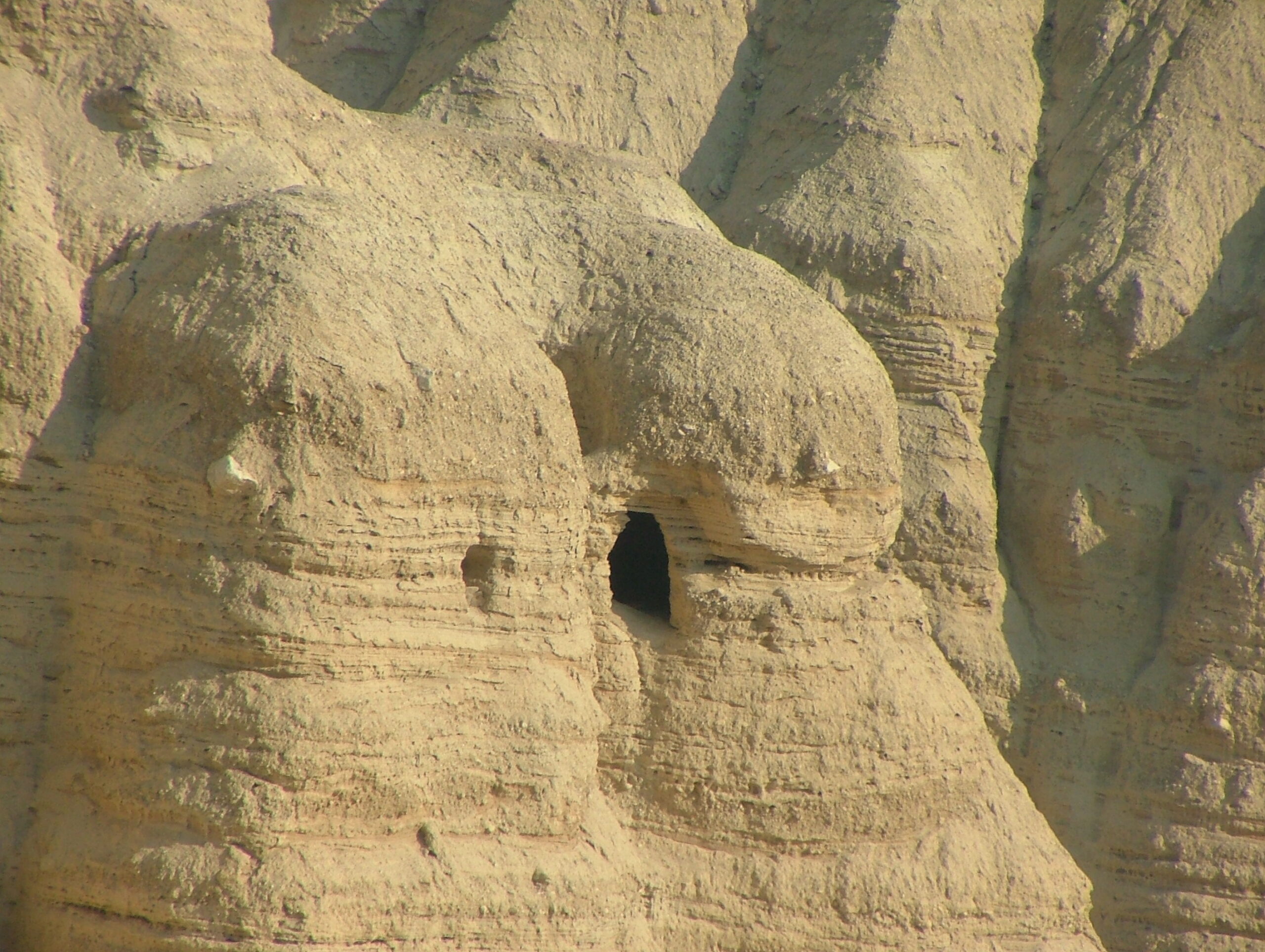
In 1947, Bedouin shepherds brought ancient manuscripts out of a cave near Qumran, above the northwestern shore of the Dead Sea. Accounts differ over the precise sequence and date of the first find, but the discovery of seven scrolls became the beginning of an extraordinary international archaeological story. Manuscripts that had remained inaccessible for centuries entered networks of antiquities dealers, scholars and museums. Their emergence transformed the study of ancient Judaism and the religious world from which Christianity developed. The importance lay in surviving evidence, rather than the confirmation of a modern supernatural legend. [1, 2]
Which matters most in a place of study: shelter, natural light or openness to others? How can we protect sacred heritage while sharing it? Please distinguish historical evidence from personal interpretation.
Qumran caves, photographed in 2012; landscape illustration, not a photograph of the 1947 discovery. SuperJew / Wikimedia Commons · CC BY-SA 3.0. Unmodified photograph; automatically resized for display.
 English
 Français
 Deutsch
 Italiano
 Español
 Português