 English
 Français
 Deutsch
 Italiano
 Español
 Português
A map can make a place easier to understand. It can also make the place seem simpler than it is. A plan shows a room as a shape, but does not show who feels welcome there, who maintains it, or who cannot find a quiet moment. Bagua offers a rich historical vocabulary of differentiated relationships. This article introduces its basic structure and then proposes a new Chibagua concept: the Map of Questions. The proposal uses eight areas of inquiry to examine a lived place, while keeping that contemporary exercise separate from traditional trigram arrangements and divination. It does not assign your future to a corner of your home. It asks what a map allows you to notice, what it leaves out, and how its authority can remain answerable to the people whose lives it describes.
1. Why learning bagua begins with a distinction
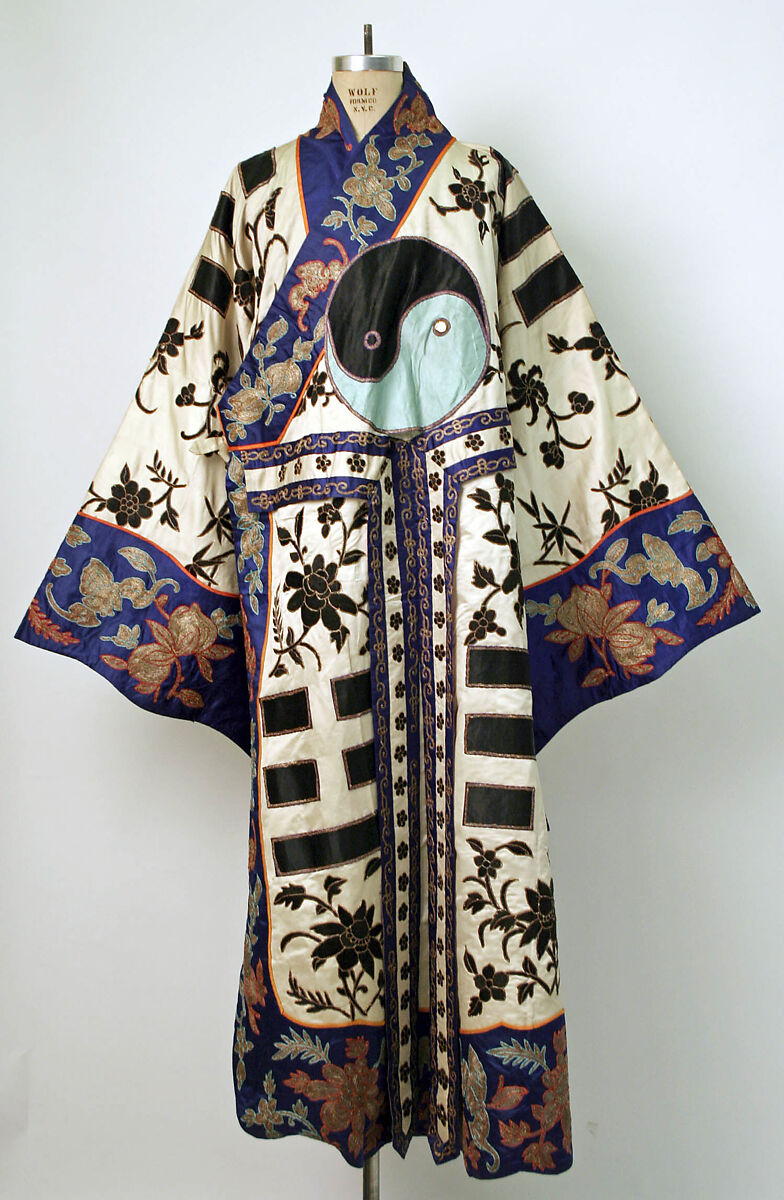
Bagua refers to the eight trigrams, figures composed of three whole or divided lines. With two possibilities at each position, there are eight combinations. These symbols belong to a Chinese cultural and philosophical history extending beyond interior decoration. The University of Michigan Museum of Art documents their connection with the Yijing, or Book of Changes, on a historical porcelain bowl. The Metropolitan Museum of Art shows them on the theatrical robe illustrated here. Their presence in different objects reminds us that a symbol can participate in several contexts. Recognising the figure does not by itself tell us how a particular person, text, ritual, or practice interprets it. A responsible introduction therefore separates identifying a structure from claiming mastery of every use associated with it.
A reader may first encounter bagua as a chart placed over a floor plan. Another reader may know it from philosophy, martial arts, museum collections, or divinatory traditions. These encounters are related through a vocabulary, but their purposes are not interchangeable. A diagram that teaches symbolic relationships does not automatically establish an architectural prescription. A practitioner explaining one method does not necessarily speak for every lineage. At Chibagua, we can learn from this diversity without pretending that all differences disappear into a single universal rule. The first question is therefore not where to place an object. It is: what kind of interpretation is being offered, by whom, for what purpose, and with what limits? That question protects both the cultural subject and the reader’s ability to choose thoughtfully.
2. Eight figures are not eight household substances
A concise introductory vocabulary gives the familiar names and natural images: Qian, heaven; Kun, earth; Zhen, thunder; Xun, wind; Kan, water; Li, fire; Gen, mountain; and Dui, lake or marsh. These associations are a starting point for study, not a complete account of the traditions. The Wudang introduction linked below explains the figures and discusses differing arrangements. A trigram should not be reduced to an instruction to purchase something made from its named image. A mountain cannot literally be installed in a small room, and the language of thunder does not require noise. Reading symbols involves interpretation. Reading a shopping list involves acquisition. Confusing the two replaces a philosophical vocabulary with an inventory and makes learning depend unnecessarily on money, ownership, and access to particular objects.
The eight trigrams also should not be treated as another name for the five phases. The schemes have different structures, even where traditions connect them. For the contemporary exercise developed here, we do not need to invent a correspondence between every question and a trigram. Doing so would imply authority the exercise has not earned. Our eight questions are a deliberate organisation of attention, inspired by the possibility of considering differentiated relationships. Their number makes the exercise memorable; it does not make it ancient. This distinction lets a reader study traditional bagua separately while using a clearly identified modern reflection. It also prevents a familiar diagram from granting our proposal more certainty than its practical experience can support. A useful concept remains useful because it clarifies something, not because it borrows an impressive appearance.
3. Different arrangements require different explanations
Introductions commonly distinguish Earlier Heaven and Later Heaven arrangements of the trigrams. They arrange the same figures differently and serve different interpretive purposes. Wudang’s account explains this distinction; Columbia’s teaching guide also introduces differences between directional approaches and attention to landforms. This article does not attempt to teach a full professional method. Its purpose is to make a reader less likely to combine incompatible instructions simply because each contains the word bagua. Before following a chart, identify the arrangement and the reference used to orient it. Ask whether the author is presenting historical explanation, a particular practice, a contemporary adaptation, or personal symbolism. A method becomes more understandable when its assumptions are visible instead of being smuggled into the drawing.
A useful everyday analogy is the difference between a geographic map and a diagram of a railway system. Both can help someone move through a city, but they simplify different things. One emphasises position; another emphasises connections. Neither becomes false merely because the shapes differ, although either can be misleading when used for the wrong task. Likewise, asking how a diagram is oriented is a question about interpretation, not a competition to make every map look identical. The analogy does not explain traditional bagua techniques; it illustrates the importance of knowing what a representation claims. If an explanation never states its frame, its reader may mistake an assumption for an observed fact. Clarity about the frame is part of the practice of reading responsibly.
4. A map is a selection of attention
Every map includes and excludes. A drawing of walls may be excellent for discussing room proportions while revealing almost nothing about who interrupts whom. A list of activities may show demands on a shared table while saying little about light or circulation. A map of belongings may locate objects but conceal the labour of returning them to those positions. The Map of Questions begins with this selective character. Instead of pretending to represent a whole life, it states eight inquiries that deserve consideration: access, beginnings, visibility, rest, care, relationships, adaptation, and limits. These inquiries can overlap in the same physical area. They are not eight exclusive territories, and they need not be drawn as an octagon or a grid. Their purpose is to widen a conversation without claiming exhaustive knowledge.
This approach changes the map’s authority. A traditional-looking diagram might tempt its user to say that a room is wrong before asking anyone how it works. A question-based representation says something more modest: here is an area we have not yet understood. The difference matters when several people share a place. One person may find a visible shelf reassuring because it preserves a project, while another experiences it as competing with their own use of the table below. The map does not settle that disagreement. It helps identify what needs to be discussed. Its success depends on whether the people involved can add information, correct assumptions, and disagree with the interpretation. A map that cannot be corrected by lived experience has become a verdict rather than a learning tool.
5. Question one: who can access the place?
Access includes more than reaching a doorway. A person may enter a room and still be unable to participate meaningfully. They may not know where belongings can be placed, which equipment is shared, or whether moving a chair is acceptable. Another person may understand all those conventions but encounter a physical barrier. A reflective map distinguishes these situations instead of calling both an atmosphere problem. Begin by asking who uses the place and what each person needs to approach its activities. Observe the ordinary route, but do not assume that your own way of moving is everyone’s way. Ask the people involved what is difficult. The answer may require a simple explanation, an agreed change, or expertise beyond a philosophical exercise. Naming the kind of difficulty helps prevent symbolic interpretation from replacing practical attention.
Imagine a fictional reading room where the most comfortable chair sits behind a small table used to display decorative objects. The arrangement looks balanced from the entrance, but someone using the chair has to move the table repeatedly. Another participant cannot comfortably do so. The question is not whether that person’s relationship to chi is deficient. The question is why access depends on a recurring physical task that was absent from the original aesthetic judgement. A map can mark this dependency, alongside the reasons someone valued the display. A reversible adjustment can then be discussed. The aim is not to make every arrangement serve every imaginable use. It is to recognise actual participation and avoid granting appearance priority by default. Access becomes a relation between a place, an activity, and particular people.
6. Question two: what makes a beginning possible?
Beginning has conditions. A table may be available in principle while its tools are scattered, its purpose is unclear, or its previous activity has not ended. A guest may be welcome in principle but unsure where to sit. A student may have books ready but no agreed interval without interruption. The second question maps these beginnings. What must someone find, understand, or negotiate before acting? Which preparations recur? Who performs them? A place that requires extensive invisible preparation is different from one whose readiness is openly shared. This does not mean every object must always be ready for every task. It means that the cost of beginning deserves recognition. Understanding that cost often gives a clearer improvement than adding a symbol intended to represent achievement or opportunity.
Consider a fictional household that shares a desk between correspondence and drawing. Each activity requires different materials. If the changeover is improvised every time, the person beginning may move another person’s unfinished work without knowing its status. A small designated tray, a note, or an agreed order of use may clarify the transition. The right solution depends on the actual project and space. The Map of Questions records the uncertainty and the proposed agreement, not a permanent command. After several uses, the household can ask whether the beginning became easier and whether anyone acquired extra work. A good result is not simply a desk that photographs neatly. It is a transition that people understand and can maintain. Beginning thus becomes a relational condition that can be explained, tested, and revised.
7. Question three: what is visible, and to whom?
Visibility can support understanding or impose exposure. An open shelf lets one person remember what is available. The same shelf may reveal another person’s private materials to visitors. A clear view of an entrance can make arrival legible, but a room where everyone can always see everyone may leave little choice about being observed. The third question therefore asks more than whether a space looks open. What needs to be discoverable? What needs protection? Who controls the difference? A philosophical reading should resist treating concealment as automatically bad and exposure as automatically good. Privacy can be a positive condition of participation. A person who can keep a letter private may be more able to use a shared desk without anxiety about unwanted disclosure.
A fictional shared studio illustrates the issue. Displaying works in progress helps collaborators learn from one another, yet an unfinished piece may carry personal significance its maker does not want discussed. A map of visibility can distinguish voluntary display, necessary instructions, and private storage. These are relationships, not moral categories of objects. The group might agree that an identified area is for invited comments while another is for work awaiting a decision. The arrangement allows information to be available without making every material a public statement. A useful review asks whether participants understand the convention and whether refusal is accepted. More display is not automatically more harmony. What matters is an intelligible relation between what can be seen, what may be used, and what may be discussed, with authority remaining with the appropriate person.
8. Question four: where can participation pause?
A map that records only active uses overlooks the conditions that let those uses continue. Rest may mean sitting quietly, leaving a task unfinished, stepping away from conversation, or reserving a room for occasional use. Different people need different pauses. The question asks where a pause can occur without forcing another person to surrender their own activity unnecessarily. It also asks whether a person can pause without being judged as unhelpful or disengaged. This is a reflection on spatial and social conditions, not a claim that a particular corner treats exhaustion. If rest is continually interrupted because every surface carries an active expectation, the map can make that expectation visible. Sometimes an agreement about time helps more than a new object or a different colour.
Imagine a fictional family room used for both conversation and reading. The person reading is interrupted whenever someone arrives because sitting there is assumed to mean availability for discussion. Moving the chair might help, but the deeper ambiguity concerns participation. A simple convention can clarify that quiet reading is an accepted use, while allowing an urgent question when needed. The Map of Questions includes this agreement because rest cannot always be drawn from furniture positions alone. It can also show where competing needs remain unresolved. Perhaps the room is too small for simultaneous quiet and animated talk. Naming that constraint allows a schedule or another arrangement to be considered. The map does not produce silence by decree. It helps people understand what a pause would require in the place they actually have.
9. Question five: what care sustains the arrangement?
An arrangement continues through work. Plants need appropriate care, textiles need cleaning, tools need returning, and shared surfaces need transitions between uses. An image of a room rarely shows who performs these tasks. The fifth question makes care part of the map rather than an afterthought. List the recurring work connected with the arrangement you are considering. Ask who already does it, who can do it, and whether the expected standard is agreed. Avoid turning care into a moral test. A difficult-to-maintain display may fail because its demands do not fit the household, rather than because the inhabitants lack commitment. An honest description includes the effort required to keep a proposed change useful, especially when the person proposing it will not perform that effort.
Suppose a fictional group wants to add several plants to a meeting space. One participant likes the appearance, another enjoys tending plants, and a third travels often. The decision can recognise these differences without assigning tasks by enthusiasm alone. What happens during absence? What space do the plants occupy? Who can change the arrangement if the care becomes impractical? The question does not determine botanical requirements, which should be checked through suitable horticultural guidance. It determines whether responsibilities are visible and revisable. A smaller arrangement may be more appropriate than an impressive display that relies on unspoken labour. Harmony in this contemporary interpretation includes the possibility of sustaining a choice. It does not mean preserving an image at whatever cost someone else absorbs.
10. Question six: which relationships does the place support?
Rooms support encounters, separations, negotiations, and shared tasks. A seating arrangement may make a group conversation easier while making private exchange difficult. A table may enable collaboration while giving one participant disproportionate control over materials. The sixth question asks what relationships are being facilitated and whether those are the relationships people currently want. It does not assign family roles through a chart or presume that proximity always produces closeness. Someone may value joining the group but also need a clear way to leave. Another may want to work nearby without continuous conversation. The place can support several forms of togetherness if their expectations are understood. Calling a room communal is less informative than describing how participation actually works there.
In a fictional household, the largest chair faces the television and the remaining seats face that chair. The arrangement might be comfortable for watching a programme, yet it can turn other conversations into exchanges directed through the occupant of the largest seat. No sinister motive need be assumed. A map of relationships simply notices which actions the configuration makes easy. The household can test a different arrangement for conversation while keeping another for viewing. If moving furniture is impractical, changing where people sit at particular times may help. The point is to distinguish the purpose of a configuration from the people who happen to occupy it. A reflective map becomes useful when it allows alternative encounters to be imagined without declaring the old arrangement universally wrong.
11. Question seven: what can adapt?
The seventh question asks how the place responds when needs change. An arrangement may work well during one period and become difficult when a new activity begins. Adaptation is not an obligation to reorganise everything constantly. It is the capacity to review assumptions without treating a previous decision as sacred. Which elements can move? Which agreements can change? Which objects or structures impose genuine constraints? Distinguish a physical limitation from a habit and a habit from a preference. That distinction often reveals options without requiring expenditure. A piece of furniture may remain where it is while its use changes. A schedule may change while the furniture remains familiar. A map of adaptation identifies possibilities at several scales instead of assuming that transformation must look dramatic.
Consider a fictional room used by someone who has begun learning an instrument. The previous arrangement supports reading, and other residents still value that use. The question is not which identity the room must permanently adopt. It is whether practice can be accommodated with understandable timing, storage, and care. Some changes may be reversible; others may require professional advice or be unsuitable. The map can record that difference. An experiment might provide a temporary storage location and an agreed practice interval, then ask whether both uses remain workable. If the result fails, the failure informs the next discussion. Adaptation respects uncertainty by keeping choices open where possible. It does not promise that every desire can fit in the same space, but it helps distinguish a real incompatibility from an unexamined assumption.
12. Question eight: what are the limits of this interpretation?
The final question turns the map toward its own limits. What does the observer not know? Which claims rely on a person’s report, which on direct observation, and which on symbolism? What would require a different kind of expertise? A floor plan does not establish electrical safety. A pleasing view does not determine the performance of a building. A symbolic association does not diagnose someone or predict a relationship. Recording these boundaries is part of philosophical integrity. It also makes collaboration easier: a reader can learn from a cultural vocabulary while recognising when a practical question needs practical evidence. The map should never make ignorance look authoritative merely because its diagram is orderly or its language sounds confident.
This question also applies to consent. Some relationships are private, and the person drawing the map is not entitled to investigate them simply because they occupy the same building. A participant can decline to disclose why a particular object matters. The map can still recognise a protected boundary without inventing an explanation. Similarly, a visitor’s observation is necessarily partial. They should not turn one afternoon into a comprehensive verdict on a household. An honest map can include uncertainty and unanswered questions. That incompleteness is useful because it prevents an interpretation from outrunning its evidence. The exercise ends with a clearer account of what is known and what remains open, rather than with an artificial promise that every area of life has been accounted for.
13. A worked example: a small shared room
Imagine a fictional room shared by two adults who read, work on correspondence, and occasionally host a friend. There is one table, three chairs, a shelf, and a window. The residents disagree about the table. One wants it consistently clear because beginning a task feels difficult when materials are present. The other wants to preserve a craft project between sessions. The Map of Questions starts by refusing to reduce the disagreement to tidy versus untidy personalities. Access asks whether everyone can reach the seats and shelf. Beginnings asks what each activity requires. Visibility asks what materials can remain on display. Rest asks whether sitting without starting work is accepted. These inquiries locate different concerns in the same physical area without assigning the whole table to one life category.
Care asks who moves and cleans the materials. Relationships asks how visitors participate without unexpectedly displacing a project. Adaptation asks whether the arrangement can change for an evening gathering. Limits asks what the map cannot settle, including private meanings the maker need not reveal. The residents propose a removable board for the craft project and agree where it can be stored temporarily. They also preserve one clear area for correspondence. The proposal is not guaranteed to succeed: the board may be too cumbersome or the storage area may be inconvenient. After several uses, they review those effects. The map has served its purpose if the disagreement is now more precise and the experiment can be assessed fairly. It has not discovered which resident represents a trigram, nor predicted whether their relationship will prosper.
14. A worked example: welcoming a discussion group
Now consider a fictional discussion group using a borrowed room. The organiser arranges chairs in a circle because that seems to express equality. Yet late arrivals must cross the whole group, bags occupy the entry area, and the person taking notes cannot comfortably use their materials. A geometric symbol of equality does not establish equal participation. The Map of Questions asks how people enter, begin, see information, pause, care for the room, relate to one another, adapt the arrangement, and understand its limits. The group can preserve the intention of shared conversation while changing the practical form. Perhaps a small opening in the seating and a clearly indicated place for belongings improve arrival without turning the room into rows directed at a speaker.
The note-taker’s needs may suggest a surface that does not isolate them from the conversation. A quiet interval can allow participants to gather thoughts without pressure to speak continuously. Care includes returning the borrowed room to the agreed condition. Relationships includes the organiser’s authority to set the agenda and participants’ ability to question it. Adaptation asks whether the arrangement works with fewer people or someone attending for the first time. Limits recognises that a spatial exercise cannot guarantee respectful discussion. The map can improve conditions and reveal assumptions, while group behaviour still needs its own agreements. This example shows why the contemporary framework maps questions rather than assigning virtue to shapes. A circle can be helpful, but it cannot do the ethical work of listening on behalf of the people inside it.
15. The centre is a place for explanation
Many diagrams have a visual centre, and readers may be tempted to give that centre absolute priority. Our question map instead uses the centre, if one is drawn, for a short description of the inquiry: whose place, which activities, and what period are being considered? This is a modern design choice, not a claim about the traditional centre of a bagua arrangement. Writing the scope there keeps the exercise accountable. A map of a kitchen during evening preparation is not a map of the whole household’s life. A map created by one resident is not automatically the collective view. The centre reminds the reader that the drawing has an author and a purpose, both of which can be discussed.
A useful scope statement might read: we are considering how two people alternate between writing and craft work at this table during weekday evenings. It is limited, but it makes meaningful observation possible. The participants can identify what information matters and what does not. They can also notice when a proposed interpretation extends beyond the scope. If a discussion begins classifying someone’s character rather than describing the transition between activities, the statement helps return attention to the agreed question. Scope is not an enemy of philosophical depth. It allows depth by preventing every object from becoming an explanation of everything. A modest centre can therefore support a richer conversation than a grand diagram that never says whose experience it represents.
16. Reading the historical image with care
The image accompanying this article shows a late nineteenth-century Chinese theatrical robe in The Metropolitan Museum of Art. Its embroidered design includes the eight trigrams and a taiji roundel. The museum identifies the robe as a theatrical garment, not a household floor plan. This distinction matters: the photograph offers direct visual contact with historical symbols while preserving the object’s particular context. We can observe whole and divided lines without pretending that the garment teaches a method of arranging a modern apartment. The museum’s record is linked so readers can explore its description rather than relying on our image alone. Open access supports learning when a reproduced object retains its identity and source, instead of becoming anonymous decoration labelled vaguely as ancient wisdom.
The image also exposes the difference between recognising and understanding. A reader might recognise a round black-and-white motif before recognising the trigram figures. Learning their structure makes more of the object legible, but the photograph cannot reveal every aspect of its making or use. That incompleteness invites study. In the Map of Questions, we similarly learn to recognise a concern before assuming we understand its meaning for others. An unfinished object on a table is visible, but its importance may require conversation. Historical attention and everyday attention both benefit from this restraint, although they are different activities. We do not turn the robe into evidence for our contemporary exercise. We use it to introduce the cultural vocabulary honestly and to distinguish a real historical object from an invented authority.
17. How to draw a map that remains open
Start with a simple sketch or a written list. You do not need a compass reading for this contemporary exercise because its questions are not assigned to directions. If you are separately studying a traditional method, follow its stated procedures and keep those notes distinct. On the question map, write the scope, the participants, and the activities. Then record one observation under each inquiry. Separate what you saw from what someone explained and from what you merely suspect. For example, the chair is repeatedly moved is an observation; the chair makes someone feel unwelcome is a claim requiring that person’s account. This difference prevents the map from becoming a way of speaking over people while appearing to analyse their environment objectively.
Use ordinary words and leave room for correction. A note such as tools must be collected before drawing begins identifies a practical sequence. A note such as this is an unlucky area closes inquiry without explaining the mechanism or evidence. The map should help a participant see where they can respond. They may correct the sequence, explain why it exists, or propose a different arrangement. Avoid making the drawing so polished that revision feels like damaging a finished product. A pencil sketch, a shared document, or a few cards can be enough. Its value lies in the quality of the questions and the fairness of the discussion, not in visual resemblance to a traditional diagram. A beautiful map can still conceal an assumption; a rough map can make one clear.
18. Choosing one experiment
Once the questions are visible, do not assume that every issue must be solved immediately. Choose one transition or difficulty that the participants consider worthwhile and within their ability to change. Explain the intended effect in practical terms. For instance, reserving a small surface might allow correspondence to begin without moving a private project. Specify who prepares the change, who can revise it, and when the result will be reviewed. Keep the experiment proportionate. A movable tray or a clearer agreement may answer the question more directly than a substantial purchase. Reversibility is useful because it permits learning without demanding confidence in a perfect prediction. It is a choice about uncertainty, not a traditional bagua rule being attributed to an unnamed lineage.
During the experiment, look for effects across the inquiries. Easier beginnings may come with more care work. Greater visibility may reduce privacy. A change that supports one relationship may complicate another. These effects do not automatically invalidate the proposal, but they deserve recognition. Ask the participants whether the benefits and burdens fit their expectations. If they disagree, describe the disagreement rather than averaging their experiences into a single harmony score. The map records a plural situation. At the review, decide whether to retain, adapt, or undo the change. Learning is preserved even if the arrangement is not. The exercise succeeds when people can explain what happened more clearly and choose their next step with fewer hidden assumptions.
19. Avoiding a map of blame
A spatial interpretation can become a map of blame when difficulties are attributed to the person whose objects occupy an area. This is especially tempting if a chart seems to connect that area with a valued aspect of life. Our contemporary exercise rejects that shortcut. Objects and arrangements may matter, but their effects must be described rather than asserted through a label. If a project occupies a table, ask which activity is impeded, what alternatives exist, and what agreements already apply. Do not claim that its maker is obstructing another person’s destiny. Such a claim replaces a negotiable issue with an accusation that cannot be examined fairly. It also lends borrowed cultural authority to a personal preference, making ordinary disagreement harder to resolve.
Blame can also be directed inward. A person might believe that an imperfect home explains every disappointment. The Map of Questions offers no such account. It addresses limited spatial relationships and cannot explain the entirety of a life. Constraints such as tenancy, money, time, and available space are real; a philosophical exercise should not turn them into moral deficiencies. Sometimes the most appropriate result is recognising that a desired change is presently unavailable and finding a smaller adjustment. Sometimes no spatial adjustment answers the issue. Honest limits protect the reader from compulsory perfection. The place can be meaningful while remaining unfinished, constrained, or contested. A map should improve understanding of those conditions, not promise that removing every visible imperfection would remove every human difficulty.
20. What bagua can invite us to study next
Learning the basic trigram structure can open several paths. A reader may study the Yijing with an appropriate translation and commentary, investigate historical objects, or learn a particular Feng Shui tradition from someone who explains its methods and lineage. Those paths require more than this article, and their differences deserve attention. The Map of Questions is another path: a contemporary reflective exercise whose value can be discussed through experience. It should not replace historical study or disguise itself as a newly discovered ancient technique. Keeping these paths visible allows curiosity without confusion. You can use our questions while continuing to learn what traditional sources actually say. You can also find the questions unhelpful without thereby rejecting the cultural history of bagua.
The deeper invitation is to recognise that interpretation carries responsibility. A map directs attention and can influence decisions, so its author should explain its assumptions, evidence, and limits. Bagua’s differentiated vocabulary encourages us to resist describing every relationship with one undifferentiated word such as energy. Our original question map extends that learning by asking about access, beginnings, visibility, rest, care, relationships, adaptation, and limits. These are not territories that own your future. They are openings for understanding a particular place with the people who inhabit it. When a map remains open to their correction, it becomes a means of shared inquiry. The goal is a clearer relationship with the place, not obedience to a diagram whose authority no one can question.
Cultural sources and image credit
- Columbia University, Fengshui: The Ways of Wind and Water, teaching guide, for introductory vocabulary and the distinction between directional approaches and attention to landforms.
- University of Michigan Museum of Art, Bowl, 1971/2.112, documenting eight trigrams associated with the Yijing on a historical Chinese object.
- Wudang, The Eight Trigrams, an introductory account of names, figures and arrangements; a source for study rather than proof of predictive effects.
- The Metropolitan Museum of Art, Theatrical robe with eight trigrams, C.I.44.106.2, China, late nineteenth century. Gift of Miss Ida E. Fischer, in memory of Viola Canman Fischer, 1944. The reproduced image is public domain under The Met’s CC0 Open Access policy. The historical garment illustrates bagua symbols; it does not demonstrate the contemporary Map of Questions framework.
What Is Feng Shui? — Explore the basics and ask questions in our forum.