 English
 Français
 Deutsch
 Italiano
 Español
 Português
Chibagua is the addition of two words: chi and bagua. The name brings together a concern with vitality and a concern with patterns of relationship. It is a modern website name, not the name of an ancient school. This opening essay explains that choice, introduces the cultural vocabulary behind it, and proposes a new Chibagua concept: the Living Vocabulary. A living vocabulary helps people observe more carefully, discuss their experience, and revise their interpretations when circumstances change. It does not promise that naming a room will control events outside it.

1. A name can invite a way of paying attention
When we name a place, we do more than identify it. A name can express what we hope will happen there: welcome, study, rest, conversation, remembrance, or discovery. It can also create expectations that the place will have to meet. A room called a sanctuary may disappoint someone who cannot find quiet in it. A website called a learning community must make learning possible through its explanations, its sources, and the way it welcomes questions. The meaning of a name therefore develops through use.
Chibagua invites readers to explore Feng Shui philosophy through the relationship between movement and pattern. The combination of chi and bagua is deliberately simple enough to remember. Yet that simplicity should not flatten the concepts into slogans. Each word belongs to cultural traditions larger than this website, and each deserves study beyond a familiar decorative formula. The combined name gives us a starting point, not ownership of the traditions it references.
The first responsibility of this essay is transparency. Chibagua is a contemporary editorial project. Its original concepts are offered as interpretations that readers can examine, question, and adapt. They are not described as historical discoveries or teachings handed down through an invented lineage. We can appreciate a tradition while being honest about what we contribute ourselves.
This distinction makes the name more useful. It allows the website to become a meeting place between cultural study and everyday reflection. Readers can ask how a vocabulary illuminates a situation without assuming that every observation confirms an ancient rule. A name then becomes a promise of careful inquiry, fulfilled through the quality of the questions it helps us ask.
2. Chi, qi, and the limits of a short translation
The word chi is also commonly written qi. The spellings arise from ways of representing Chinese terms in the Latin alphabet. They should not be treated as two separate substances or competing forces. In introductory discussions, qi is often translated as energy, but a brief translation cannot convey every meaning a term acquires across different historical and cultural contexts. Readers should be cautious when a familiar word appears to make a complex idea completely transparent.
Columbia University’s Asia for Educators teaching guide introduces qi alongside complementary yin and yang, five elements, and eight possible trigrams. Those terms provide a cultural orientation for studying Feng Shui. The guide also distinguishes approaches concerned with direction and position from approaches concerned with landforms. This short contextual summary does not make the Living Vocabulary a historical method. Our contemporary framework remains an editorial proposal.
In this article, chi invites attention to vitality, movement, and the conditions that support activity. That is a chosen philosophical emphasis, not an exhaustive definition. We can investigate whether a room helps people begin a task, circulate comfortably, put down belongings, or recover after effort. Such observations may be discussed through the language of chi, but they do not measure qi as a physical quantity.
The distinction matters because words can quietly become claims. Saying that an entrance feels welcoming describes an experience. Saying that an entrance guarantees prosperity asserts something much broader. The Living Vocabulary asks us to make that difference visible. An accessible introduction should expand comprehension without pretending that a simple translation has settled questions of history, belief, or evidence.
3. Bagua and the value of making distinctions
Bagua names the eight trigrams. A trigram consists of three lines, with each line represented as solid or broken. Different arrangements of those lines produce eight possibilities. This basic structure is part of the introductory vocabulary, but it is not a complete account of how the trigrams are interpreted or used. A serious study of a particular tradition needs appropriate sources, context, and guidance rather than an assumption that all popular diagrams mean the same thing.
For the purposes of this essay, bagua encourages attention to patterns and distinctions. A place becomes easier to discuss when we recognize that rest, work, arrival, privacy, and shared activity have different demands. These examples are our reflective prompts. They are not presented as a canonical bagua reading, and the article does not instruct readers to determine auspicious directions for a property.
A pattern can help us notice relationships that would otherwise remain vague. Yet the pattern can also become a trap if everything must fit it. A household’s experience may include disability, caring responsibilities, limited housing choices, or competing schedules that a simple diagram does not represent. The room remains more particular than the map used to consider it.
The Living Vocabulary therefore values distinctions without making them final. It asks what a map helps us see and what it leaves out. Bagua can invite a disciplined conversation about relationships, while inhabitants remind us that relationships continue beyond the diagram. A useful vocabulary guides attention back to the place and the people, rather than replacing them with a confident classification.
4. Why bring these two words together?
Movement without pattern can be difficult to understand. We may notice that a household is busy without recognizing where its recurring pressures arise. Pattern without movement can become rigid. A plan can look elegant while failing to support the changing activities that take place within it. Chibagua brings the two concerns into conversation so that neither becomes sufficient on its own.
Imagine a table used for eating, study, and paid work. Its physical location is one part of the arrangement. Equally important are the transitions between uses: where papers go, who clears dishes, when another person needs the surface, and whether a task can be resumed later. A static diagram may show the table while leaving this sequence invisible. Observing the sequence can reveal why the apparently sensible arrangement repeatedly causes frustration.
The combined name suggests a question in two parts. What is moving, changing, or being sustained? What relationships give that movement a comprehensible form? The answer might involve furniture, but it can also involve an agreement about time or responsibility. A philosophical vocabulary earns its place when it helps describe such connections more accurately.
This is not a claim that chi simply means movement and bagua simply means order in every tradition. It is the website’s interpretation of its own name. Stating that interpretation honestly permits readers to evaluate it. Chibagua can then remain a contemporary invitation to study, rather than a label that borrows historical authority for ideas whose origin belongs here.
5. Introducing the Living Vocabulary
The Living Vocabulary is an original Chibagua concept for using philosophical language in a way that remains answerable to experience. A term is living when it helps people notice, communicate, and reconsider. It becomes closed when it dictates a conclusion before the situation has been examined. The difference is not whether a word is old or new, but how it participates in inquiry.
The concept has three commitments. First, observations should remain describable in ordinary language. Second, historical claims should be supported by sources rather than invented authority. Third, interpretations should remain revisable when the experience of inhabitants reveals something the vocabulary missed. These commitments create a relationship between attention, cultural respect, and practical responsibility.
Consider the word harmony. It can begin a useful discussion about whether a room supports different activities fairly. It can also end discussion if someone declares that their preferred arrangement is harmonious and refuses every objection. The word itself has not changed. Its use has changed from an invitation to a verdict. A living vocabulary notices that difference and asks whether people still have room to describe their needs.
This framework does not claim to be an ancient Feng Shui school. It does not establish a diagnostic scale or predict outcomes. It proposes a way of learning with concepts rather than submitting experience to them. Its value depends on whether readers find it useful for understanding particular situations, and it remains legitimate to use simpler language when that language serves the conversation better.
6. The three levels of a careful statement
A Living Vocabulary distinguishes observation, interpretation, and claim. An observation might be that a person must move several objects before beginning a meal. An interpretation might be that the transition between work and shared life lacks support. A claim might be that a particular change will solve the difficulty. Separating these levels makes the reasoning easier to examine.
Observations are not automatically complete or impartial. One person may overlook a burden that another experiences every day. Nevertheless, describing a sequence creates something people can compare. They can ask when it happens, who participates, and what remains uncertain. The discussion becomes more useful than a general announcement that the home contains bad energy.
Interpretations connect observations with a vocabulary. They can be imaginative and meaningful without becoming compulsory. Someone may describe a room through chi, another through routine, and another through emotional association. The task is to understand what each interpretation helps reveal. A symbolic explanation should not prevent a practical problem from receiving practical attention.
Claims require proportionate support. A movable tray may make clearing a table easier, but it cannot reasonably be said to guarantee success in unrelated areas of life. The Living Vocabulary encourages conclusions limited to what was actually observed. We can appreciate an improvement without expanding it into a universal law. Precision does not diminish philosophical curiosity; it gives curiosity a clearer relationship with the experience that prompted it.
7. An entrance as a first exercise
An entrance reveals the difference between appearance and use particularly clearly. A photograph may show a beautiful doorway while concealing the effort of arriving with shopping, managing a wet coat, finding somewhere to sit, or understanding a household rule. The first exercise is therefore to describe arrival before evaluating the entrance’s symbolism.
Choose a familiar arrival and trace its sequence. A person approaches, opens the door, moves inside, puts down belongings, and joins the next activity. Notice the point at which hesitation or unnecessary effort appears. Perhaps a useful surface is occupied, a route is narrow, or another person expects an immediate conversation. Describe the difficulty in words that everyone involved can understand.
Then bring chi and bagua into the reflection cautiously. Chi can prompt questions about circulation and replenishment. Bagua can prompt questions about how different relationships are being distinguished. Those prompts do not constitute a traditional assessment. They help us ask whether welcome, privacy, practical access, and responsibility have been considered together.
A proportionate response might be a clearer agreement, an accessible hook, or a different place for deliveries. It should include the person who maintains the new arrangement. After a trial, ask what improved and what became harder. The Living Vocabulary is useful if it supports this cycle of observation and revision. It has failed if the name of a concept becomes a reason to ignore an inhabitant’s experience.
8. Harmony includes the person who maintains it
Every arrangement has a continuing life. Surfaces need cleaning, plants need care, routes need to remain usable, and shared systems need people to understand them. An interior judged only when it is newly arranged can hide these demands. The philosophy of a place should include what makes the arrangement sustainable after the photograph has been taken.
Ask who performs each recurring action. How much time and effort does it require? Can another person do it when the usual caretaker is away? Does the person performing the work have influence over the decisions that create it? These questions reveal a dimension of harmony that decorative analysis can easily overlook.
A complicated storage system may work well for its designer and confuse everyone else. An open display may be treasured while creating a cleaning burden somebody did not agree to carry. A response might simplify the system, clarify responsibilities, or change an expectation. There is no universal requirement that every household become minimal. The aim is a more honest relationship between what is desired and what can be maintained.
The Living Vocabulary treats maintenance as evidence about the arrangement. If a proposal works only through someone’s invisible overwork, that experience belongs inside its evaluation. Chi and bagua can encourage attention to relationships, but neither should become a way to exclude the people who sustain those relationships. A philosophical name is meaningful when it makes their contribution easier to recognize.
9. Balance is not an equal quantity of everything
Balance is often imagined as a fixed midpoint. In daily life, however, different activities require different conditions. A room does not necessarily need equal hours of silence and conversation or equal amounts of every visual quality. A setting can be appropriately quiet during study and lively during a celebration. The relevant question is whether changes are understandable and responsive to the people involved.
The introductory vocabulary of yin and yang concerns complementary tendencies. Within our contemporary inquiry, it invites reflection on contact and withdrawal, activity and rest, openness and protection. These examples are not a complete account of the concept across traditions. They help demonstrate why a philosophical distinction should remain relational rather than become a permanent label attached to a person or room.
Someone who usually enjoys company may need solitude today. A closed door may protect concentration rather than express rejection. An open entrance may welcome guests while exposing a person who needs privacy. A living vocabulary allows these circumstances to change the discussion. It does not insist that one quality must be good in every situation.
Practical flexibility might involve a curtain, a movable lamp, a quiet period, or a signal that others understand. The best choice depends on the actual constraints and needs. Balance then becomes a capacity to adapt, not a requirement to reproduce a symmetrical picture. Chibagua’s name can support that reflection when movement and pattern remain in conversation rather than being treated as competing demands.
10. The five phases without a shopping list
Wood, fire, earth, metal, and water belong to the five-phase vocabulary associated with Chinese traditions. An introduction should resist reducing that vocabulary to a compulsory list of materials or decorative purchases. A term may support meaningful reflection without implying that buying an object will resolve the relationships through which a difficulty continues.
For this essay, we can ask how a setting supports beginning, expression, continuity, distinction, and adaptation. These are contemporary editorial prompts, not exhaustive translations of the five phases. They may reveal that a room encourages new projects without helping anyone finish old ones, or offers activity without allowing recovery. The prompts serve inquiry; they do not diagnose destiny.
What follows from such an interpretation matters. If a household seems overloaded, the response may be a discussion about obligations rather than another ornament. If a room resists change, the issue may concern permission to move belongings rather than a missing symbolic material. A valued object can participate in meaning, but its meaning should not conceal the conditions that sustain the problem.
The Living Vocabulary connects symbols with responsibility. A decorative fountain cannot substitute for a fairer division of care. A colour cannot make an obstructed route accessible. We can appreciate the symbolic life of a place while keeping practical descriptions available. The framework becomes more generous when it allows different ways of understanding a room to inform one another without demanding that every person accept the same interpretation.
11. A map should return us to the territory
Maps help because they select. They make some relationships easier to see by leaving other details out. That selectivity is also their limit. A diagram of a room may show a route while omitting the effort of carrying something along it. A schedule may show shared time while omitting the work needed to prepare it. A reflective map should therefore be considered a tool, not a complete replacement for experience.
Bagua invites an introduction to patterned distinctions, but its particular applications differ among approaches. Readers who want to study a specific placement method should consult suitable sources. The Living Vocabulary does not provide a shortcut around that study. It offers a question about any map: does the map help us understand this place, or are we changing the account of the place merely to protect the map?
Imagine a diagram that assigns one area to quiet reflection. The area may also contain essential household equipment used throughout the day. An inhabitant’s difficulty is not resolved by declaring that the diagram is correct. We must examine the competing uses and available alternatives. The particular setting can complicate the initial categories without making careful reflection impossible.
A useful map sends us back to questions: who can use the space, what happens there, what must be maintained, and what has changed? The Living Vocabulary keeps those questions available. Chibagua joins chi and bagua partly to remind us that patterns gain meaning through lived movement, while movement becomes more comprehensible when we can describe its relationships with care.
12. The room of several purposes
Many households cannot dedicate a separate room to every activity. One space may hold sleep, work, study, storage, and conversation. A philosophy that assumes abundant space can unintentionally blame people for compromises they cannot avoid. A Living Vocabulary begins with the resources actually available, including the possibilities that remain limited.
Consider a person who works at the only table and shares it for meals. The difficulty may concern transitions rather than the table’s location. Where can unfinished materials remain safe? How will others know when the surface is available? Who is expected to reset it? Asking these questions can reveal practical options without promising that a perfect arrangement exists.
A tray may reduce handling steps. An agreed interval may make the change of use predictable. A different storage expectation may prevent one person from carrying all the resetting work. Each possibility should be discussed with those affected. The article does not recommend adding objects automatically; another object can itself create a burden or obstruct a route.
Chi can prompt attention to circulation, while bagua can prompt attention to differentiated uses. The contemporary interpretation remains useful only while the household’s experience can modify it. If the first proposal fails, we can revise it or recognize a constraint beyond furniture. The lesson is a way of questioning, not a formula that obliges a small home to behave like a large one.
13. The garden image and what it cannot show
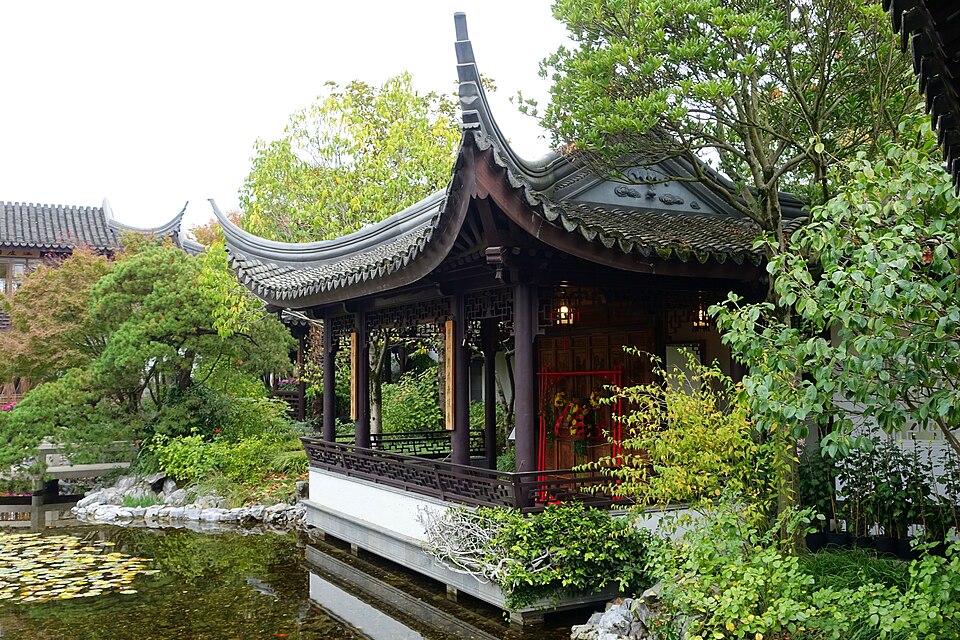
The image accompanying this essay depicts a pavilion, bridge, and pond in Lan Su Chinese Garden, Portland. It offers a visible relationship between shelter, route, water, and vegetation. That relationship makes it a useful illustration for thinking about the website’s interest in movement and pattern. The photograph does not establish that the garden possesses ideal Feng Shui, nor does it authorize copying its arrangement into every home.
The Metropolitan Museum of Art’s Chinese Gardens exhibition discusses connections between garden design and visual arts, including pavilions as viewing places and focal points. This provides cultural context for considering a garden as more than a collection of isolated objects. It does not endorse the Living Vocabulary, which remains our contemporary contribution.
A photograph cannot fully show the experience of walking through a place. It also omits changing weather, maintenance work, access difficulties, and the reasons particular forms were chosen. We can appreciate its composition while asking what lies beyond the frame. The limits of the image become part of the reflection rather than a reason to dismiss it.
The photograph is credited to Daderot and dedicated to the public domain under CC0. The source and licence are displayed with the image so readers can trace its origin. Freely licensed imagery supports the learning project by making reuse transparent. An image should enrich the article’s subject, but it should never be presented as evidence for a claim that the image itself cannot establish.
14. Memory and the objects that resist simple categories
Some objects matter because of relationships rather than appearance. A worn chair may connect a person with a relative. A collection may recall journeys, friendships, or years of study. A box may contain memories that its owner is not ready to sort. A philosophical vocabulary becomes inadequate if it treats these objects only as clutter, colour, material, or placement.
Ask what an object means before proposing its removal. Meaning may be difficult to explain, and a person is not obliged to justify every possession in order to retain agency over it. A thoughtful discussion can distinguish the object’s value from a practical difficulty it creates. A treasured object may be retained while its storage changes, but that possibility requires participation rather than a unilateral decision.
The Living Vocabulary makes room for complexity. An object can support memory and create a maintenance burden at the same time. A display can express belonging while narrowing a route. Recognizing both aspects helps people consider alternatives without reducing the situation to a single verdict. The aim is greater comprehension, not a rule that every meaningful object must remain exactly where it is.
Chibagua’s combination of chi and bagua encourages this double attention. We consider the ongoing life surrounding an object and the pattern through which that life is organized. Yet the inhabitant’s account remains essential. No map can fully tell us what a possession carries, and no abstract description of flow should erase a relationship that someone wishes to preserve.
15. Time belongs inside the arrangement
A room is not used under one permanent condition. Morning and evening bring different needs; seasons change light and temperature; work, illness, visitors, and caring responsibilities can alter a household’s rhythm. An arrangement that once made sense may require reconsideration without having been a mistake. Philosophical attention includes this ordinary fact of change.
Ask which conditions a proposed improvement assumes. Does it work only when one person is absent? Does it require a quiet period that the household cannot maintain? Does a valued surface remain useful when daylight changes? These questions can prevent a successful moment from being mistaken for a universally successful arrangement.
Time also reveals repetition. Moving an object once may be easy, while moving it several times each day becomes exhausting. Waiting briefly may be reasonable, while repeatedly asking someone to postpone their needs becomes unfair. The Living Vocabulary attends to the whole pattern, including how often an action occurs and who carries it through.
The response may involve a physical adjustment or a clearer agreement about use. It may also involve accepting that one setting cannot support every activity simultaneously. Chi can prompt attention to continuity and recovery; bagua can prompt distinctions among activities. Our contemporary use of those prompts remains accountable to the changing conditions of the place. Harmony becomes an ongoing relationship with time rather than a finished arrangement protected from revision.
16. Power changes what a person can choose
A philosophy of inhabitation must recognize unequal authority. Owners, tenants, employers, workers, guests, children, and temporary residents have different abilities to change a place. The person most affected by a difficulty may possess the least power to resolve it. Asking that person to improve their attitude or rearrange belongings can obscure the actual constraint.
A tenant may not be allowed to alter a fixture. A worker may not choose their seat. A child may depend on adults to make a route usable. A person with limited mobility may need others to respect an arrangement essential to their access. These situations call for attention to responsibility as well as experience. Awareness alone does not provide authority, money, space, or permission.
The Living Vocabulary distinguishes noticing a problem from being obliged to solve it alone. People with greater capacity to act should hear the experiences of those adapting to their decisions. Their preferred appearance cannot automatically outweigh another person’s dignity, access, or safety. A claim of harmony should be examined from more than the position of the person who controls the room.
This also encourages restraint when viewing other homes. A photograph of disorder cannot explain insecure housing, caring work, limited resources, or a temporary crisis. Chibagua’s name should invite curiosity about circumstances rather than judgement. A vocabulary that makes blame easier while making constraints harder to describe has become less useful, even if it sounds philosophically sophisticated.
17. Translation as an act of listening
Chibagua welcomes readers across languages. Translating a philosophical article therefore requires more than transferring attractive words. The reasoning, qualifications, examples, and distinctions need to remain understandable. A translation that preserves the vocabulary but loses its limits could turn a modest interpretation into a claim of certainty that the original never made.
Words such as energy, balance, and harmony can evoke different associations. A translated explanation should state how a term is being used in the article without implying that one local association captures every historical meaning. Chi and bagua remain the elements of the website name, while the surrounding sentences help readers understand the contemporary editorial intention.
The same responsibility applies to images. Alternative text should describe what is visible, and captions should preserve attribution and licence information. An image may illustrate shelter, routes, or relationships with nature without being called an ideal arrangement. Localized wording should help readers understand the illustration’s role and find its source.
The Living Vocabulary treats this work as part of listening. A learning community does not ask readers to infer missing distinctions merely because a phrase sounds familiar. It makes the distinctions available in their language. Translation can then become a bridge between different experiences, allowing people to discuss a shared subject without pretending that their cultural associations are identical or that their circumstances must match.
18. Learning without promises of control
People often turn to philosophies of place because they want their lives to become more manageable. That desire deserves respect. Yet an article should not exploit it by promising that a direction, object, or phrase will guarantee wealth, relationships, or freedom from misfortune. Complex outcomes have many causes, and a thoughtful account of a room should not claim control over everything beyond it.
The Living Vocabulary offers another form of value: clearer understanding. A person may identify why arrival feels demanding, why a shared surface causes repeated conflict, or why a supposedly simple arrangement requires too much upkeep. These discoveries can lead to proportionate action. Their usefulness does not depend on pretending that the action determines unrelated future events.
The framework also leaves room for symbolic meaning. An inhabitant can value a ritual, colour, or object without being required to present it as scientific proof. Others can approach the same environment through ordinary descriptions. A fair conversation lets meanings be expressed while keeping claims distinct from the evidence available for them.
This is a central promise of the Chibagua name as we interpret it: curiosity with responsibility. Chi and bagua invite attention to relationships, but neither term should become a way to assign guilt for hardship. A philosophical project can deepen comprehension while acknowledging what it cannot establish. That acknowledgement supports trust because readers can see the limits alongside the invitation to explore.
19. A practical week with the name Chibagua
Begin with one recurring situation rather than the whole home. On the first day, describe its sequence in ordinary language. Choose arrival, preparing a meal, beginning study, or using a shared seat. Record what happens before, during, and after the activity. The aim is an intelligible account, not a judgement about whether the household possesses good or bad energy.
On the following days, ask about movement and pattern separately. What must circulate, remain available, or be replenished? What activities need to be distinguished, and which relationships have been overlooked? Then compare the answers. A route may be clear while somebody lacks a chance to rest; a storage system may be ordered while nobody understands how to use it.
Invite those affected to describe their experience. Select one small, safe, reversible proposal if a useful possibility emerges. Do not alter somebody else’s possessions without participation, obstruct essential routes, or undertake unfamiliar building work to follow an exercise. Sometimes a clearer agreement is the more appropriate change.
After a trial, ask what improved and what became harder. Keep, revise, or reverse the proposal according to what was learned. Use the vocabulary only while it helps. This week turns the name into a practice of questioning: chi prompts attention to ongoing life, bagua prompts attention to relationships, and the Living Vocabulary ensures that both remain open to correction by the people inhabiting the place.
20. The name is a beginning, not a conclusion
Chibagua joins chi and bagua, but the joining does not settle every question about Feng Shui. It opens a learning project. Readers can study concepts, histories, interpretations, and practical examples while distinguishing what is inherited from what is newly proposed. A responsible website makes that distinction visible rather than using a memorable name to imply unlimited expertise.
The Living Vocabulary contributes a contemporary way to pursue the project. Its terms remain useful when they help people notice, communicate, and revise. Its maps remain useful when they return attention to the territory. Its examples remain useful when they respect particular circumstances. None of these qualities requires that readers accept every interpretation, buy a prescribed object, or regard a room as an oracle.
The combined name also suggests an ethical relationship. Movement includes the effort of those who maintain an arrangement. Pattern includes the rules through which people negotiate its use. Vitality includes the possibility of recovery. Harmony includes the right to express a need without humiliation. These are Chibagua’s contemporary philosophical commitments, offered for discussion rather than presented as the final meaning of a diverse tradition.
To understand the name is therefore to understand an invitation. Look closely at the place you inhabit. Listen to the people whose experiences make it a lived environment. Learn the vocabulary with respect for its cultural contexts. Let new interpretations carry their own names, and let practical evidence revise them. Chi plus bagua becomes Chibagua: a beginning for more attentive questions about how life and place continually meet.
Sources and further study
- Columbia University, Asia for Educators: Fengshui teaching guide. Introductory vocabulary and cultural context; it does not endorse the Living Vocabulary.
- The Metropolitan Museum of Art: Chinese Gardens. Cultural context for relationships among gardens, architecture and visual arts.
- Wikimedia Commons: Daderot’s photograph of Lan Su Chinese Garden. Image provenance and public-domain CC0 dedication.
What Is Feng Shui? — Explore the basics and ask questions in our forum.